

The Unbreakable Bond: The Necessity of Law for Civil Liberty
The relationship between law and liberty often strikes the modern mind as an inherent paradox. We instinctively recoil from constraint, valuing freedom as an unburdened expanse of choice. Yet, a deeper philosophical inquiry, one rooted in the foundational texts of Western thought, reveals a profound truth: far from being antithetical, law is the indispensable crucible in which civil liberty is forged and sustained. This is not merely a convenient arrangement but a fundamental necessity for any society aspiring to offer genuine freedom to its citizens. Without the structured framework of law, what appears to be absolute liberty quickly devolves into a state of nature, where the weak are prey to the strong, and no individual's rights or freedoms are secure, rendering true civil liberty an impossibility.
The Prima Facie Tension: Law as Constraint, Liberty as Freedom
At first glance, the very concept of law seems to stand in direct opposition to liberty. Law dictates, proscribes, and limits, while liberty champions choice, autonomy, and the absence of external impediment. This intuitive tension forms the bedrock of much political discourse.
- Law: In its broadest sense, law refers to a system of rules that a society or government develops to regulate the actions of its members. It encompasses statutes, customs, and principles that are enforced through social or governmental institutions. Philosophically, it represents the imposition of order and predictability.
- Liberty: Often understood as the freedom to act, speak, or think without hindrance or restraint. However, this definition is incomplete. Absolute liberty, or license, suggests a freedom unbound by any consideration for others, leading to a state where everyone's "freedom" clashes violently.
The common misconception is that law is merely a series of prohibitions, a net cast to ensnare individual desire. But this view neglects the profound positive contributions of law, particularly its role in establishing the very conditions under which genuine, shared liberty can flourish. Is this tension truly a necessity, or merely a contingency of imperfect human societies? The Great Books suggest it is far closer to the former.
From Chaos to Cosmos: The State of Nature and the Birth of Law
The most compelling philosophical argument for the necessity of law for liberty emerges from the thought experiments of the social contract theorists, prominently featured in the Great Books of the Western World. Thinkers like Thomas Hobbes, John Locke, and Jean-Jacques Rousseau, despite their differing conclusions, all began by imagining a "state of nature"—a condition without government or codified law.
- Thomas Hobbes's Leviathan: Hobbes famously described the state of nature as a "war of all against all" (bellum omnium contra omnes), where life is "solitary, poor, nasty, brutish, and short." In this scenario, individuals possess absolute natural liberty, but this freedom is meaningless because it comes with no security. One is free to do anything, but equally free to suffer anything. There are no rights, only power. To escape this intolerable condition, individuals rationally consent to form a society under a sovereign authority (law) to ensure peace and self-preservation. Here, the necessity of law is born from the contingency of human nature's darker impulses.
- John Locke's Two Treatises of Government: Locke presented a more optimistic, yet still perilous, state of nature. While governed by the Law of Nature (reason), individuals lack an impartial judge to resolve disputes or an executive power to enforce justice. This leads to inconveniences, as each person is judge, jury, and executioner in their own case. To protect their natural rights—life, liberty, and property—individuals form a civil society, entrusting the enforcement of law to a government. For Locke, law is necessary not to create rights, but to secure and protect pre-existing ones, thus transforming natural liberty into civil liberty.
- Jean-Jacques Rousseau's The Social Contract: Rousseau argued that man is born free, but everywhere he is in chains. While his state of nature is less brutal than Hobbes's, he still posits that true moral and civil liberty only arises when individuals enter into a social contract, surrendering their natural freedom to the "general will." By obeying laws they collectively prescribe for themselves, citizens achieve a higher form of liberty—moral liberty—where they are truly free because they obey only themselves.
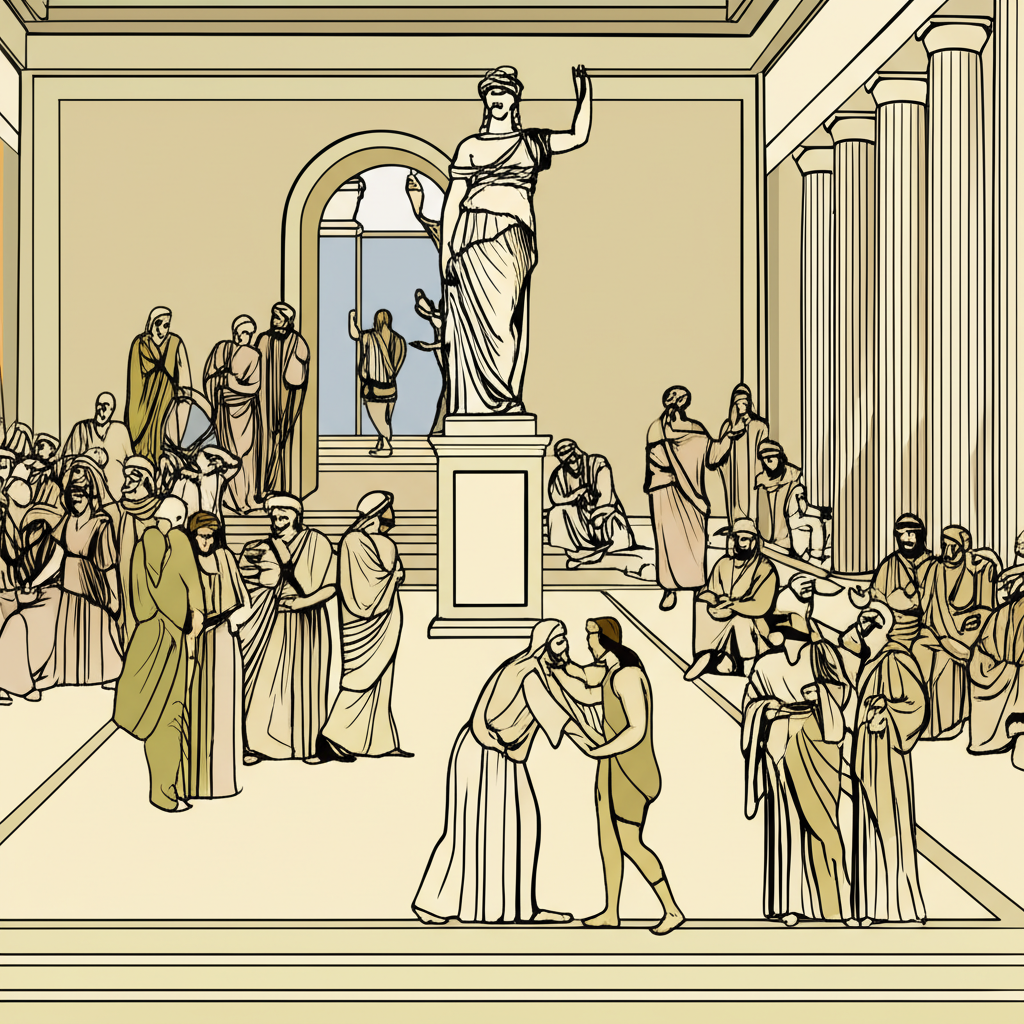 or a personification of Law standing watch over the scene, symbolizing the foundation of discourse and freedom within a legal framework.)
The Architecture of Freedom: How Law Enables Liberty
The transition from a state of nature to civil society underscores a critical insight: law is not merely a barrier to freedom, but its very architecture. It builds the structure within which individual freedoms can not only exist but thrive and be mutually compatible.
Defining Rights and Responsibilities
Law provides the clarity and definition that transforms abstract concepts of freedom into tangible rights. Without law:
- Property Rights (Locke): My claim to my land or possessions is only as strong as my ability to defend it. Law establishes clear ownership, allowing me the liberty to use, enjoy, and transfer my property without constant fear of usurpation.
- Personal Security: The right to life and bodily integrity is meaningless if there are no consequences for assault or murder. Law protects citizens from harm, granting them the liberty to live without perpetual fear.
- Freedom of Speech and Assembly: These liberties are secured by laws that protect individuals from arbitrary punishment for expressing their views, provided these expressions do not infringe upon the rights or safety of others.
Ensuring Equality Under the Law
One of the most profound contributions of law to liberty is its capacity to establish a degree of equality among citizens. The principle that "no one is above the law" is a bulwark against tyranny and arbitrary power.
- Rule of Law vs. Rule of Men: As articulated by Aristotle and later by thinkers like Montesquieu, societies governed by the rule of law ensure that decisions are based on established principles, not the whims of individuals. This prevents despotic rule and protects the liberty of the individual from arbitrary power.
- Protection of the Vulnerable: Law acts as a shield for the weak against the strong. Without legal protections, those with greater physical, economic, or political power would inevitably dominate, extinguishing the liberties of others.
Facilitating Collective Action and Progress
Beyond individual rights, law is the lubricant for the complex machinery of civil society. It makes possible cooperative ventures that are essential for human flourishing and the expansion of collective liberty.
- Commerce and Trade: Contracts, property laws, and regulations create a predictable environment for economic exchange, allowing citizens the liberty to pursue their livelihoods and engage in mutually beneficial transactions.
- Public Services: Laws enable the collection of taxes and the organization of public works—education, infrastructure, healthcare—which collectively expand the opportunities and liberties available to all citizens.
- Justice System: A functional legal system provides a peaceful and impartial means of resolving disputes, preventing private vendettas and maintaining social cohesion.
The Citizen's Dilemma: Navigating Law and Liberty
While the necessity of law for liberty is undeniable, the relationship is not static or without its own contingencies. The quality of law, its justness, and its application profoundly impact the extent of liberty enjoyed by citizens.
| Philosopher | Key Idea on Law & Liberty | Impact on Citizen Liberty |
|---|---|---|
| Plato | In The Republic, advocates for a society governed by reason and justice, ideally led by philosopher-kings. While not "law" in the modern sense, his ideal state prioritizes the harmony of the whole, with individual roles defined by the city's good. | Individual liberty is subordinate to the collective good and one's designated function. Freedom is found in fulfilling one's natural role within a just order. |
| Aristotle | In Politics, emphasizes the rule of law as superior to the rule of men. A good constitution (which is a form of law) is essential for a flourishing polis and the cultivation of civic virtue among citizens. | Liberty is found in participation in the political life of the polis, governed by just laws. Freedom is not license, but living well according to virtue within a legal framework. |
| Cicero | In On the Commonwealth, argues that true law is right reason in agreement with nature, universal, eternal, and unchangeable. Human laws derive their legitimacy from this higher, natural law. | Citizens are free when they live according to reason and natural law, which good civil laws embody. Liberty is tied to moral rectitude and participation in a just republic. |
| John Stuart Mill | In On Liberty, champions individual freedom against the tyranny of the majority and governmental overreach. Introduces the "harm principle": the only legitimate reason for law to restrict liberty is to prevent harm to others. | Maximizes individual freedom, especially in thought, expression, and lifestyle, as long as it does not directly harm others. Law's necessity is to protect this sphere of individual autonomy. |
The ongoing challenge lies in ensuring that law remains a tool for liberation, not oppression. When laws are unjust, arbitrary, or excessively restrictive, they cease to be the foundation of liberty and become its antithesis. The active participation of the citizen in the democratic process, the vigilant defense of constitutional principles, and the right to challenge unjust laws are all vital contingencies that ensure law serves its true purpose.
The Perils of Lawlessness: A Retreat from Civil Society
To grasp the full necessity of law, one need only contemplate its absence. Societies where law breaks down—due to conflict, corruption, or systemic failure—offer a stark reminder of the fragile nature of civil liberty. In such scenarios:
- Security Evaporates: Without law enforcement, crime flourishes, and personal safety becomes paramount, severely limiting the freedom to move, work, or even exist peacefully.
- Rights Become Meaningless: Property is seized, speech is silenced, and life itself becomes cheap. The concept of a "right" has no weight without a legal system to uphold it.
- Economic Stagnation: Commerce collapses without legal frameworks for contracts, property, and dispute resolution. The liberty to pursue economic opportunity vanishes.
- Social Cohesion Dissolves: Trust erodes, communities fragment, and the collective ability to address common challenges disappears.
This state is a retreat from civil society, a descent back towards a kind of practical state of nature, where the benefits of collective living and the promise of civil liberty are utterly extinguished.
Conclusion: The Enduring Compact
The philosophical journey through the landscape of law and liberty reveals an inescapable truth: law is not merely an optional addition to civil society, but its bedrock. It is the essential framework that transforms raw, perilous freedom into secure, meaningful liberty for the citizen. The necessity of law stems from its unique capacity to define, protect, and enable individual rights, ensure equality, and facilitate the complex interactions that characterize a flourishing human community.
While the specific forms and applications of law are always contingent upon historical, cultural, and political circumstances, the fundamental principle remains: without law, there is no true civil liberty. It is the enduring compact by which we trade the unbridled chaos of absolute freedom for the structured, secure, and infinitely more profound freedom of a justly ordered society. To neglect this bond is to misunderstand the very essence of what it means to be a free citizen.
📹 Related Video: ARISTOTLE ON: The Nicomachean Ethics
Video by: The School of Life
💡 Want different videos? Search YouTube for: ""Hobbes vs. Locke: The Social Contract Explained" - a comparative analysis of their theories on the state of nature and the role of government."
📹 Related Video: ARISTOTLE ON: The Nicomachean Ethics
Video by: The School of Life
💡 Want different videos? Search YouTube for: ""The Rule of Law: Why It Matters" - a discussion on the importance of legal frameworks for justice, stability, and individual rights."