

The Immutable Logic of Causality: Exploring the Law of Cause and Effect
The universe, in its grand complexity, often appears to operate under an intricate web of connections. At the heart of our understanding of this web lies a fundamental philosophical Principle: the Law of Cause and Effect. This Law posits that every event, every change, and every phenomenon (the "effect") is the direct result of a preceding event or set of conditions (the "cause"). It is the bedrock upon which much of our scientific inquiry, philosophical reasoning, and everyday comprehension of reality is built. To grasp this Principle is to begin to unravel the very logic of existence itself, recognizing that nothing truly happens in isolation, but rather within an unbroken chain of events.
The Enduring Principle: A Historical Perspective
From the earliest stirrings of systematic thought, philosophers have grappled with the nature of causality. The Law of Cause and Effect is not merely a scientific observation but a profound philosophical insight that has shaped our intellectual heritage.
-
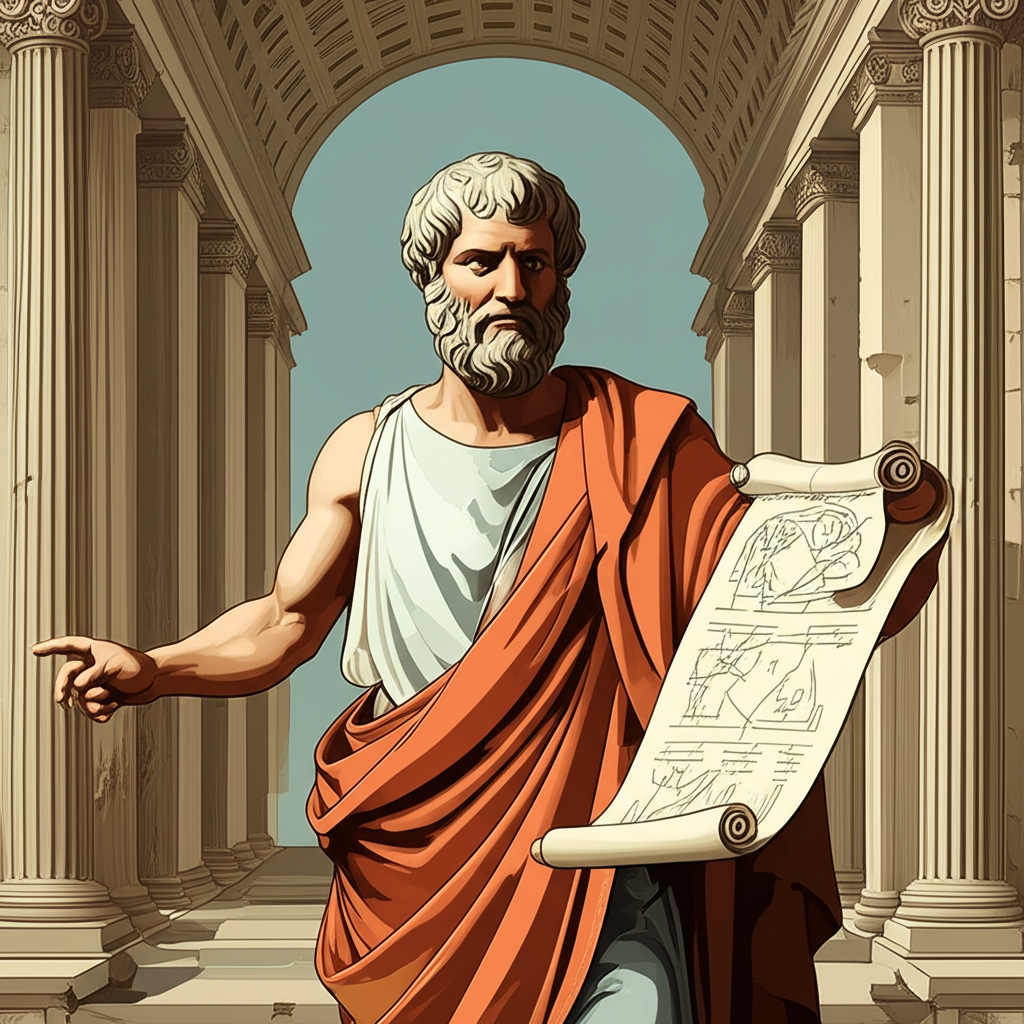
Ancient Greek Foundations: In the Great Books of the Western World, we find thinkers like Aristotle meticulously dissecting the concept of cause. In his Physics and Metaphysics, he outlined his famous Four Causes:
- Material Cause: What something is made of (e.g., the bronze of a statue).
- Formal Cause: The form or essence of a thing (e.g., the shape of the statue).
- Efficient Cause: The primary agent or force that brings something into being (e.g., the sculptor).
- Final Cause: The purpose or end for which a thing exists (e.g., the reason for creating the statue).
Aristotle's framework provided a comprehensive way to understand why things are the way they are, firmly establishing the idea that understanding a phenomenon meant understanding its causes.
-
Medieval Elaboration: Later, scholastic philosophers like Thomas Aquinas, drawing upon Aristotle, used the Principle of causality to argue for the existence of God as the "Unmoved Mover" or the "First Cause." This was a powerful application of the Law, suggesting an ultimate origin for all chains of cause and effect.
-
Enlightenment Scrutiny: The Enlightenment brought a new level of critical examination. David Hume, in his An Enquiry Concerning Human Understanding, famously questioned whether we truly observe a necessary connection between cause and effect, or merely a "constant conjunction" of events. His skepticism challenged the intuitive certainty of the Law, suggesting that our belief in causality might be more a product of habit and psychological expectation than empirical observation or pure logic. Immanuel Kant, in response, argued that causality is not merely an empirical observation but a fundamental category of human understanding, a Principle that our minds impose on experience to make sense of the world. Without it, our experience would be a chaotic jumble of unrelated sensations.
The Logic of Our World: Manifestations and Implications
The Law of Cause and Effect is not confined to academic debates; it permeates every aspect of our existence and understanding.
-
Scientific Inquiry: The scientific method itself is a testament to this Law. Scientists formulate hypotheses about potential causes, design experiments to isolate variables, and observe the resulting effects. Whether studying gravity, chemical reactions, or biological processes, the search for causal relationships is paramount. Without this underlying Principle, the very idea of scientific prediction or explanation would crumble.
-
Personal Responsibility: In our daily lives, we instinctively operate under this Law. We understand that our actions (causes) have consequences (effects). This forms the basis of personal responsibility, moral reasoning, and the pursuit of goals. If we want a particular outcome, we must initiate the appropriate cause.
-
Technological Advancement: Every invention, every piece of technology, from a simple lever to a complex computer, is an application of understanding causal relationships. Engineers manipulate causes (inputs, forces, programming) to achieve desired effects (outputs, movements, calculations).
The Intricacies and Challenges
While the Law of Cause and Effect is a powerful explanatory Principle, its application is not always straightforward.
- Complex Systems: In complex systems, identifying a single cause for a particular effect can be challenging. Often, multiple factors contribute, creating a web of interconnected causes. For instance, a disease might have genetic, environmental, and lifestyle causes.
- Quantum Realm: Modern physics, particularly quantum mechanics, introduces probabilistic elements that seem to challenge classical deterministic causality. Events at the subatomic level can appear to occur without a definitive, preceding cause in the traditional sense, operating instead on probabilities. However, for the macroscopic world we inhabit, the Law remains overwhelmingly valid and indispensable.
- Determinism vs. Free Will: The Logic of an unbroken chain of cause and effect raises profound questions about free will. If every choice is merely the inevitable effect of prior causes, where does human agency lie? This philosophical dilemma continues to be a rich area of debate.
Conclusion: A Cornerstone of Understanding
The Law of Cause and Effect stands as one of the most fundamental Principles guiding our understanding of the universe. From the ancient insights of Aristotle to the critical inquiries of Hume and Kant, its exploration has shaped the trajectory of human thought. It provides the essential logic that allows us to make sense of our experiences, build knowledge, and navigate the world. While its nuances continue to provoke deep philosophical questions, its enduring power as a Law that governs the observable world remains unquestioned, offering a profound lens through which to view the intricate dance of existence.
YouTube Video Suggestions:
-
📹 Related Video: What is Philosophy?
Video by: The School of Life
💡 Want different videos? Search YouTube for: ""Crash Course Philosophy Causality""
2. ## 📹 Related Video: PLATO ON: The Allegory of the Cave
Video by: The School of Life
💡 Want different videos? Search YouTube for: ""David Hume on Cause and Effect Explained""