

The Enduring Echoes of Eidos: Plato's Forms in Metaphysics
Have you ever wondered what makes a beautiful sunset beautiful, or what links every single act of justice across time and space? For the ancient Greek philosopher Plato, the answer lay not in the physical world around us, but in a realm of perfect, unchanging Ideas or Forms. This concept, central to his metaphysics, posits that beyond the fleeting appearances of our senses lies a deeper, truer reality composed of these eternal blueprints. These Forms serve as the ultimate universal essences, giving meaning and structure to the countless particular things we encounter daily. Understanding Plato's Forms is like unlocking a secret dimension of reality, where perfection isn't just an aspiration, but the very fabric of existence.
Unveiling the Eidos: What Exactly Are These Forms?
At its heart, Plato's theory of Forms, or Eidos (from the Greek for "form," "shape," or "idea"), is a response to the ever-changing, often contradictory nature of our sensory world. He argued that what we perceive with our eyes and ears are mere shadows or imperfect copies of perfect archetypes existing in a separate, non-physical realm.
Consider a simple example: a chair. There are countless chairs in the world – wooden chairs, plastic chairs, armchairs, office chairs. They all differ in size, material, and design, yet we recognize them all as "chairs." Plato would argue that this recognition isn't just based on shared physical attributes, but on their participation in the Form of Chair – the perfect, ideal essence of what a chair truly is.
Characteristics of Plato's Forms:
- Eternal and Unchanging: Unlike physical objects that are born, decay, and die, Forms exist outside of time and space. They are immutable.
- Perfect and Ideal: They represent the ultimate standard of what something can be. The Form of Beauty is perfect beauty itself, not merely beautiful.
- Non-Physical: Forms are not made of matter; they exist in an intelligible realm, accessible only through reason, not sensory experience.
- Universal: A single Form can be participated in by many particular objects. The Form of Justice applies to all just acts.
- The Cause of Being: Physical objects derive their existence and characteristics from the Forms they imitate or participate in.
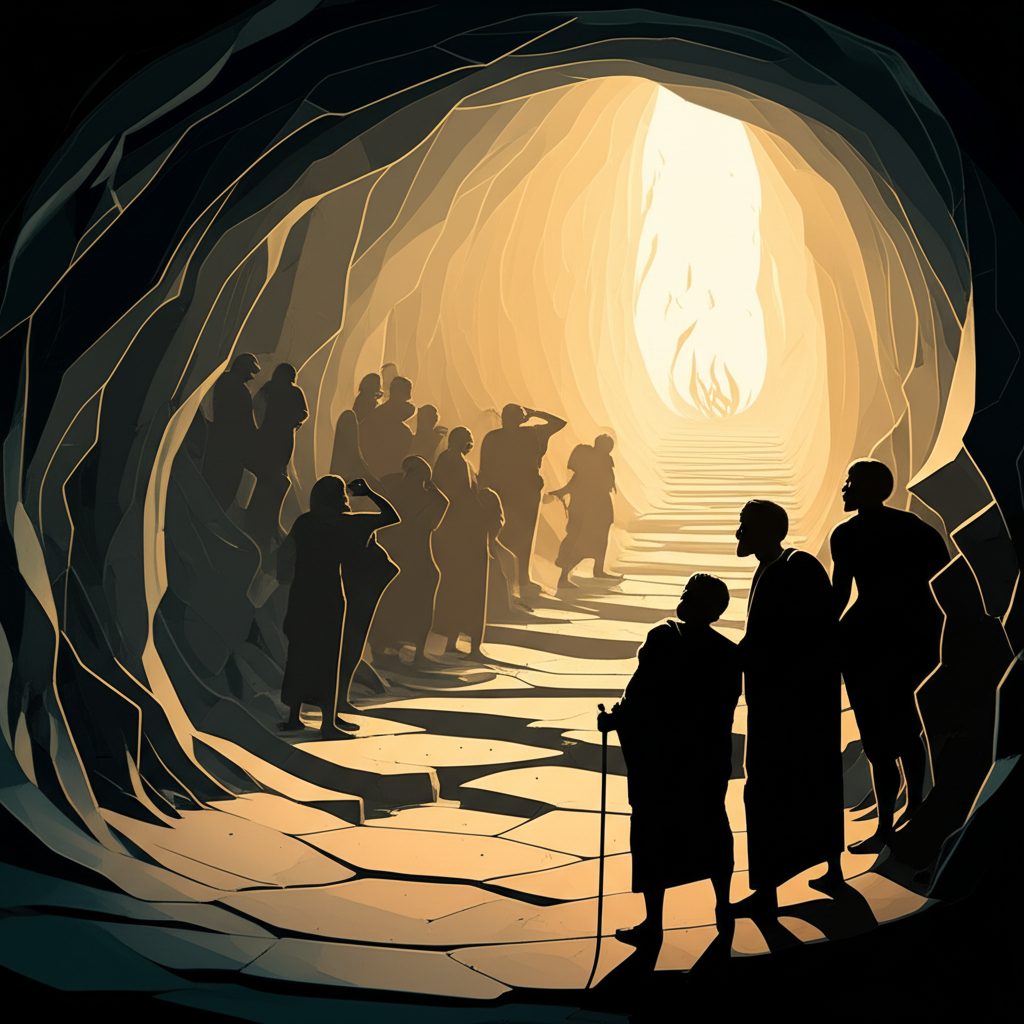
Bridging the Divide: The Universal and the Particular
One of the most profound philosophical problems Plato's Forms address is the relationship between the universal and the particular. How can many individual, distinct things (particulars) share a common quality or essence (universal)?
| Aspect | The Particular World (Sensory) | The Universal World (Intelligible) |
|---|---|---|
| Nature | Imperfect, changing, multiple, physical | Perfect, unchanging, singular, non-physical |
| Access | Through senses (sight, touch, etc.) | Through reason, intellect, philosophical inquiry |
| Reality | Less real, mere copies or appearances | More real, true reality |
| Example | This beautiful painting, that just action | The Form of Beauty, The Form of Justice |
| Relation | Participates in, imitates, or copies a Form | The essence or blueprint for particulars |
Every specific, individual instance – a particular red apple, a particular courageous soldier, a particular circular plate – is understood by Plato as an imperfect manifestation of a corresponding universal Form (Redness, Courage, Circularity). The apple participates in the Form of Redness, the soldier participates in the Form of Courage. Without these Forms, Plato argued, there would be no stable basis for knowledge, meaning, or even communication. How could we discuss "justice" if there was no overarching, shared Idea of justice that applied beyond individual acts?
Why Forms are Fundamental to Metaphysics
Plato's theory of Forms is not just a curious philosophical notion; it's a foundational pillar of his entire philosophical system, particularly his metaphysics – the branch of philosophy concerned with the fundamental nature of reality.
- Defining Reality: For Plato, the Forms constitute true reality. The physical world is merely a derivative, less real reflection. This shifts the focus of inquiry from the transient to the eternal.
- Basis for Knowledge (Epistemology): If everything in the sensory world is constantly changing, how can we have stable, certain knowledge? Plato argued that true knowledge (episteme) can only be of the unchanging Forms, not of the ever-shifting particulars. Our understanding of mathematical truths, for instance, comes from grasping Forms, not from observing imperfect circles drawn on a blackboard.
- Ethical Foundation: The most important Form, for Plato, was the Form of the Good, which illuminates all other Forms and is the source of all value and order. To live a good life, according to Plato, is to align oneself with this ultimate Form, seeking to understand and embody its principles. Justice, courage, and temperance are all understood in relation to their ideal Forms, guided by the overarching Form of the Good.
- Order and Coherence: The Forms provide an orderly structure to the cosmos. They explain how disparate things can belong to the same category and how the universe can have an underlying rational structure despite its apparent chaos.
The Lasting Legacy of Plato's Ideas
While Plato's theory of Forms faced significant criticism, notably from his own student Aristotle, who argued that Forms could not exist separately from the particulars, its influence on Western thought is immeasurable. From early Christian theology, which saw Forms as divine thoughts, to later philosophical movements concerned with universals, essences, and objective truth, Plato's Eidos continues to resonate. It challenges us to look beyond superficial appearances and question what truly constitutes reality, knowledge, and value. The "Idea" of Form, in its purest sense, remains a powerful and provocative concept, inviting us to ponder whether the most real things are those we can touch, or those we can only grasp with the mind.
YouTube Video Suggestions:
-
📹 Related Video: PLATO ON: The Allegory of the Cave
Video by: The School of Life
💡 Want different videos? Search YouTube for: "Plato's Theory of Forms explained animated"
2. ## 📹 Related Video: PLATO ON: The Allegory of the Cave
Video by: The School of Life
💡 Want different videos? Search YouTube for: "Allegory of the Cave explained philosophy"