

My Unwritten Books (2008)
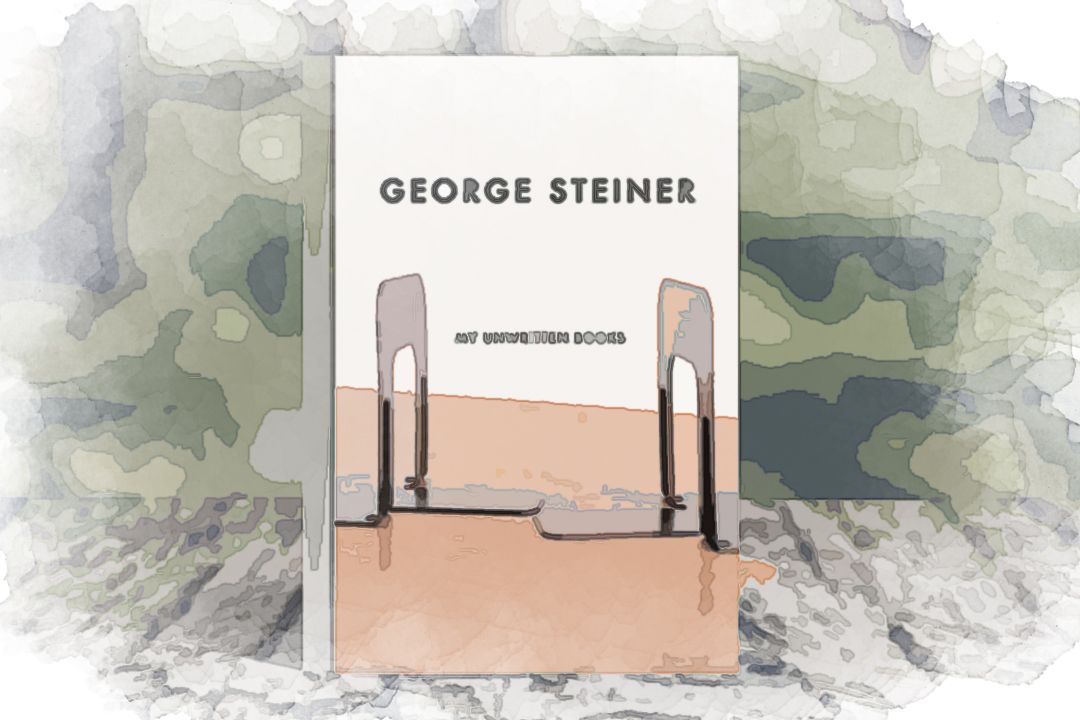
My Unwritten Books (2008) by George Steiner
Setting: An immense, quiet library where the shelves seem to curve with the arc of space-time. Dust motes dance in shafts of perpetual twilight. GEORGE sits at a heavy oak table, his hands resting on a closed, blank ledger. Across from him sits SOPHIA, her presence calm and luminous.
Sophia: The silence in this room is of a peculiar quality, isn't it? It is not an absence of sound, but a repository of all the words that were never spoken. You seem to be listening to it, George.
George: (His gaze fixed on the blank book) I am listening to the clamor of my own. I have reached an age, a season, where the body and the clock conspire to tell you that the time for new beginnings is past. My career as an educator, a critic, a writer… it has largely run its course. And what weighs on me most is not a sense of completion, but the sheer, tactile presence of all the work I will now never undertake.
Sophia: You speak of them as if they are lost treasures. Tell me of these books you will not write.
George: (A faint, melancholy smile) Oh, they are more real to me now than some I have published. There was to be a great inquiry into the poetics of chess, exploring the game not as a science, but as a silent, brutal dialectic. Another, a true Talmudic commentary on Kafka, tracing his parables back to their deepest rabbinic roots, a task no one has yet dared. I had hoped to write a small, perfect volume on the grammar of hatred, how its syntax has shaped our modern horrors. Each one a life's work. Each one now a ghost at my table.
Given my age, I am pretty near the end, probably, of my career as a writer, a scholar, a teacher. And I wanted to speak of things I will not be able to do.
— George Steiner (1929-2020)
Sophia: And you see this as a deficit? A list of failures?
George: What else could it be? They are promises I made to myself that I cannot keep. The architect’s blueprint for a cathedral that was never built. The potential remains, but the structure will never catch the light.
Sophia: Consider the nature of a wellspring. Its value is not in the single vessel you fill from it, but in the inexhaustible source itself. The books you did write, the students you did teach—did they not drink from this same deep well of ideas? The unwritten book on Kafka surely informed every lecture you gave on him. The silent dialectic of chess must have sharpened every analysis you made of language and conflict.
George: Perhaps. But the source is formless. The work is in giving it form, in wrestling the idea into the discipline of the chapter, the paragraph, the final, unforgiving sentence. An idea is a mist; a book is a crystal. I have left behind so much mist.
Sophia: No. You have left behind a climate. The books you see as unwritten were not separate projects waiting in a queue. They were the atmosphere that sustained your entire intellectual life. They were the gravitational force that held your finished works in their orbit. A scholar’s legacy is not a finite stack of volumes on a shelf. It is the sum of the questions he dared to ask, both aloud and in the privacy of his own mind.
George: (Looks from the blank ledger to his own hands) So the ghosts are not accusers?
Sophia: They are witnesses. They attest to a mind so fertile that a single lifetime was never going to be enough to harvest it all. The unwritten books are not a sign of your limits, but a proof of your immensity. They are the silent, resonant hum beneath the music you actually played. They are the most honest part of your biography.
(George runs a hand over the smooth, unmarked cover of the ledger. He does not open it. A look of quiet understanding settles on his face.)
George: The things I will not be able to do…
Sophia: …are the very things that made you who you are. They are not your unwritten books. They are your truest bibliography.

The planksip Writers' Cooperative is proud to sponsor an exciting article rewriting competition where you can win part of over $750,000 in available prize money.
Figures of Speech Collection Personified
Our editorial instructions for your contest submission are simple: incorporate the quotes and imagery from the above article into your submission.
What emerges is entirely up to you!
Winners receive $500 per winning entry multiplied by the article's featured quotes. Our largest prize is $8,000 for rewriting the following article;
 Heraclitus
At planksip, we believe in changing the way people engage—at least, that's the Idea (ἰδέα). By becoming a member of our thought-provoking community, you'll have the chance to win incredible prizes and access our extensive network of media outlets, which will amplify your voice as a thought leader. Your membership truly matters!