

Mission Possible
What was (were) I (we) Talking About?
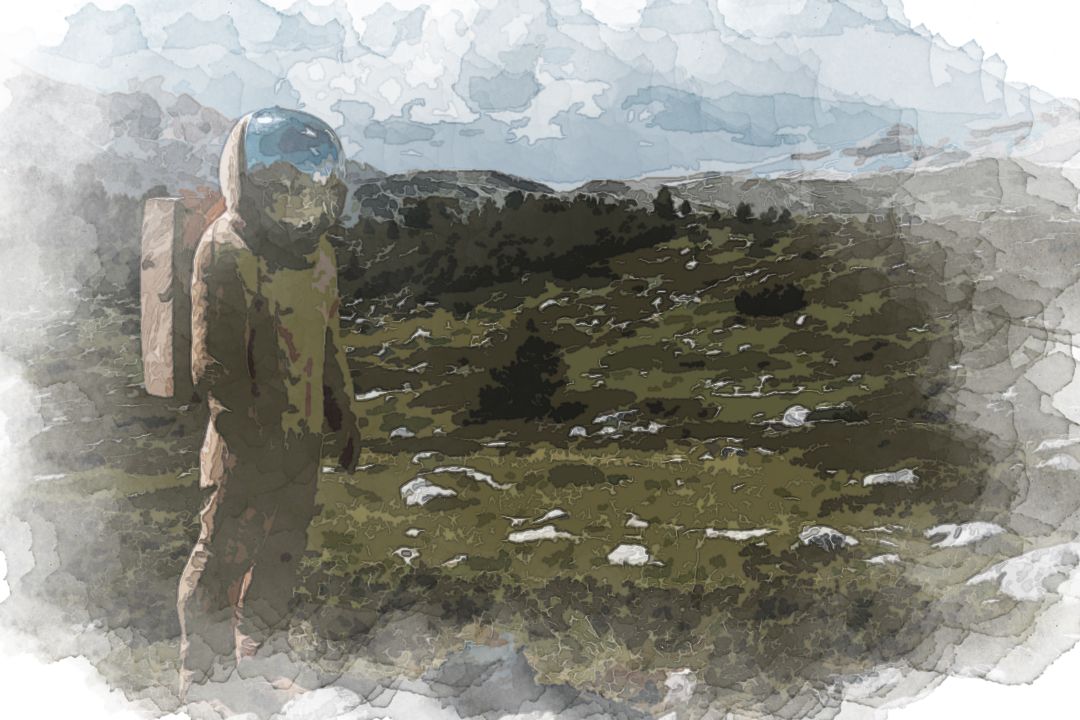
Setting: A serene, timeless library whose windows look out not onto a landscape, but into the swirling patterns of nebulae and stars.
(The scene opens with Gottfried and James in the middle of a discussion, a chessboard between them untouched for some time.)
Gottfried: You must concede the point, James. The world of knowledge is split in two, and the division is as clear as night and day. There are truths we arrive at through pure thought. Think of a geometric proof! Its conclusion is inevitable, absolute. Its opposite is not just wrong, it is inconceivable. Such truths are necessary.
There are also two kinds of truths: truth of reasoning and truths of fact. Truths of reasoning are necessary and their opposite is impossible; those of fact are contingent and their opposite is possible.
— Gottfried Wilhelm Leibniz (1646-1716)
James: They are beautiful, I grant you. Like perfectly cut gems. I have spent my life studying a different sort of truth—the sort you find buried in dusty archives and the contradictory accounts of men.
Gottfried: Precisely! You are speaking of truths of fact. It is a fact, for instance, that Caesar crossed the Rubicon. But could he have chosen not to? Of course! The alternative was entirely possible. His action was a contingent reality, not a logical necessity. One truth is eternal, the other is a product of circumstance. The distinction is foundational!
James: (A faint, weary smile touches his lips) Foundational, perhaps. But tell me, Gottfried, which of those two truths governs our lives? As a young man, I was much like you. I believed I could learn the rules, understand the system, and master the great narrative of the world. I thought the power of my mind was limitless, that I could eventually grasp the complete story.
Gottfried: And why can you not? The facts may be numerous, but they are still governed by cause and effect, which reason can untangle.
James: Because as I traced one thread, I discovered it was woven into a tapestry so vast, so complex, that my own life was too short to see its edges. For every answer I found, a dozen new questions bloomed. The great lesson of my work was not in the facts I collected, but in the slow, humbling realization of my own boundaries. We age, and we learn what we cannot do, what we cannot know. That, it seems, is the most profound truth of fact I have ever encountered.
Gottfried: You are conflating the nature of truth with the limitations of the observer! That is a sentimental, not a logical, argument. The structure is perfect, even if the student is flawed. We are talking about the very architecture of reality, and you are… you are lamenting that you cannot count all the bricks by yourself.
(A quiet descends. Gottfried stares intently at the cosmic swirl outside the window, his brow furrowed in concentration, trying to formulate a new line of reasoning. James watches him for a moment before sighing softly.)
James: Tell me again, Gottfried… what was it we were talking about? I seem to have lost my way.
Gottfried: (Turning from the window, his own certainty momentarily shaken) I… I was making a vital distinction between necessary and contingent realities. And you were… well, you were discussing the melancholy of growing older. I fail to see the intersection.
(A third voice, melodic and resonant, fills the space between them. Sophia has been standing by a nearby bookshelf, holding a single, unadorned book.)
As we advance in life, we learn the limits of our abilities.
— James Anthony Froude (1818-1894)
Sophia: The intersection is the point you have both just reached. It is the place where the map ends and the journey begins.
(Both men turn to her, their expressions shifting from confusion to reverence.)
Sophia: Gottfried, you chart the realm of the possible with the immaculate tools of reason. You seek the universal laws that must be true in any world. It is the mind’s glorious attempt to build a home of pure certainty.
(She turns her gaze to James.)
Sophia: And you, James, walk the earth of what is. You have felt the texture of its soil and the unpredictability of its seasons. You have learned that the most important truths of a life are not those of the blueprint, but those discovered in the building, especially the discovery of where your own reach falls short.
(She places the book on the table between them.)
Sophia: You lost the thread of your conversation because you were no longer on separate paths. You were standing on the same ground. The quest for absolute, necessary knowledge inevitably leads to the contingent, factual discovery of one’s own limits. And the acceptance of those limits is, in itself, a necessary truth for a soul to learn.
Gottfried: So, my framework is not the end, but the beginning…
James: (Nodding in understanding) And my limits are not a failure, but a finding.
Sophia: Exactly. One is the magnificent ambition of the mind; the other is the quiet wisdom of the spirit. You were not talking about different things at all. You were simply asking, from two different perspectives, what it means to be a thinking being in a world of endless facts. And that pause—that moment of asking, "What were we talking about?"—is often the beginning of the answer.

The planksip Writers' Cooperative is proud to sponsor an exciting article rewriting competition where you can win part of over $750,000 in available prize money.
Figures of Speech Collection Personified
Our editorial instructions for your contest submission are simple: incorporate the quotes and imagery from the above article into your submission.
What emerges is entirely up to you!
Winners receive $500 per winning entry multiplied by the article's featured quotes. Our largest prize is $8,000 for rewriting the following article;
 Heraclitus
At planksip, we believe in changing the way people engage—at least, that's the Idea (ἰδέα). By becoming a member of our thought-provoking community, you'll have the chance to win incredible prizes and access our extensive network of media outlets, which will amplify your voice as a thought leader. Your membership truly matters!