

The Enduring Power of Dialectic in Shaping Political Thought
The dialectic, a concept as ancient as philosophy itself, stands as a cornerstone in understanding the evolution and challenges of political theory. Far from being a mere academic exercise, it represents a dynamic method of reasoning—a process of intellectual exchange and critical inquiry that has profoundly influenced how we conceive of government, justice, and societal progress. From the Socratic dialogues seeking truth to complex theories of historical change, the dialectic offers a powerful lens through which to analyze, critique, and even shape the political landscape. This article explores its multifaceted role, drawing insights from the rich tradition found within the Great Books of the Western World.
What is Dialectic, Really? Unpacking a Core Philosophical Method
At its heart, dialectic is a method of philosophical inquiry that involves the examination of opposing ideas or arguments to arrive at a higher truth or understanding. It's a journey of intellectual engagement, moving beyond simple assertion to rigorous debate and synthesis.
Historically, the concept has manifested in several key forms:
- Socratic Dialectic: As famously depicted in Plato's dialogues, this involves a series of questions and answers, often leading to the exposure of contradictions in an interlocutor's beliefs, thereby refining understanding and moving closer to truth. It's a process of cooperative argumentative reasoning.
- Platonic Dialectic: For Plato, the dialectic was the highest form of intellectual pursuit, enabling philosophers to ascend from the world of appearances to grasp the Forms themselves—the eternal, unchanging essences of reality, including justice and the good, crucial for ideal government.
- Hegelian Dialectic: Georg Wilhelm Friedrich Hegel conceived of dialectic as a fundamental principle of reality and thought, operating through a "thesis-antithesis-synthesis" model. An idea (thesis) generates its opposite (antithesis), and their conflict leads to a new, more comprehensive idea (synthesis), which then becomes a new thesis. This process drives historical and intellectual development.
- Marxian Dialectic: Karl Marx adapted Hegel's dialectic, applying it to material conditions and social relations. For Marx, the dialectic explained the historical progression of societies through class struggle, where the inherent contradictions within economic systems (e.g., capitalism) lead to revolutionary change, ultimately shaping the form of government.
Regardless of its specific interpretation, the common thread is the engagement with contradiction, opposition, and critical inquiry as a path to deeper insight.
From Ancient Greece to Modern Governance: The Dialectic’s Historical Journey
The dialectic has served as an indispensable tool for political philosophy across millennia, providing frameworks for understanding societal structures, power dynamics, and the very nature of the state.
The Socratic Method and the Ideal Polis
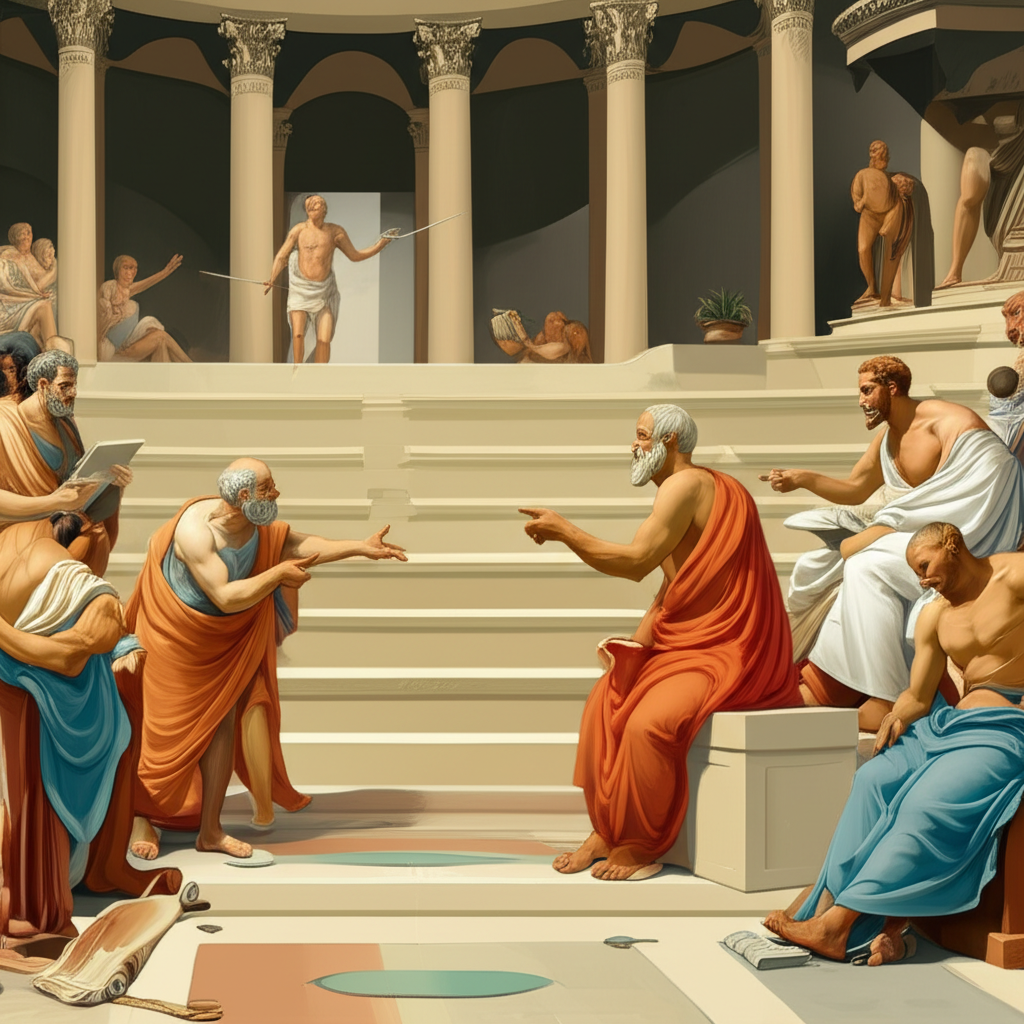
In ancient Athens, Socrates, as chronicled by Plato, used the dialectic to challenge conventional wisdom and expose the limitations of unexamined beliefs. His relentless questioning, often focusing on concepts like justice, virtue, and the best form of government, laid the groundwork for Western political thought. Through dialogue, Socrates aimed to purify understanding, believing that true knowledge was essential for ethical living and sound political leadership. Plato's Republic, a monumental work in political philosophy, is itself a grand dialectical inquiry into the nature of justice and the ideal state, achieved through sustained reasoning and debate among its characters.
Hegel's Spirit and the Evolution of States
Hegel’s dialectical approach offered a profound way to understand history not as a random series of events, but as a rational, progressive unfolding of the "Spirit" or "Idea." For Hegel, the state was the highest embodiment of ethical life, evolving through dialectical stages. Each historical form of government (e.g., monarchy, aristocracy, democracy) represented a thesis that generated its own antithesis, leading to a more rational and free synthesis. This perspective provided a powerful narrative for understanding the development of nations and political institutions.
Marx and the Dialectic of Class Struggle
Karl Marx inverted Hegel's idealism, grounding the dialectic in material reality. He argued that history is driven by the contradictions arising from economic systems and class relations. The inherent conflict between the ruling class (thesis) and the exploited class (antithesis) leads to revolutionary change, culminating in a new societal structure (synthesis). Marx’s application of the dialectic to political economy offered a radical critique of capitalism and predicted its eventual overthrow, profoundly influencing socialist and communist political movements and theories of government.
The Dialectic's Tools for Political Reasoning
The practical application of dialectic in political theory extends beyond mere historical analysis. It provides essential tools for rigorous reasoning and critical engagement:
- Critique and Deconstruction: The dialectic encourages questioning existing political structures, policies, and ideologies by identifying their inherent contradictions or unstated assumptions.
- Policy Formulation: By considering opposing viewpoints and potential counter-arguments, policymakers can develop more robust and comprehensive solutions.
- Understanding Conflict: It offers a framework for analyzing political conflicts, not just as clashes of will, but as expressions of underlying contradictions that may lead to new resolutions.
- Promoting Dialogue: The Socratic method, in particular, emphasizes the value of open discussion and mutual inquiry in reaching consensus or at least a deeper understanding of differing perspectives within a government or society.
- Historical Analysis: It helps scholars understand how political systems evolve, collapse, and transform over time, revealing patterns of change driven by internal tensions.
Contemporary Relevance: Dialectic in Democratic Discourse
Even in modern democracies, the spirit of the dialectic remains vital. Political debates, parliamentary proceedings, judicial arguments, and public discourse all involve a back-and-forth of ideas, challenges, and counter-challenges. A healthy democracy, in essence, thrives on a dialectical process where diverse viewpoints are aired, scrutinized, and ideally, synthesized into policies that serve the common good.
However, the challenge lies in maintaining a constructive dialectic—one focused on genuine reasoning and truth-seeking, rather than mere rhetorical victory. The ability to engage with opposing arguments, to see the partial truths in different perspectives, and to strive for a more comprehensive understanding is crucial for effective government and societal progress.
Conclusion: The Unfolding Conversation
The dialectic is not a static concept but an ongoing conversation, constantly evolving yet retaining its fundamental purpose: to advance understanding through the engagement with opposition. From the ancient pursuit of justice in the ideal government to the modern analysis of power structures and social change, its influence on political philosophy is indelible. By embracing its principles of critical inquiry and rigorous reasoning, we continue to refine our understanding of political life, striving for systems that are more just, more equitable, and more reflective of a comprehensive truth.
YouTube Video Suggestions:
-
📹 Related Video: SOCRATES ON: The Unexamined Life
Video by: The School of Life
💡 Want different videos? Search YouTube for: ""Socratic Method Explained Philosophy""
2. ## 📹 Related Video: What is Philosophy?
Video by: The School of Life
💡 Want different videos? Search YouTube for: ""Hegel Dialectic Explained Political Philosophy""