

The Universal Principle of Life: An Enduring Philosophical Inquiry
Life, in its myriad forms, from the simplest bacterium to the most complex human thought, presents an undeniable, often overwhelming, spectacle. But beneath the surface of this vibrant diversity, is there a singular, underlying force – a Universal Principle – that governs its very essence? This question has captivated thinkers for millennia, from the pre-Socratics to contemporary philosophers, revealing a consistent thread in the tapestry of Western thought: the search for the fundamental Principle that animates existence itself.
This article delves into the philosophical pursuit of "The Universal Principle of Life," exploring how ancient wisdom, particularly from the Great Books of the Western World, grappled with the interplay of the Universal and Particular, the cyclical dance of Life and Death, and the inherent order of Nature. We aim to illuminate how this profound inquiry not only defines the boundaries of what it means to be alive but also shapes our understanding of existence, purpose, and our place within the grand cosmic order.
Unpacking the "Principle": A Philosophical Foundation
To speak of a "Universal Principle of Life" requires a careful understanding of what "principle" itself entails in a philosophical context. It is not merely a rule or a guideline, but rather an arche (ἀρχή) – a beginning, a first cause, or a fundamental source from which all else derives. For the ancients, a principle was often seen as the ultimate explanation for a phenomenon, an unchanging truth beneath the shifting appearances of reality.
- Aristotle's Metaphysics: For Aristotle, a principle is that from which something is, comes to be, or is known. It is the primary element, the foundational cause. In the context of life, this principle would be what makes something alive rather than inanimate, what drives its growth, development, and eventual decline.
- Plato's Forms: While not directly a "principle of life" in the same sense, Plato's theory of Forms posits an ideal, unchanging essence (e.g., the Form of the Good, the Form of Beauty) that particular instances in the sensible world merely participate in. One might infer a "Form of Life" as the perfect archetype from which all living beings draw their vitality.
The search for this principle is, therefore, a quest for the ultimate why and how of life's existence, transcending mere biological description to touch upon metaphysical truth.
The Interplay of the Universal and the Particular
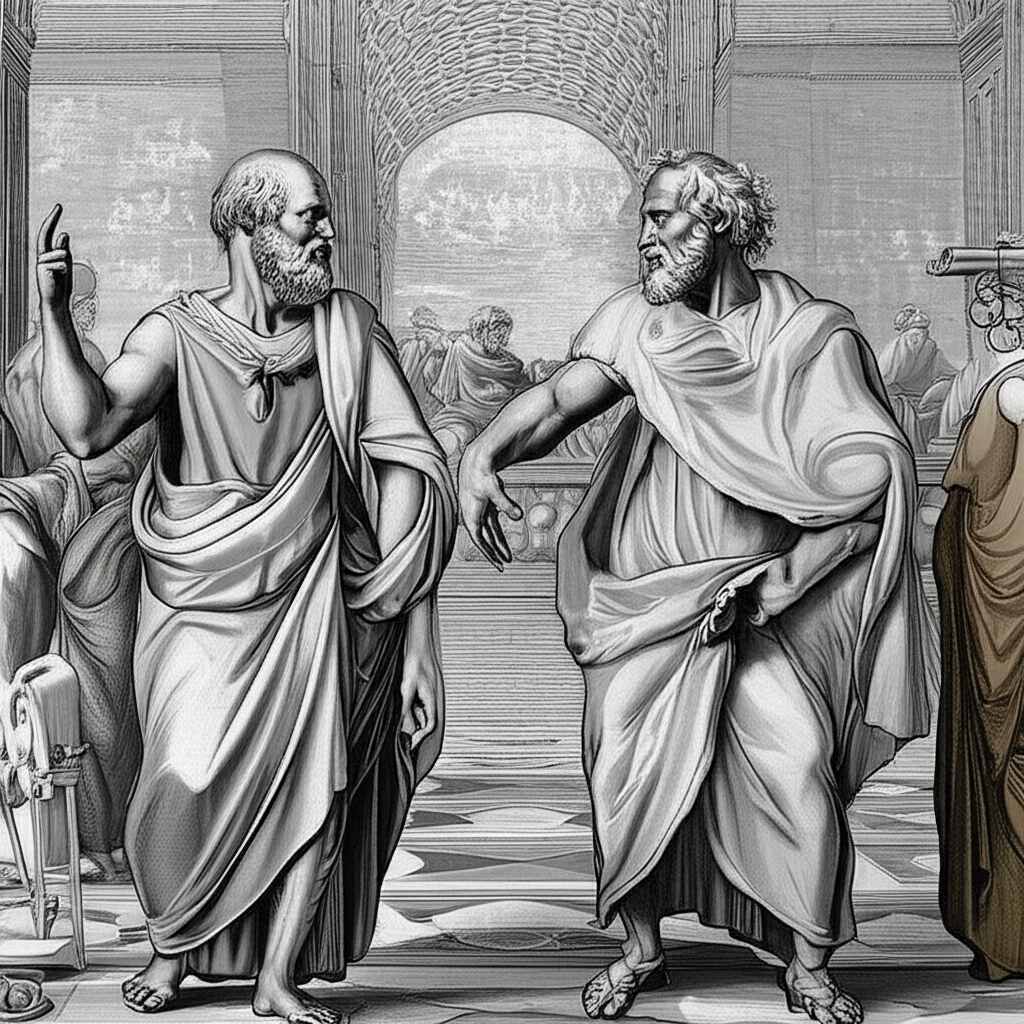
The concept of a universal principle immediately brings forth the tension between the Universal and Particular. How can one overarching principle account for the boundless variety of individual lives?
This philosophical dilemma is central to the Great Books:
- Plato's Perspective: For Plato, the Universal holds primacy. The individual, particular instances of life are but imperfect reflections of an ideal, eternal "Life Itself." The soul, immortal and divine, partakes in this universal life force, striving to return to its pure, non-corporeal state. The particulars of our earthly existence are transient, while the universal essence endures.
- Aristotle's Perspective: Aristotle, while acknowledging universals, emphasized their manifestation within particular things. The universal principle of life, for him, is not separate from living beings but inherent within them as their entelechy – the inner purpose or potential that drives them to actualize their form. Every oak acorn contains the universal principle of "oak-ness" that guides its growth into a particular oak tree. The universal is in the particular.
This dynamic tension highlights that the Universal Principle of Life is not a monolithic, external force, but rather something that expresses itself uniquely in each living entity, while simultaneously binding them all to a common essence.
Life, Death, and the Cyclical Nature of Existence
Crucially, any "Universal Principle of Life" must account for its inherent counterpart: Death. The Great Books reveal that life and death are not merely opposites but two sides of the same coin, integral to the cyclical flow of Nature.
- Heraclitus and Flux: The pre-Socratic philosopher Heraclitus famously proclaimed that "everything flows" (panta rhei). For him, change and flux were the fundamental principle of the cosmos. Life and death are part of this incessant transformation, a constant becoming and unbecoming. "We step and do not step into the same rivers; we are and are not." The principle of life, therefore, is not a static state but a dynamic process that encompasses both generation and corruption.
- Stoic Philosophy: The Stoics, deeply rooted in the concept of logos (universal reason or principle), viewed life and death as natural and inevitable components of the cosmic order. To live in accordance with Nature meant accepting the cycle of birth, growth, decay, and death as part of the rational design of the universe. The Universal Principle of Life, in this view, dictates not only the spark of existence but also its natural cessation, making room for new life.
This understanding moves beyond a simplistic view of life as mere duration, instead embracing it as an active participation in a grand, continuous process where death is not an end to the principle, but a transformation within it.
Nature's Immutable Laws and the Vital Force
The concept of Nature (physis) is inseparable from the Universal Principle of Life. From the earliest inquiries, philosophers sought to understand the inherent order, laws, and vital forces that animate the natural world.
- The Presocratics: Thales sought the primary substance (water), Anaximenes (air), and Empedocles (four elements) from which all life emerged. Their quest was for the arche of existence, the fundamental stuff or force that underlies all natural phenomena, including life.
- Aristotle's On the Soul: Aristotle delves into the concept of the soul (psyche) as the "first actuality of a natural body having life potentially in it." For him, the soul is not separate from the body but is its form, its organizing principle. Different types of souls (nutritive, sentient, rational) represent different capacities of life, all rooted in the natural world. The Universal Principle of Life, then, is the very capacity for self-organization, growth, and reproduction inherent in living matter.
The Universal Principle of Life, therefore, is deeply embedded within the fabric of Nature, manifesting as the inherent drive towards organization, self-preservation, and reproduction that characterizes all living things. It is the invisible hand guiding the unfolding of existence according to immutable, yet dynamic, laws.
Reflecting on the Enduring Principle
The pursuit of "The Universal Principle of Life" is more than an academic exercise; it is a profound philosophical journey that compels us to contemplate our own existence. By engaging with the wisdom of the Great Books, we gain not only historical context but also timeless insights into the fundamental questions that continue to resonate.
- Understanding our Place: Recognizing a universal principle can foster a sense of interconnectedness with all life and the broader cosmos.
- Embracing Impermanence: Acknowledging the cycle of life and death, as dictated by this principle, can lead to a more profound acceptance of change and finitude.
- Appreciating Nature: A deeper understanding of Nature's role reinforces our responsibility to cherish and protect the intricate web of life.
The Universal Principle of Life, as explored through these ancient lenses, is not a simple formula but a complex, multifaceted concept that invites continuous inquiry and contemplation. It is the enduring mystery that makes philosophy, and indeed life itself, so compelling.
YouTube: Plato's Theory of Forms explained
YouTube: Aristotle Metaphysics Entelechy
📹 Related Video: What is Philosophy?
Video by: The School of Life
💡 Want different videos? Search YouTube for: "The Universal Principle of Life philosophy"