

The Universal Principle of Life: An Enduring Inquiry
The quest to understand the fundamental essence of existence has captivated thinkers for millennia. At the heart of this inquiry lies the concept of a "Universal Principle of Life"—an underlying force, structure, or pattern that animates all living things, from the smallest microbe to the most complex human being. This article delves into the philosophical exploration of this profound principle, tracing its lineage through the Great Books of the Western World and examining how it bridges the Universal and Particular manifestations of existence, ultimately confronting the inseparable realities of Life and Death within the grand theatre of Nature. We will explore its historical interpretations, its enduring mysteries, and its implications for our understanding of being.
Unpacking the Essence: What is the Universal Principle?
From the earliest philosophical stirrings, humanity has sought to identify what distinguishes the living from the non-living. Is there a common spark, a shared blueprint, or an animating spirit that binds all biological entities? The "Universal Principle of Life" posits such an overarching reality, suggesting that despite the vast diversity of species and individual experiences, there is a singular, foundational principle at play. This principle is not merely a descriptive category but an active, formative power that guides growth, reproduction, and the very act of being alive.
Ancient Roots: Physis and Entelechy
Philosophers of antiquity were among the first to grapple with this concept. The pre-Socratics, for instance, often spoke of phusis (nature) as an inherent, self-organizing principle that governed the cosmos and all within it. For them, life was not an accident but an expression of this fundamental cosmic order.
Plato, in his theory of Forms, might suggest that the "Form of Life" itself is the ultimate universal principle, from which all particular living things derive their existence and vitality. However, it was Aristotle who provided one of the most comprehensive early frameworks for understanding the principle of life. In his work On the Soul, Aristotle posits the soul (psyche) as the first actuality of a natural body having life potentially. This soul is not merely a ghost in the machine but the form of the body, its entelechy—that which makes a thing what it is and enables it to perform its characteristic activities. For Aristotle, the soul is the organizing principle, the source of nutrition, sensation, locomotion, and thought, varying in complexity across different life forms.
Key Aristotelian Concepts of Life's Principle:
- Nutritive Soul: Found in all living things (plants, animals, humans); responsible for growth, reproduction, and sustenance.
- Sensitive Soul: Found in animals and humans; responsible for sensation, desire, and locomotion.
- Rational Soul: Unique to humans; responsible for thought, reason, and intellect.
This tiered understanding highlights how a universal principle can manifest in particular ways, with each level building upon the one below.
The Inseparable Dance: Life, Death, and Nature's Grand Cycle
The "Universal Principle of Life" cannot be fully grasped without acknowledging its intrinsic counterpart: death. Life and death are not merely opposing forces but two sides of the same coin, woven into the fabric of Nature. The principle of life, by its very definition, implies a beginning, a flourishing, and an end—a continuous cycle of generation and corruption that defines the natural world.
The Role of Nature
Nature serves as the grand stage upon which this principle unfolds. From the intricate ecosystems described by early naturalists to the complex biological processes understood by modern science, nature is the dynamic expression of life's universal force. Philosophers like Spinoza, in his Ethics, conceived of God or Nature (Deus sive Natura) as a single, infinite, self-caused substance, where all particular things, including living beings, are modes or attributes. In this view, the principle of life is not external to nature but inherent within it, a manifestation of its infinite power and essence.
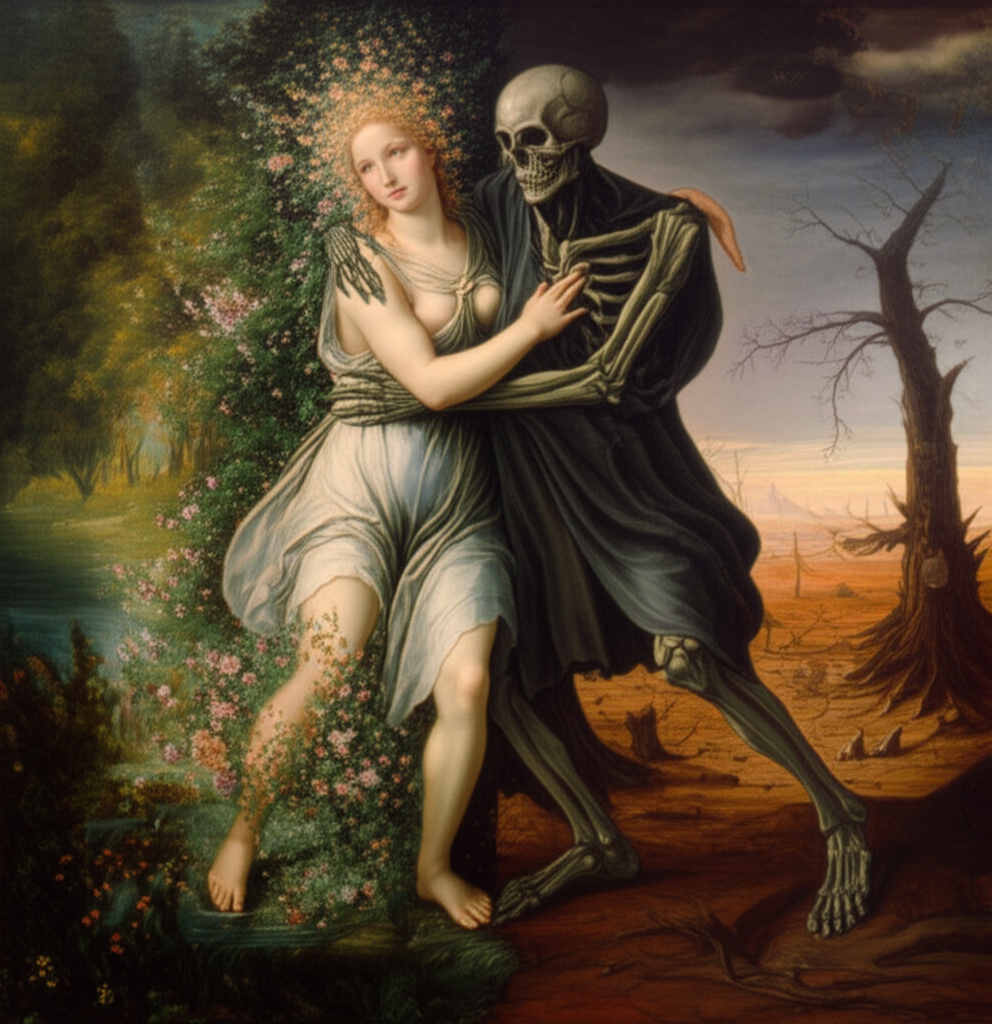
The cycle of Life and Death is not a flaw in the principle but its very mechanism. Death clears the way for new life, ensuring the perpetuation and evolution of species. This understanding has profound implications for how we view our individual mortality within the larger, ongoing stream of existence.
Universal and Particular: Manifestations of a Singular Essence
One of the most compelling aspects of the "Universal Principle of Life" is its ability to reconcile the Universal and Particular. How can a single, overarching principle account for the boundless diversity of individual lives?
Thinkers throughout history have grappled with this paradox:
- Plato's Forms: The universal Form of Life exists independently, and particular living things participate in or imperfectly reflect this ideal.
- Aristotle's Souls: The universal definition of "soul" as the principle of life is instantiated in particular ways (nutritive, sensitive, rational) depending on the organism.
- Medieval Scholasticism (e.g., Aquinas): Drawing on Aristotle, Aquinas viewed the soul as the substantial form of the body, a particular instantiation of a universal divine creative act that imbues matter with life.
- Modern Philosophy (e.g., Kant): Kant explored the concept of teleology in nature, suggesting that organisms appear to be organized for a purpose, implying an underlying, universal principle of organization, even if its ultimate source remains unknowable to pure reason.
| Philosophical Perspective | Universal Principle | Particular Manifestation | Reconciliation |
|---|---|---|---|
| Platonism | Form of Life | Individual living things | Participation |
| Aristotelianism | Soul (Psyche) | Nutritive, Sensitive, Rational Souls | Degrees of Actuality |
| Spinozism | Deus sive Natura | Modes of Substance | Inherent expression |
| Kantian Teleology | Principle of Purposiveness | Organismic self-organization | Reflective Judgment |
This interplay between the universal and the particular highlights the richness of philosophical inquiry. The universal principle provides the coherence and meaning, while the particular instances provide the vibrant, diverse tapestry of life we observe.
The Enduring Inquiry
The "Universal Principle of Life" remains a potent subject of philosophical contemplation. While scientific advancements have illuminated the biochemical and genetic mechanisms of life, the deeper question of what it means to be alive, and whether there is a unifying principle beyond mere mechanism, persists. Are we merely complex machines, or are we expressions of a more profound, universal animating force?
This inquiry compels us to look beyond the immediate and the observable, inviting us to ponder our place within the vast and intricate web of Nature. It challenges us to consider not just how life works, but why it is, and what purpose, if any, it serves in the grand scheme of existence. The wisdom of the Great Books continues to provide a rich foundation for these timeless questions, guiding us as we seek to understand the very essence of being.
📹 Related Video: ARISTOTLE ON: The Nicomachean Ethics
Video by: The School of Life
💡 Want different videos? Search YouTube for: ""Aristotle On The Soul Explained""
📹 Related Video: ARISTOTLE ON: The Nicomachean Ethics
Video by: The School of Life
💡 Want different videos? Search YouTube for: ""Spinoza Ethics Explained - Substance and Modes""