

The relation between the Universal and Particular forms the bedrock of legal philosophy, a tension essential to understanding Law and achieving Justice. This article explores how universal principles—like natural rights or inherent moral truths—must invariably contend with the particularities of individual cases, specific cultures, and evolving societal norms. It delves into the historical philosophical discourse that attempts to reconcile these two indispensable dimensions, arguing that their dynamic interplay is not a flaw, but the very engine of a just legal system.
The Enduring Paradox of Law: General Principles, Specific Realities
At the heart of any sophisticated legal system lies a fundamental, often challenging, relation: the inherent tension between the universal and the particular. Law, by its very nature, strives for universality. It seeks to establish general rules, applicable to all, ensuring consistency, equality, and predictability. Yet, law must always engage with the particular: the unique circumstances of an individual case, the distinct cultural context of a society, or the specific historical moment in which it is applied. This is not a paradox to be resolved, but a dynamic interplay that defines the very pursuit of Justice. As we delve into the rich tapestry of Western thought, from the ancient Greeks to modern philosophy, this constant negotiation emerges as a central theme in the construction of meaningful Law.
The Universal Aspect: Seeking Enduring Principles
The quest for universal principles in Law is deeply rooted in the philosophical tradition. Thinkers across millennia have sought to identify a higher, unchanging standard against which human laws could be measured.
Natural Law and the Quest for Ought
The concept of natural law stands as a prime example of this universal ambition. It posits that certain moral truths and principles of Justice are inherent in nature, discoverable by reason, and thus transcend specific human enactments. These are laws that ought to be, regardless of whether they are codified.
Philosophical Foundations from Antiquity to Modernity
- Plato's Ideal Forms: In the Republic, Plato's theory of Forms suggests an ideal, perfect realm of which earthly phenomena are mere shadows. Applied to Law, this implies an ultimate, universal standard of justice that human laws should strive to emulate. The philosopher-king, imbued with knowledge of these Forms, would legislate in accordance with this universal truth.
- Aristotle's Natural Justice: In his Nicomachean Ethics, Aristotle distinguishes between natural justice and legal justice. Natural justice, he argues, has the same force everywhere and does not depend on our accepting it or not. It represents principles that are universally valid, irrespective of human convention.
- Cicero's True Law: For Cicero, as expressed in De Re Publica and De Legibus, true Law is "right reason in agreement with Nature; it is of universal application, unchanging and everlasting." It is a divine Law that cannot be abrogated and binds all people at all times.
- Aquinas's Eternal and Natural Law: Thomas Aquinas, synthesizing Aristotelian philosophy with Christian theology in his Summa Theologica, posits a hierarchy of laws. Eternal Law is God's governance of the universe. Natural Law is humanity's participation in the Eternal Law through reason, allowing us to discern fundamental moral precepts (e.g., preserving life, seeking truth). Human Law then derives its validity from its adherence to Natural Law.
- Kant's Categorical Imperative: Immanuel Kant's ethical framework, particularly the Categorical Imperative from his Groundwork of the Metaphysics of Morals, demands that moral actions be universalizable. An action is only moral if its maxim could be willed to become a universal Law without contradiction. This provides a rigorous, rational basis for universal ethical principles, directly influencing modern conceptions of human rights.
| Philosopher | Key Concept | Relevance to Universal Law |
|---|---|---|
| Plato | Forms/Ideas | Law should reflect an ideal, unchanging truth of Justice. |
| Aristotle | Natural Justice | Some things are just by nature, not merely by human convention. |
| Cicero | True Law | A universal, eternal, unchangeable law inherent in nature, accessible by right reason. |
| Aquinas | Natural Law | Human reason's participation in God's eternal law, discerning fundamental moral precepts. |
| Kant | Categorical Imperative | Moral laws must be universalizable, binding without exception. |
The Particular Dimension: Navigating Specificity
While the aspiration for universal Law provides a moral compass, the reality of human experience demands attention to the particular. Legal systems must function in a world of individual cases, diverse cultures, and evolving circumstances.
The Imperative of Context and Custom
Law is not applied in a vacuum. It is deeply embedded in the social, political, and historical fabric of a community. Different societies develop different customs, traditions, and values, which invariably shape their specific legal codes. The particularity of a culture often dictates the specific statutes, penalties, and enforcement mechanisms that are deemed appropriate and just. For instance, common law traditions, with their reliance on judicial precedent, are a testament to the gradual, case-by-case development of Law, adapting general principles to an accumulating body of particular facts.
Equity and the Individual Case
Perhaps the most compelling argument for the particular in Law comes from Aristotle's concept of epieikeia, or equity. In Nicomachean Ethics, Aristotle recognizes that all Law is universal, yet "there are some things about which it is impossible to speak correctly in general terms." Life presents an infinite variety of particular situations that no general rule, however well-crafted, can perfectly encompass.
- The Deficiency of Universality: A universal Law, by its very nature, must generalize. It cannot account for every conceivable nuance or exception. When a general Law leads to an unjust outcome in a specific instance, equity steps in to correct this deficiency.
- Justice in Application: Equity ensures that the spirit of the Law prevails over its rigid letter in particular cases, allowing for a more profound form of Justice. It acknowledges that true fairness sometimes requires deviation from the general rule. This principle is vital in judicial discretion, where judges must interpret and apply Law to unique factual scenarios.
The Dynamic Relation: A Necessary Tension
The interplay between the Universal and Particular is not a static opposition but a dynamic relation that drives legal evolution and the pursuit of Justice.
Bridging the Gap: Legislation and Interpretation
Legislatures, in crafting laws, attempt to translate universal principles (e.g., fairness, equality, public safety) into concrete, particular statutes. This process is inherently an act of bridging the gap. However, the true test of this relation often occurs in the judicial branch. Judges, in interpreting Law, must constantly reconcile the general text of a statute with the specific facts and unique human stories brought before them. They engage in an ongoing dialogue, seeking to uphold the universal intent of the Law while ensuring its just application to the particular individual.
Justice at the Crossroads: Balancing Ideals and Realities
The continuous effort to balance universal ideals with particular realities is where Justice truly resides. It is the negotiation between the abstract ideal of fairness and the concrete circumstances of human lives. Georg Wilhelm Friedrich Hegel, in his Philosophy of Right, explored how universal reason finds its concrete expression in the particular institutions of ethical life (Sittlichkeit), such as the family, civil society, and the state. For Hegel, the Law moves from abstract right (universal principles) to moral consciousness (individual will) and finally to ethical life, where both find their synthesis in the concrete, living reality of a community.
Challenges in Reconciling Universal and Particular Law
- Ambiguity of General Principles: Universal ideals like "freedom" or "equality" can be interpreted differently across particular contexts.
- Unforeseen Circumstances: No general Law can perfectly anticipate every unique situation, leading to gaps or unintended consequences.
- Cultural Relativism: Diverse societies may have different conceptions of Justice, making truly universal Law difficult to implement without cultural imposition.
- Risk of Inflexibility: Strict adherence to universal rules without regard for particulars can lead to rigid and unjust outcomes.
- Risk of Arbitrariness: Over-reliance on particularity without grounding in universal principles can undermine consistency, equality, and predictability in Law.
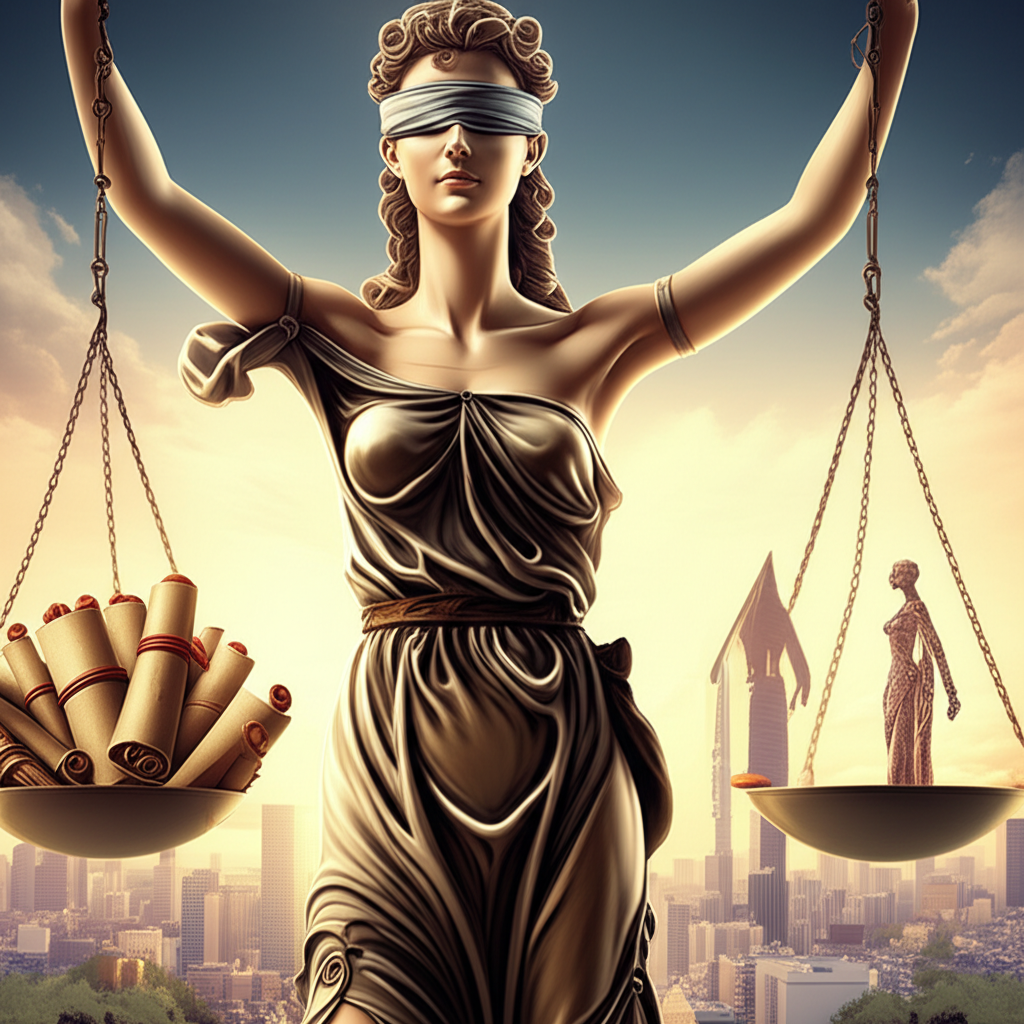
Conclusion: Towards a Holistic Understanding of Law
The relation between the Universal and Particular is not a weakness in Law but its enduring strength. It is a testament to Law's capacity for both principled consistency and flexible adaptation. From the timeless ideals of natural Law to the granular application of equity, philosophical inquiry has consistently grappled with this essential duality. True Justice is not found in the triumph of one over the other, but in the continuous, deliberate effort to harmonize these two essential dimensions. The ongoing dialogue between universal ideals and particular realities is what allows Law to remain both stable and responsive, a framework for order that can truly serve the complex and ever-changing tapestry of human existence.
YouTube Video Suggestions:
-
📹 Related Video: ARISTOTLE ON: The Nicomachean Ethics
Video by: The School of Life
💡 Want different videos? Search YouTube for: ""Aristotle Nicomachean Ethics Book V Equity Law""
2. ## 📹 Related Video: What is Philosophy?
Video by: The School of Life
💡 Want different videos? Search YouTube for: ""Natural Law Theory Explained Crash Course Philosophy""