

The Unseen Architects: How Mathematics Shapes Our Understanding of Space and Geometry
The universe, in its boundless expanse and intricate detail, often presents itself as a canvas upon which phenomena unfold. Yet, beneath the visible tapestry, lies an unseen architect: mathematics. It is through the rigorous lens of mathematical inquiry that humanity has sought not merely to describe space and geometry, but to fundamentally define, question, and ultimately comprehend their very essence. From the foundational axioms of ancient Greece to the mind-bending concepts of modern physics, mathematics stands as a profound bridge between the empirical and the ideal, continually reshaping our philosophical understanding of quantity, form, and the ultimate nature of space itself.
This journey is not just one of scientific discovery, but a deep philosophical exploration, revealing how our mathematical constructs have mirrored, influenced, and even dictated our perception of reality. We delve into the historical arc of this fascinating relationship, drawing insights from the enduring wisdom contained within the Great Books of the Western World.
The Pristine Blueprint: Euclidean Geometry and the Ancient World
Our philosophical journey into the mathematics of space begins, as so many intellectual endeavors do, with the Greeks. Specifically, with Euclid of Alexandria, whose monumental work, The Elements, published around 300 BCE, laid the bedrock for what we now understand as classical geometry. For centuries, Euclidean geometry was not just a mathematical system; it was considered the absolute, undeniable truth about space.
Euclid’s genius lay in his axiomatic approach. He began with a small set of self-evident truths—definitions, postulates, and common notions—and from these, rigorously deduced a vast array of geometric theorems. This deductive system, characterized by its logical purity, suggested that the properties of space were inherent, universal, and discoverable through pure reason.
Key Characteristics of Euclidean Space:
- Absolute and Infinite: Space was seen as an infinite, immutable container in which objects existed.
- Flat: The sum of angles in a triangle always equals 180 degrees; parallel lines never meet.
- Homogeneous: Its properties are the same everywhere.
The philosophical implication of Euclid’s work, deeply influential across the ages, was that Mathematics could reveal eternal truths about Form and Space. The very structure of the cosmos, it seemed, was inherently geometric, waiting to be unveiled by the discerning mind. As one might find in the pages of the Great Books, Euclid's work became a paradigm for rational thought, influencing philosophers from Aristotle to Kant.
Plato's Ideal Realm: Forms, Quantity, and the Mathematical Blueprint
While Euclid codified the rules of geometry, Plato, a century earlier, provided a profound philosophical framework for why Mathematics seemed to hold such sway over reality. In his Theory of Forms, Plato posited that the physical world we perceive through our senses is merely an imperfect shadow of a more fundamental, perfect, and unchanging realm of Forms.
For Plato, mathematical objects—the perfect circle, the ideal triangle, the precise cube—were not mere human inventions, but exemplars of these eternal Forms. The geometric forms we draw on paper are always approximations; the true, perfect form exists independently in this ideal realm. This perspective elevated mathematics from a mere descriptive tool to a gateway to ultimate reality.
In works like the Timaeus, Plato explores the creation of the cosmos, describing the Demiurge shaping the universe according to geometric principles, using regular polyhedra (the Platonic solids) as the fundamental building blocks of matter. Here, quantity and form are not just attributes of objects but are foundational to their very existence and structure. The philosophical significance is immense: mathematics provides the blueprint for existence, and understanding its principles is a path to understanding the divine order of the universe.
Bridging Worlds: Descartes and the Birth of Analytic Geometry
Centuries later, the intellectual landscape shifted dramatically with René Descartes in the 17th century. His work, particularly in La Géométrie (an appendix to his Discourse on Method), revolutionized the study of Space and Form by unifying two previously disparate branches of Mathematics: algebra and geometry.
Descartes' invention of the coordinate system allowed geometric shapes to be represented by algebraic equations. A point could be defined by a set of numbers (coordinates), a line by an equation, and so on. This was more than just a clever trick; it was a profound philosophical re-conceptualization.
Descartes' Contributions to Our Understanding of Space:
- Space as Extension: For Descartes, the essence of matter (and thus space) was simply "extension"—the property of taking up space. This was a purely quantitative and geometric definition.
- Universal Mathematics: He envisioned a "universal mathematics" that could apply to all aspects of reality, dissolving the boundaries between different sciences.
- Analytical Power: By translating geometric problems into algebraic ones, Descartes provided a powerful new method for solving complex problems, fostering a new era of scientific inquiry.
This analytical approach transformed geometry from the study of static figures into a dynamic field where form could be manipulated and understood through numerical quantity. It paved the way for calculus and modern physics, demonstrating the incredible power of mathematics to integrate and explain different domains of knowledge.
The Unfolding Universe: Non-Euclidean Geometries and the Flexible Fabric of Space
For over two millennia, Euclid's geometry stood as the unchallenged truth about space. However, in the 19th century, a radical intellectual breakthrough occurred: the development of non-Euclidean geometries. Mathematicians like Carl Friedrich Gauss, Nikolai Lobachevsky, and Bernhard Riemann dared to question Euclid’s fifth postulate (the parallel postulate), which states that through a point not on a given line, exactly one line parallel to the given line can be drawn.
Their investigations led to the astonishing realization that perfectly consistent and logically valid geometries could exist where this postulate was denied.
Types of Non-Euclidean Geometries:
- Hyperbolic Geometry (Lobachevsky, Bolyai): In this geometry, through a point not on a given line, infinitely many lines parallel to the given line can be drawn. The sum of angles in a triangle is less than 180 degrees. This can be visualized on a saddle-shaped surface.
- Elliptic Geometry (Riemann): In this geometry, no lines parallel to a given line can be drawn through a point not on it. All lines eventually intersect. The sum of angles in a triangle is greater than 180 degrees. This can be visualized on the surface of a sphere (where "lines" are great circles).
The philosophical implications were monumental. If there could be multiple, equally valid mathematical descriptions of Space, then the absolute, immutable nature of space, as conceived by Euclid and even Kant, was shattered. Mathematics no longer simply described a pre-given reality; it offered alternative realities, challenging our very intuition about form and measurement. The question shifted from "What is the geometry of space?" to "Which geometry best describes our space?"
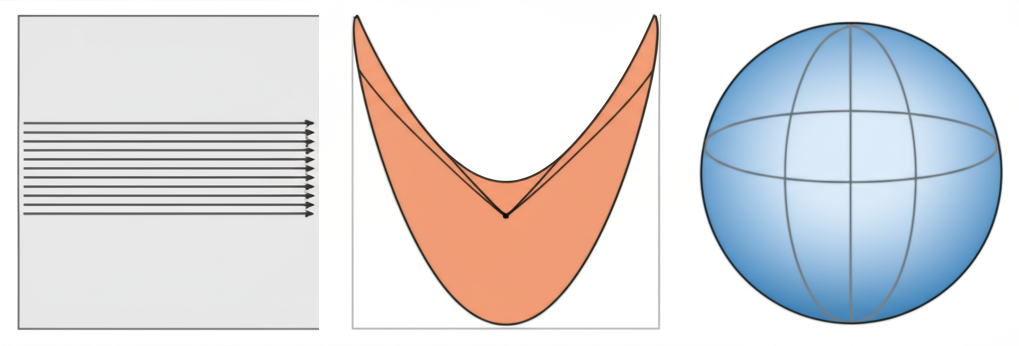 on a spherical surface intersecting at two points, demonstrating no true parallels.)
Einstein's Revelation: Space-Time as a Dynamic Entity
The abstract mathematical concepts of non-Euclidean geometry found their most profound real-world application in Albert Einstein's theories of relativity, particularly General Relativity (1915). Einstein, whose work appears in the Great Books collection, proposed that Space and time are not separate, static entities, but are interwoven into a dynamic four-dimensional fabric called space-time.
Crucially, Einstein demonstrated that massive objects warp this space-time fabric, and what we perceive as gravity is simply the effect of this curvature. Light and objects follow the shortest path (geodesics) through this curved space-time.
Key Mathematical Insights of Relativity:
- Geometry as Gravity: The geometry of space-time is not fixed but is determined by the distribution of mass and energy. Mathematics is not just describing gravity; it is gravity.
- Relativity of Measurement: Concepts like distance (quantity) and time intervals are no longer absolute but depend on the observer's motion and the gravitational field.
- Non-Euclidean Universe: Our universe, particularly near massive objects, is best described by a non-Euclidean geometry (specifically, Riemannian geometry).
Einstein's work cemented the idea that Mathematics is the fundamental language of the universe, where the very form of space is dynamic and responsive. It dissolved the Cartesian distinction between space as a container and matter as its contents, showing them to be inextricably linked through the elegant mathematics of curved geometry.
Beyond the Visible: Topology and Abstract Mathematical Spaces
In the wake of these revolutionary shifts, modern Mathematics has continued to push the boundaries of what we mean by Space and Form. Topology, a field that emerged in the late 19th and 20th centuries, offers an even more abstract perspective. Rather than focusing on precise measurements of distance, angles, or curvature (as in metric geometry), topology studies properties of space that are preserved under continuous deformations—stretching, bending, twisting, but not tearing or gluing.
Core Concepts in Topology:
- Connectivity: Whether a space is in one piece or multiple pieces.
- Compactness: Whether a space can be "covered" by a finite number of open sets.
- Holes (Genus): The number of "holes" in a surface (e.g., a donut has one hole, a sphere has none).
- Boundaries: Whether a space has edges or is "closed."
Topology allows mathematicians to study the most fundamental forms and structures of space without being constrained by specific metrics or geometries. It reveals that a coffee cup and a donut are topologically equivalent because one can be continuously deformed into the other. This highly abstract approach to Mathematics helps us understand the underlying form of complex structures, from the universe itself to the intricate folding of proteins. It reveals that quantity can be qualitative, dealing with counts of holes or components, rather than just precise measurements.
Key Milestones in the Mathematics of Space & Geometry
| Era | Key Figures/Concepts | Contribution to Understanding Space & Geometry | Keywords |
|---|---|---|---|
| Ancient | Euclid, Plato | Established axiomatic geometry; posited ideal Forms as basis for geometric reality. | Mathematics, Space, Form |
| Renaissance | Descartes | United algebra and geometry; defined space as extension. | Mathematics, Space, Form |
| 19th Century | Lobachevsky, Riemann | Developed non-Euclidean geometries, challenging the absolute nature of space. | Mathematics, Space, Form |
| 20th Century | Einstein | Showed space-time is curved by mass/energy; geometry is gravity. | Mathematics, Space, Quantity |
| Modern | Topology, Abstract Spaces | Explored properties of space preserved under deformation; focused on connectivity and fundamental forms. | Mathematics, Space, Form, Quantity |
Conclusion
Our journey through the mathematics of space and geometry reveals a profound philosophical truth: Mathematics is far more than a tool for measurement; it is an active participant in shaping our understanding of existence. From the static, absolute space of Euclid to the dynamic, curved space-time of Einstein, and on to the abstract forms explored by topology, mathematical developments have consistently challenged and expanded our perception of reality.
The ongoing dialogue between Mathematics, Quantity, Form, and Space continues to inspire new philosophical questions about the nature of truth, the limits of human intuition, and the universe we inhabit. As we continue to explore the cosmos and the very fabric of reality, it is clear that mathematics will remain the indispensable language, the unseen architect, guiding our understanding of the profound mysteries that lie within and beyond our perception.
YouTube Video Suggestions:
-
📹 Related Video: PLATO ON: The Allegory of the Cave
Video by: The School of Life
💡 Want different videos? Search YouTube for: ""Plato Timaeus geometry philosophy explained""
-
📹 Related Video: PLATO ON: The Allegory of the Cave
Video by: The School of Life
💡 Want different videos? Search YouTube for: ""non-Euclidean geometry philosophical implications""