

The Unfolding Tapestry: Evolution, Progress, and the Human Story
The theory of Evolution, a cornerstone of modern Science, presents us with a profound understanding of life's unfolding Change across vast stretches of time. Yet, when we couple it with the concept of Progress, we step from the realm of biological description into the more contentious territory of philosophical judgment. This article will explore the intricate relationship between Darwinian evolution and the human aspiration for progress, examining how the scientific observation of change has shaped, challenged, and sometimes distorted our understanding of improvement.
Evolution: A Mechanism of Change, Not a March to Perfection
At its heart, the theory of evolution, as articulated by Charles Darwin in On the Origin of Species, describes a process of descent with modification through natural selection. It explains the astonishing diversity of life on Earth, driven by environmental pressures and genetic variation. This is a scientific theory, meticulously supported by evidence from paleontology, genetics, and comparative anatomy.
However, a common misconception, particularly in popular discourse, is to conflate evolution with an inherent drive towards "higher" or "better" forms. This teleological interpretation, often termed "evolutionary Progress," suggests a linear ascent towards some ultimate perfection, with humanity frequently placed at the apex. Grace Ellis, here, reminds us that while complexity can increase, and adaptations can be remarkably sophisticated, evolution itself has no foresight, no ultimate goal. It is a blind watchmaker, responding to immediate conditions.
Key Aspects of Evolutionary Change:
- Adaptation: Organisms become better suited to their specific environments. This is context-dependent.
- Diversification: Life branches out, leading to new species and forms.
- No Inherent Direction: Evolution does not necessarily lead to greater complexity, intelligence, or morality. Simpler forms can be incredibly successful.
- Contingency: The path of evolution is heavily influenced by chance events and historical circumstances.
Progress: A Human Construct Imposed on Nature's Flow
The idea of Progress, on the other hand, is distinctly human. Rooted deeply in Enlightenment thought and later amplified by industrial and technological advancements, it posits an improvement over time—social, moral, intellectual, or technological. Thinkers like Condorcet envisioned a perpetual advancement of humanity towards a more perfect state. The challenge arises when we try to map this human ideal onto the amoral, non-directional process of biological evolution.
| Feature | Evolution (Scientific) | Progress (Philosophical/Social) |
|---|---|---|
| Nature | Process of biological change | Idea of improvement or advancement |
| Direction | Non-directional, contingent | Often perceived as linear, goal-oriented |
| Values | Value-neutral, descriptive | Value-laden, prescriptive |
| Driving Force | Natural selection, genetic variation | Human agency, reason, technology, morality |
| Outcome | Adaptation, diversification, survival | "Better" societies, individuals, conditions |
The danger of conflating evolution with progress is that it can lead to harmful ideologies, such as social Darwinism, which misapplied biological principles to justify social inequalities, colonialism, or eugenics. It assumed that certain human societies or groups were "more evolved" and therefore "more progressive," ignoring the cultural and historical contingency of human development.
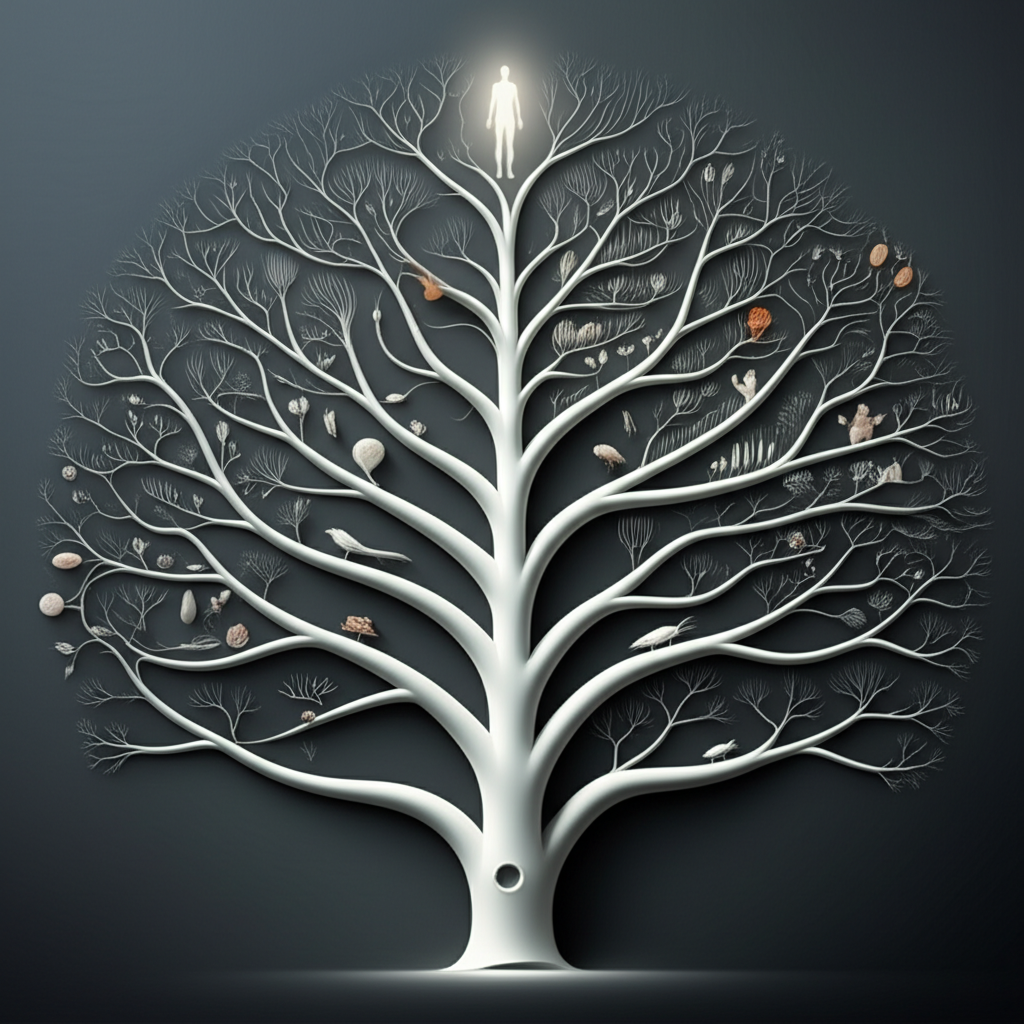
Science, Change, and the Challenge to Anthropocentrism
Science, through the theory of evolution, offers a powerful antidote to anthropocentric views of Progress. It forces us to confront our place not as the culmination of all Change, but as one species among millions, shaped by the same fundamental processes that govern all life. This perspective, deeply embedded in the Great Books tradition through philosophical inquiries into human nature and our place in the cosmos, is both humbling and liberating.
It suggests that while humanity can certainly strive for progress within its own social and ethical frameworks – developing fairer societies, advancing knowledge, and improving living conditions – we must be careful not to project these aspirations onto the natural world itself. The Change wrought by evolution is a testament to nature's adaptability, not its moral compass.
Reconciling Evolution and Progress in a Modern Context
So, how can we thoughtfully integrate the scientific understanding of evolution with our human desire for progress?
- Separate but Interacting Concepts: Recognize evolution as a scientific description of biological change, and progress as a human-defined value judgment about improvement.
- Informed Progress: Use scientific insights, including evolutionary biology, to inform our goals for progress. For instance, understanding human evolutionary psychology can shed light on our biases and help us design more equitable social structures.
- Ethical Responsibility: If evolution shows us the power of environmental influence, then human progress must involve a profound ethical responsibility towards the environment and other species. We are agents of immense Change, and our actions have global consequences.
- Embrace Contingency: Acknowledge that our "progress" is not inevitable. It requires constant effort, critical self-reflection, and adaptation to new challenges. The future of humanity, like the future of any species, is not guaranteed.
The unfolding tapestry of life, woven by evolution, is rich with Change. Our task, as thinking beings, is to understand this process and, within our own sphere, to strive for meaningful Progress—not as nature's ultimate destination, but as a conscious, ethical endeavor.
**## 📹 Related Video: What is Philosophy?
Video by: The School of Life
💡 Want different videos? Search YouTube for: ""Evolution and Teleology Philosophy" or "The Philosophical Implications of Darwin's Theory""**