

The Unseen Hand: Exploring the Role of Fate in History
The grand tapestry of human history unfolds before us, a sprawling narrative of triumphs, tragedies, and transformative moments. But beneath the surface of individual choices and societal shifts, a persistent question lingers: is history merely a chronicle of human agency, or is it guided by an unseen, predetermined force? This article delves into the enduring philosophical debate surrounding Fate in the shaping of History, examining how the concepts of Necessity and Contingency intertwine to drive Change across epochs. From ancient prophecies to modern theories of historical determinism, we explore the profound implications of whether our collective journey is an open road or a predestined path.
Defining the Indefinable: Fate, History, and the Human Condition
At its core, the concept of fate posits that events are predetermined and inevitable, unfolding according to a cosmic plan or an inexorable chain of cause and effect. When applied to history, this suggests that the rise and fall of empires, the advent of revolutions, and the course of human progress are not simply the sum of countless individual decisions but rather manifestations of a deeper, inescapable destiny.
History, in this context, becomes more than just a record; it transforms into the unfolding of this preordained narrative. This perspective often stands in stark contrast to the idea of human free will and the belief that our choices genuinely shape the future. The tension between these views forms the bedrock of philosophical inquiry into historical causation.
Ancient Echoes: Moira, Providence, and Fortuna
From the earliest philosophical inquiries, thinkers have grappled with the notion of fate.
- The Greek Moira: In ancient Greece, the concept of Moira, or the Fates, was powerful. Even the gods were subject to their decrees. Homer's epics and the great tragedies, foundational texts in the Great Books of the Western World, depict heroes struggling against or succumbing to a destiny woven by these cosmic spinners. Heraclitus, with his emphasis on constant flux and the logos (an underlying rational principle governing the universe), hinted at a necessary order, where "all things come to pass through strife and necessity." This suggests that even change itself is part of a fated, cyclical pattern.
- Stoic Determinism: Later, the Stoics developed a sophisticated form of determinism, arguing that the universe operates according to a rational, divine plan (providence). While individuals possess a degree of inner freedom (the ability to assent or dissent to external events), the grand sweep of history and the external world were seen as inexorably fated.
- Augustine's Divine Plan: In the Christian tradition, figures like St. Augustine, whose works are cornerstones of Western thought, wrestled with the apparent conflict between God's omniscient providence and human free will. He concluded that while God knows all future events, human beings still make genuine choices, a complex theological reconciliation that continues to be debated.
- Machiavelli's Fortuna and Virtù: Moving into the Renaissance, Niccolò Machiavelli, in The Prince, introduced the concepts of fortuna (fortune or fate) and virtù (skill, courage, and political prowess). Machiavelli acknowledged the powerful role of fortuna, which he likened to a tumultuous river that can devastate the land. However, he also stressed that a wise leader with virtù could build dikes and embankments to mitigate its destructive power, suggesting that human agency, though limited, can still influence the course of events. This marks a crucial shift towards emphasizing human capacity within a fated world.
The Modern Lens: Necessity, Contingency, and the Engine of Change
The Enlightenment and subsequent eras brought new perspectives, often challenging the direct intervention of divine fate but introducing other forms of historical determinism.
- Hegel's Spirit of History: Georg Wilhelm Friedrich Hegel posited that history is the unfolding of the Absolute Spirit, moving dialectically towards greater self-awareness and freedom. For Hegel, historical events, even seemingly accidental ones, are necessary stages in this grand, rational process. Individual actions contribute to this larger, fated trajectory of philosophical Change.
- Marx's Historical Materialism: Karl Marx, building on Hegel, argued that history is driven by economic forces and class struggle. The progression from feudalism to capitalism and inevitably to communism was, for Marx, a historical necessity, a fated outcome dictated by the material conditions of production.
- Tolstoy's Critique of Great Men: Leo Tolstoy, in War and Peace, famously challenged the "great man" theory of history. He argued that historical events are the product of countless minute actions by ordinary people, rather than the singular decisions of leaders. While not explicitly endorsing a divine fate, Tolstoy's view suggests an emergent, almost inevitable quality to historical movements, where individual agency is subsumed by a larger, collective flow.
The interplay between Necessity and Contingency becomes crucial here. Necessity refers to events that must happen, given certain prior conditions or underlying laws (e.g., the laws of physics, or perhaps historical materialism). Contingency, conversely, refers to events that could have been otherwise, accidental occurrences that significantly alter the course of history (e.g., a sudden illness of a leader, a chance encounter, a particular weather pattern on a battle day).
Many contemporary historians and philosophers acknowledge that history is a complex weave of both. While broad societal trends or technological advancements might seem necessary in their eventual emergence, the specific timing, location, and actors involved are often contingent. The dynamic tension between these two forces is what truly drives historical Change.
Perspectives on Fate in History
| Perspective | Core Idea | Key Proponents/Traditions | Emphasis on Fate/Agency |
|---|---|---|---|
| Classical Determinism | Events are entirely predetermined by divine will or cosmic laws. | Greek Fates (Moira), Stoicism, aspects of Augustinian thought | High Fate, Low Agency |
| Historical Materialism | History is driven by economic forces and class struggle, leading to inevitable societal transformations. | Karl Marx, Friedrich Engels | High Fate (Economic), Low Agency |
| Philosophical Idealism | History is the unfolding of an underlying rational spirit or idea. | G.W.F. Hegel | High Fate (Spirit), Low Agency |
| Contingent History | History is largely shaped by unpredictable events, individual choices, and chance occurrences. | Modern empiricist historians, some existentialist thinkers | Low Fate, High Agency |
| Probabilistic Fate | While specific events are contingent, broad trends or outcomes have a high probability of occurring. | Some sociological theories, "big history" approaches | Moderate Fate, Moderate Agency |
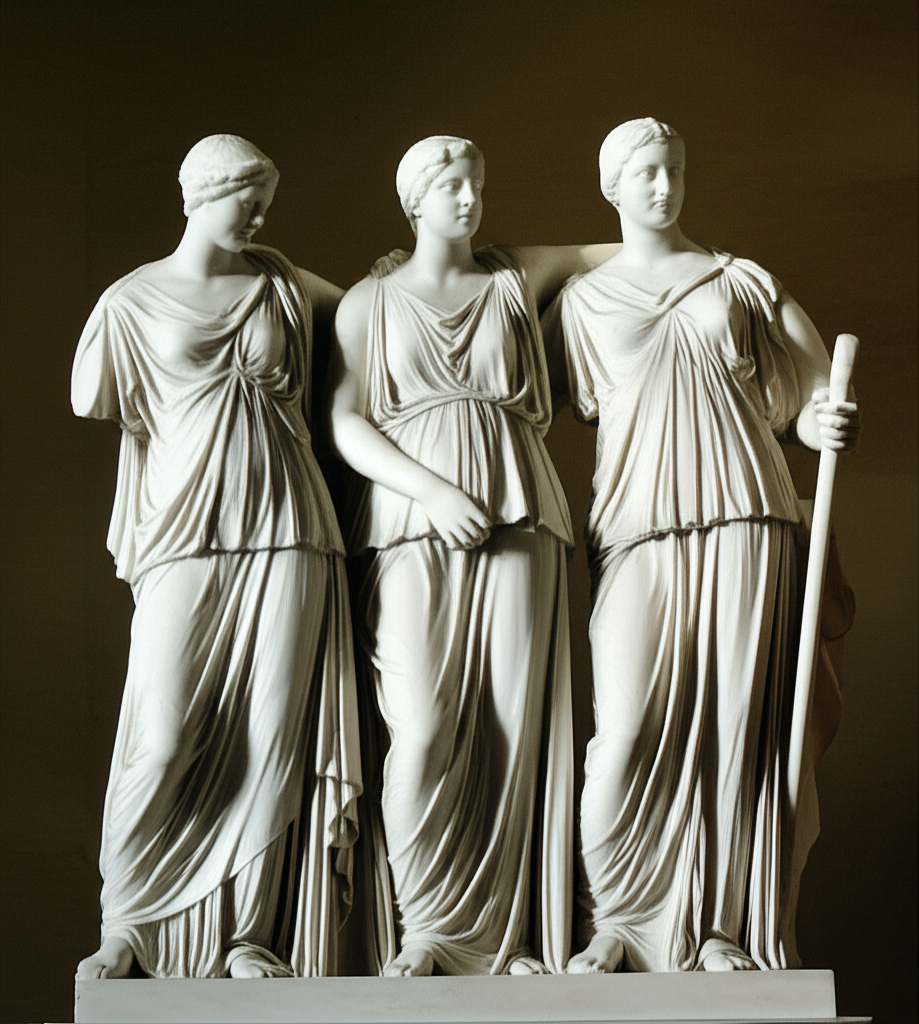 – Clotho spinning the thread of life, Lachesis measuring its length, and Atropos cutting it. Their serene yet powerful expressions convey an immutable authority over human destiny, set against a backdrop of ancient ruins suggesting the passage of time and the impermanence of human endeavors.)
Conclusion: The Enduring Enigma
The question of fate's role in history remains one of philosophy's most profound and enduring enigmas. While few modern thinkers subscribe to a rigid, deterministic view of history in the classical sense, the influence of underlying forces—be they economic, technological, or cultural—is undeniable. The interplay of Necessity and Contingency sculpts the landscape of Change, reminding us that while our individual choices are potent, they operate within a larger, often inscrutable framework.
Understanding history, therefore, requires a nuanced perspective: acknowledging the undeniable impact of human agency and the unpredictable nature of events, while also recognizing the powerful currents that seem to steer humanity toward certain outcomes. The debate over Fate in History is not merely academic; it shapes our understanding of responsibility, freedom, and the very meaning of our collective journey.
📹 Related Video: What is Philosophy?
Video by: The School of Life
💡 Want different videos? Search YouTube for: ""determinism vs free will philosophy history""
📹 Related Video: ARISTOTLE ON: The Nicomachean Ethics
Video by: The School of Life
💡 Want different videos? Search YouTube for: ""Hegel historical dialectic explained""