

The Indivisible Link: Education as the Cornerstone of Liberty
The pursuit of liberty, that enduring aspiration for self-governance and freedom from arbitrary control, is often championed as a fundamental human right. Yet, its true realization and sustained flourishing depend profoundly on a less celebrated, though equally vital, prerequisite: education. This article posits that education is not merely an adjunct to liberty but its very foundation, equipping individuals with the critical faculties necessary to understand, claim, and defend their freedoms, thereby safeguarding both personal autonomy and the health of the democratic State. Without an educated populace, liberty risks devolving into license, or worse, succumbing to the manipulations of demagoguery and tyranny.
Unpacking the Role of Education in Fostering True Liberty
Liberty, in its most profound sense, is more than the absence of external constraint; it is the capacity for informed choice, for self-determination rooted in reason and understanding. It is here that education assumes its indispensable role. An educated individual is better equipped to:
- Discern Truth from Deception: Critical thinking, cultivated through education, allows individuals to evaluate information, challenge assumptions, and resist propaganda, crucial for navigating complex political landscapes.
- Participate Meaningfully in Governance: Active citizenship in a free society demands an understanding of rights, responsibilities, and the mechanisms of government. Education provides this civic literacy.
- Exercise Economic Self-Sufficiency: Knowledge and skills gained through education empower individuals to secure their livelihoods, reducing dependence and fostering economic freedom.
- Engage in Moral and Ethical Deliberation: Liberty is not absolute; it operates within a framework of shared values and responsibilities. Education fosters the capacity for ethical reasoning, enabling individuals to balance personal freedoms with the common good.
- Challenge Injustice and Advocate for Change: An awareness of history, philosophy, and social structures, cultivated through learning, provides the tools to identify systemic injustices and work towards a more equitable society.
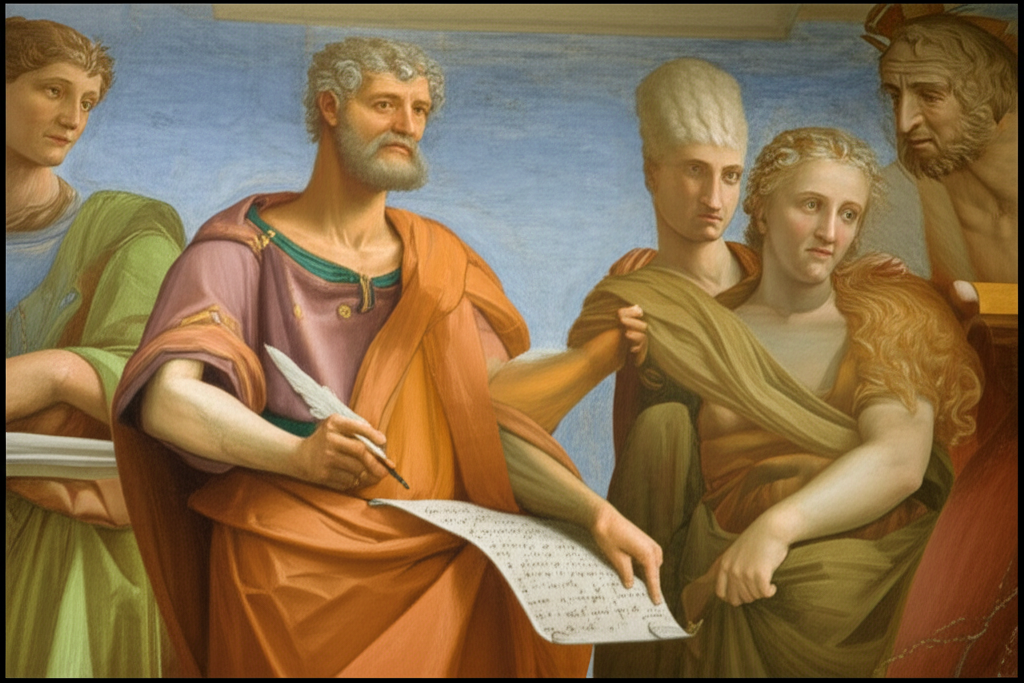 and "Liberty" (holding a Phrygian cap and broken chains) standing together on a pedestal, with citizens debating and engaging in civic life in the background, all bathed in a warm, illuminating light, symbolizing the enlightenment that education brings to freedom.)
Philosophical Foundations: Insights from the Great Books
The profound connection between education and liberty is a recurring theme throughout the Western philosophical tradition, as illuminated by the Great Books of the Western World. Thinkers across millennia have grappled with how best to cultivate citizens capable of self-governance.
Classical Perspectives on Education and the Ideal State
- Plato (c. 428–348 BCE), The Republic: Plato famously outlined an elaborate system of education designed to produce philosopher-kings, guardians, and workers, each fulfilling their role in the ideal State. While his vision was hierarchical and arguably illiberal by modern standards, his emphasis on education for shaping virtuous citizens and understanding objective truth (as in the Allegory of the Cave) underscores its fundamental importance for societal order and individual enlightenment. For Plato, true freedom lay in conforming to rational truth, attained through rigorous intellectual training.
- Aristotle (384–322 BCE), Politics & Nicomachean Ethics: Aristotle argued that education is essential for the flourishing of the polis (city-state) and for individuals to achieve eudaimonia (human flourishing). He believed that citizens must be educated in virtue and civic duty to participate effectively in a free society, distinguishing between different forms of government based on the education and virtue of their citizens. A well-ordered State, for Aristotle, was one whose citizens were educated for liberty and civic responsibility.
Enlightenment Era: Reason, Rights, and Public Education
The Enlightenment cemented the idea that individual reason, fostered by education, was the bedrock of liberty.
- John Locke (1632–1704), Some Thoughts Concerning Education & Two Treatises of Government: Locke, a seminal figure for modern liberal thought, saw education as crucial for developing rational individuals capable of understanding their natural rights and responsibilities. He advocated for an education that cultivates reason, virtue, and self-control, enabling individuals to govern themselves and resist the arbitrary power of the State, thus securing their liberty.
- Jean-Jacques Rousseau (1712–1778), Émile, or On Education & The Social Contract: Rousseau emphasized an education that allows for natural development and cultivates civic virtue, preparing individuals to participate in the "general will" of a free society. His vision sought to reconcile individual freedom with collective sovereignty, a balance dependent on properly educated citizens.
- John Stuart Mill (1806–1873), On Liberty: Mill's impassioned defense of individual liberty rests heavily on the premise of an educated populace capable of critical thought and open discourse. He argued for the importance of intellectual freedom and the "marketplace of ideas," where diverse opinions are debated and refined. For Mill, education cultivates the individuality and critical faculties necessary for a vibrant, free society, safeguarding against the tyranny of both the State and public opinion.
The Dynamic Interplay: Education, Liberty, and the State
The relationship between education, liberty, and the State is complex and often fraught with tension. On one hand, the State often plays a crucial role in providing universal education, thereby democratizing access to the tools of liberty. Public education systems, from elementary schools to universities, aim to equip citizens with the knowledge and skills needed to participate in a free society.
However, the State's involvement also presents potential pitfalls:
- Curriculum Control: Who dictates what is taught? A State that monopolizes education can easily manipulate curricula to promote specific ideologies, potentially undermining critical thought and individual liberty.
- Funding and Access: Inadequate funding or unequal access to quality education can perpetuate social inequalities, denying certain segments of the population the foundational tools for true liberty.
- Academic Freedom: The freedom of educators and researchers to explore controversial topics and challenge established norms is vital for a robust intellectual environment, yet it can be threatened by State interference or political pressures.
A truly free society demands a delicate balance: a State that supports and funds comprehensive, high-quality education while simultaneously protecting academic freedom and fostering a diversity of educational approaches. The ultimate goal is to empower individuals, not to indoctrinate them.
Contemporary Challenges and the Enduring Role of Education
In our modern age, characterized by an explosion of information, the role of education in safeguarding liberty has become even more critical. The prevalence of misinformation, "fake news," and echo chambers threatens informed public discourse and the very fabric of democratic societies. Education, therefore, must adapt to:
- Cultivate Media Literacy: Teaching individuals to critically evaluate sources, understand biases, and identify propaganda is paramount.
- Promote Digital Citizenship: Equipping citizens with the skills to navigate the digital landscape responsibly and ethically.
- Foster Lifelong Learning: Recognizing that education is not a finite process but an ongoing journey essential for adapting to a rapidly changing world and continually reinforcing the foundations of liberty.
Conclusion
The foundational premise remains clear: education is the bedrock upon which genuine liberty is built and sustained. From the classical ideals of virtuous citizenship to the Enlightenment's emphasis on individual reason, and into our complex modern era, the call for an informed populace resonates. The State has a profound role to play in providing and protecting education, but it must do so in a manner that empowers rather than controls. For without the critical thinking, ethical reasoning, and civic understanding that education imparts, liberty risks becoming an empty promise, easily eroded by ignorance, manipulation, or apathy. To truly be free, we must first be educated.
YouTube Video Suggestions:
-
📹 Related Video: PLATO ON: The Allegory of the Cave
Video by: The School of Life
💡 Want different videos? Search YouTube for: ""Plato's Allegory of the Cave Explained - Philosophy Basics""
2. ## 📹 Related Video: What is Philosophy?
Video by: The School of Life
💡 Want different videos? Search YouTube for: ""John Locke's Philosophy of Education - Self-Government and Reason""