

The Elusive Arrow: Unpacking the Problem of Time in Physics
Summary: The Problem of Time in Physics is a profound philosophical and scientific challenge, stemming from the stark contrast between our intuitive experience of time as a flowing, irreversible progression and its treatment within fundamental physics. While we perceive a distinct past, present, and future, the equations of classical and quantum physics largely remain indifferent to time's direction, often treating it as merely another spatial quantity. This discrepancy presents a significant obstacle to unifying our understanding of the universe, forcing us to question whether time is a fundamental aspect of reality or an emergent phenomenon.
The Unsettling Discrepancy: Our Experience vs. Physics' Equations
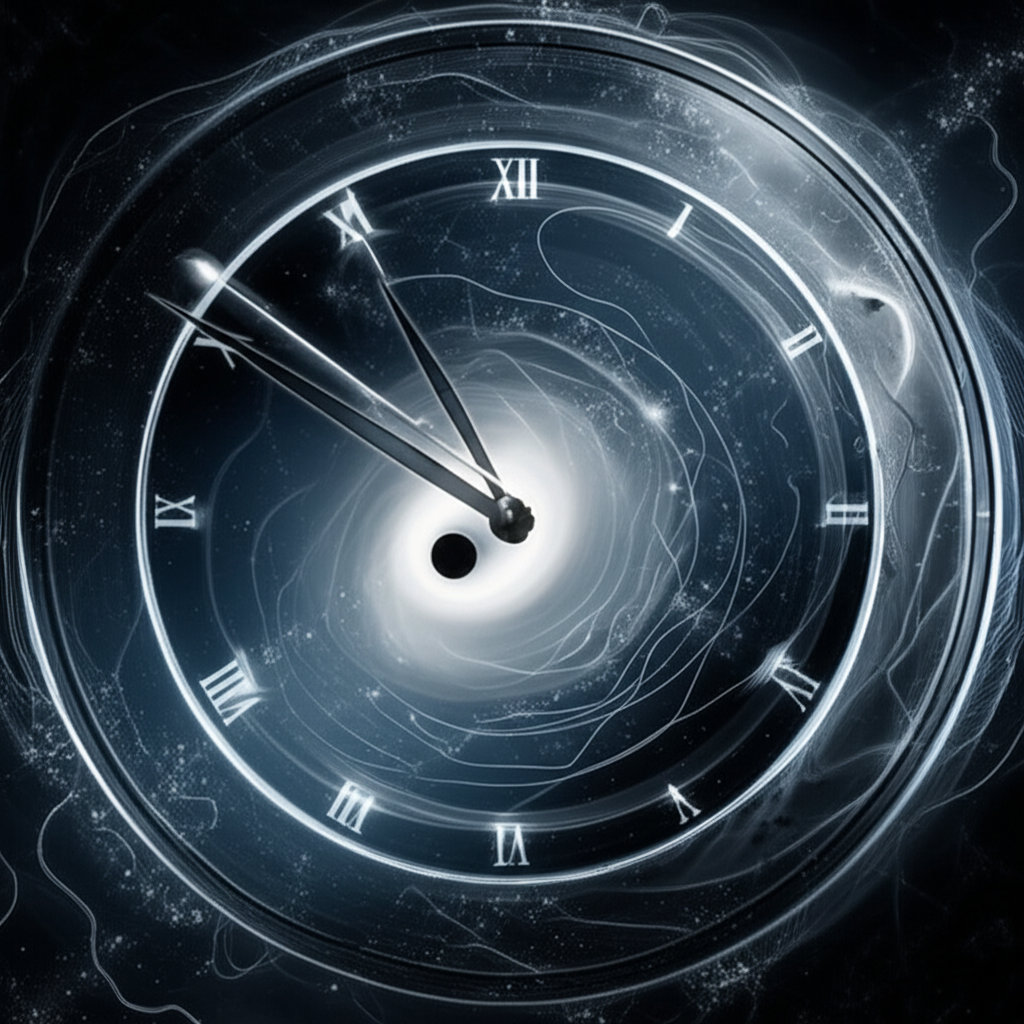
We all know time. We feel its relentless march forward, the irreversible transition from past to future, the fleeting nature of the present moment. We plan our days, reminisce about yesterday, and anticipate tomorrow, all within this familiar framework of chronological succession. Yet, when we delve into the bedrock principles of physics, this intuitive understanding of time begins to unravel, revealing a profound and persistent problem.
From Newton's absolute, universal clock to Einstein's relativistic spacetime, and even into the perplexing realm of quantum mechanics, time presents itself not as a flowing river, but often as a static dimension, a mere quantity that can be measured, dilated, or even, in some theories, disappear entirely. This fundamental disconnect between our lived experience and the mathematical elegance of physical laws lies at the heart of the "Problem of Time."
Time's Arrow: Why Does It Only Fly Forward?
One of the most perplexing aspects of time is its apparent unidirectionality. Why does an egg break but never reassemble itself? Why do we remember the past but not the future? This phenomenon, often called the "arrow of time," seems ubiquitous in our macroscopic world.
- The Thermodynamic Arrow: The most common explanation for time's arrow comes from thermodynamics, specifically the second law, which states that the entropy (disorder) of a closed system always tends to increase. This increase in disorder gives time its direction. A broken egg is a state of higher entropy than an intact one. While the fundamental laws governing individual particles are largely time-symmetric (meaning they work equally well forwards or backward in time), the sheer probability of macroscopic systems evolving towards higher entropy states creates the illusion of an irreversible flow. But is this merely an emergent property, or does it point to something deeper about time itself?
Einstein's Revolution: Time as a Relative Quantity
Albert Einstein fundamentally reshaped our understanding of time with his theories of relativity. He demonstrated that time is not an absolute, universal constant but is relative, dependent on the observer's motion and gravitational field.
- Special Relativity and Time Dilation: In special relativity, time is intertwined with space, forming a four-dimensional fabric called spacetime. Moving clocks run slower relative to stationary ones – a phenomenon known as time dilation. This isn't an illusion; it's a real physical effect, confirming that time is a quantity that can be stretched or compressed.
- General Relativity and Gravitational Time Dilation: General relativity further complicates matters, showing that massive objects warp spacetime, causing time to run slower in stronger gravitational fields. For physicists, time in this context is often treated as a coordinate, a label for points in spacetime, rather than an active, flowing entity. This perspective often leads to the concept of a "block universe," where all moments – past, present, and future – exist simultaneously, fixed in the fabric of spacetime, much like different points on a map. This radically challenges our intuitive sense of a unique, moving "now."
The Quantum Quandary: Time's Disappearance Act
If relativity challenges our intuition about time's flow, quantum mechanics introduces an even more unsettling prospect: the possibility that time might not exist at the most fundamental level.
- The Wheeler-DeWitt Equation: In attempts to formulate a quantum theory of gravity, physicists like John Wheeler and Bryce DeWitt developed an equation that describes the wave function of the universe. The startling feature of the Wheeler-DeWitt equation is that it does not contain a time variable. This has led some to suggest that time is not a fundamental quantity but rather an emergent property, perhaps arising from the entanglement of quantum states or from the interaction of observers with the quantum realm.
- The Problem of Measurement and Quantum Time: In quantum mechanics, the act of measurement plays a crucial role, collapsing a superposition of possibilities into a definite state. This seems to imply a temporal sequence – measurement happens at a certain time. However, the very notion of time itself becomes ambiguous when trying to describe the universe as a single quantum system. How can we define time if there's no external clock and no clear "before" and "after" in a timeless quantum state?
Reconciling the Discrepancies: The Search for a Unified Theory
The "Problem of Time" is perhaps most acute in the quest to unify general relativity (which describes gravity and spacetime on large scales) with quantum mechanics (which describes matter and energy on microscopic scales). These two pillars of modern physics offer fundamentally different perspectives on time.
- Is Time an Emergent Property? Many contemporary theories of quantum gravity, such as loop quantum gravity and string theory, grapple with the idea that time might not be a fundamental dimension but an emergent phenomenon, much like temperature or pressure emerges from the collective behavior of atoms. If time is emergent, then our experience of its flow is a macroscopic illusion, a grand problem for our perception of reality.
- The Block Universe vs. A Flowing Now: The philosophical implications are profound. If the block universe interpretation of relativity holds, our sense of a 'present' moment moving through time is an illusion. All events, past, present, and future, simply exist. This stands in stark contrast to our lived experience and has been a subject of philosophical debate for centuries. Augustine of Hippo, in his Confessions, famously pondered the nature of time, asking "What then is time? If no one asks me, I know; if I wish to explain it to one who asks, I know not." His struggle to locate the 'present' between a non-existent past and a not-yet-existent future resonates deeply with the modern physicist's dilemma.
Philosophical Echoes of a Physical Problem
The modern physical problem of time is not entirely new; it echoes ancient philosophical inquiries into the nature of change, permanence, and existence. The very concept of time as a measurable quantity (as opposed to a subjective experience) has a long and complex history.
| Philosophical Perspective | Key Idea Regarding Time | Connection to Physics Problem |
|---|---|---|
| Parmenides | Reality is changeless, eternal, and indivisible. Motion and change (and thus time) are illusions. | Resonates with timeless equations and the block universe, where fundamental reality might be static. |
| Heraclitus | "Everything flows," reality is constant change and flux. "You cannot step into the same river twice." | Contrasts with timeless physics, emphasizing the dynamic, flowing nature of existence that physics struggles to capture. |
| Aristotle | Time is the "number of motion with respect to 'before' and 'after'." It is dependent on change. | Supports the idea of time as an emergent property linked to physical processes, rather than an independent entity. |
| Augustine of Hippo | Time is a "distention of the soul," a psychological reality. Past and future exist only in memory and anticipation. | Highlights the subjective experience of time, which physics often omits, and questions the objective reality of the past/future in a timeless universe. |
Conclusion: A Profound Challenge to Our Understanding
The Problem of Time in Physics remains one of the most compelling and unresolved challenges in science and philosophy. It forces us to confront the very nature of reality, asking whether our most fundamental experience – the passage of time – is a universal truth or merely a construct of our consciousness. Whether time is a fundamental quantity, an emergent illusion, or something entirely different, its enigmatic nature continues to push the boundaries of human inquiry, promising profound insights into the fabric of existence.
**## 📹 Related Video: ARISTOTLE ON: The Nicomachean Ethics
Video by: The School of Life
💡 Want different videos? Search YouTube for: ""The Problem of Time in Quantum Gravity" - Search for talks by Carlo Rovelli or Sean Carroll on this topic."**
**## 📹 Related Video: ARISTOTLE ON: The Nicomachean Ethics
Video by: The School of Life
💡 Want different videos? Search YouTube for: ""Einstein's Relativity and the Block Universe Explained""**