

The Role of Chance in Evolution is far more profound than a mere statistical anomaly; it is a foundational philosophical concept that challenges our understanding of Nature, purpose, and design. This article delves into how what we perceive as random events are, in fact, integral to life's unfolding, inviting us to reconsider the very fabric of existence through a lens informed by both scientific discovery and ancient philosophical inquiry.
Beyond Mere Randomness: Defining Chance in Nature
The Nuance of Unpredictability
When we speak of chance in the context of evolution, it's tempting to reduce it to a simple roll of the dice. But for a philosophical mind, the concept is far richer, far more vexing. Is chance truly an absence of cause, or merely an intersection of causal chains too complex for us to fully grasp? This question lies at the heart of its role in shaping life. Ancient thinkers, from Aristotle contemplating his four causes to the Stoics grappling with Nature's grand design, understood that not all events fit neatly into a deterministic chain. The Great Books of the Western World are replete with discussions on contingency, accident, and the unpredictable, hinting at the deep philosophical roots of this inquiry long before Darwin.
The Unseen Hand: Chance as an Evolutionary Architect
Mutation, Drift, and the Philosophical Implications
Biologically, chance manifests in spontaneous genetic mutations and the stochastic processes of genetic drift. These aren't guided; they simply happen. Yet, these seemingly undirected events are the very wellspring of novelty, the raw material upon which natural selection acts. Without them, evolution as we know it would grind to a halt. This elevates chance from a passive bystander to an active architect, albeit one without conscious intent. Its role is not merely to introduce variation but to fundamentally shape the trajectory of life, often in ways that defy prediction.
Here are some key sources of evolutionary chance:
- Genetic Mutation: Random changes in DNA sequences, the ultimate origin of new genetic information and phenotypic traits. These are not directed towards beneficial outcomes.
- Genetic Drift: Random fluctuations in the frequency of particular genes (alleles) in a population, especially significant in smaller populations, leading to non-adaptive changes.
- Environmental Catastrophes: Unpredictable natural events (e.g., asteroid impacts, volcanic eruptions, sudden climate shifts) that drastically alter selective pressures and can lead to mass extinctions or rapid speciation, often by chance wiping out dominant species.
- Initial Conditions and Historical Contingency: The particular path evolution takes is often dependent on specific, unrepeatable past events, making the future unpredictable and unique.
Nature's Grand Experiment: Where Chance Meets Necessity
The Interplay of Randomness and Selection
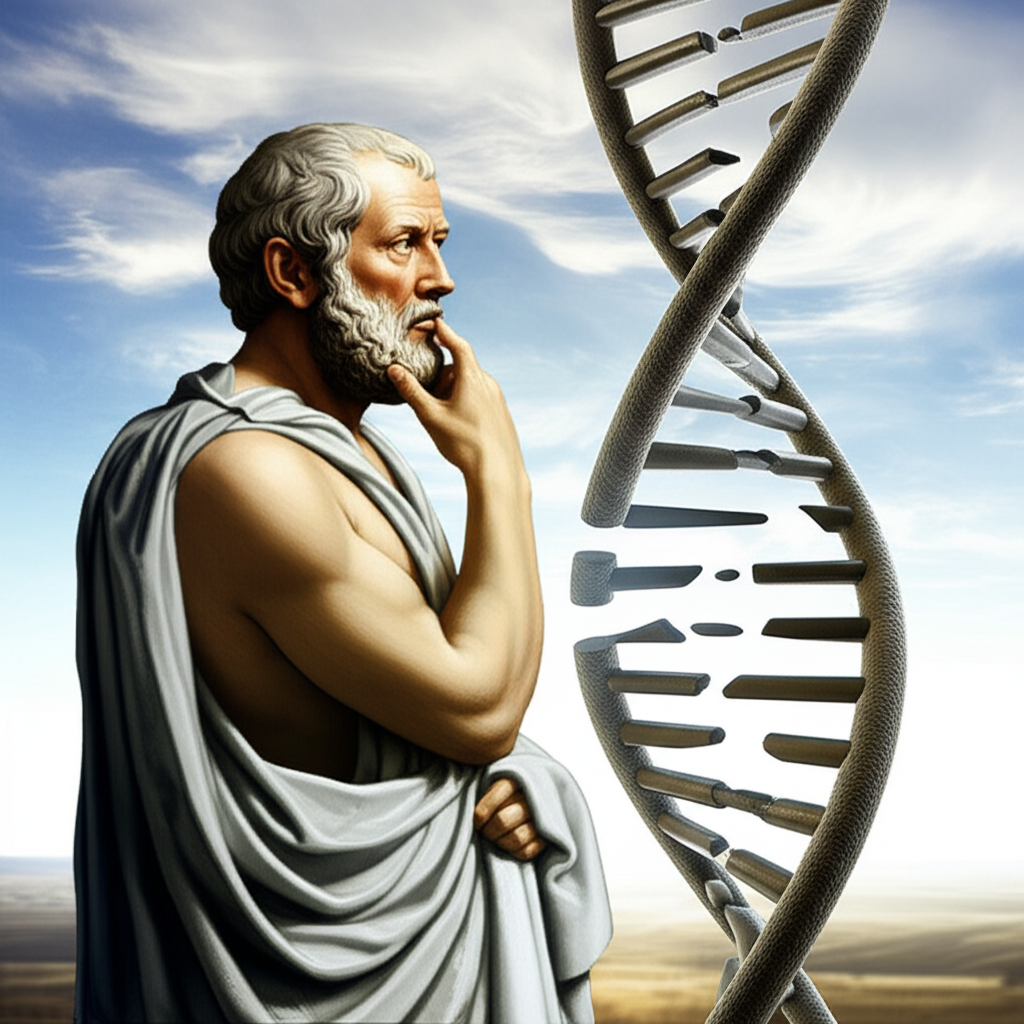
It's crucial to understand that chance in evolution doesn't operate in a vacuum. It provides the variations, but Nature – through the sieve of natural selection – then 'chooses' which of these variations are best suited for survival and reproduction. This dynamic interplay is where the philosophical tension truly lies. Is Nature's selection a form of necessity, shaping the accidental into the adaptive? Or does the irreducible element of chance mean that the path of evolution was never predetermined?
Philosophers have long grappled with the relationship between necessity and contingency. From the ancient atomists who saw the world as a dance of chance encounters, to later thinkers who sought a divine or inherent order, the tension between what must be and what might be has been a persistent theme in the Great Books of the Western World. In evolution, chance introduces the "might be," while selection introduces the "must be" (given environmental pressures).
The Existential Weight of a Chance-Driven World
Purpose, Meaning, and the Human Condition
If chance plays such a fundamental role in evolution, what does this imply for our search for purpose and meaning? Does it diminish the idea of a grand design, or does it invite a new appreciation for the resilience and adaptability of life itself? This perspective can be unsettling, challenging anthropocentric views that place humanity at the pinnacle of a pre-ordained ascent. Instead, we are products of a magnificent, often unpredictable, natural process.
Embracing the role of chance in Nature's unfolding is not an embrace of nihilism, but an invitation to a deeper, more humble understanding of our place in the cosmic dance. It encourages us to find meaning not in predetermined outcomes, but in the creative potential of the present, and in the profound beauty of life's intricate, contingent journey.
The Role of Chance in Evolution remains one of the most compelling philosophical inquiries of our time. It compels us to move beyond simplistic notions of randomness and to recognize its profound, creative power within Nature. From the ancient reflections found in the Great Books of the Western World to contemporary scientific insights, understanding chance is not merely about understanding biology; it's about understanding the very essence of existence, the intricate dance between the predictable and the wonderfully, terrifyingly unpredictable.
📹 Related Video: What is Philosophy?
Video by: The School of Life
💡 Want different videos? Search YouTube for: ""philosophy of chance and determinism""
📹 Related Video: PLATO ON: The Allegory of the Cave
Video by: The School of Life
💡 Want different videos? Search YouTube for: ""evolutionary contingency philosophical implications""