

The Unfolding Tapestry: Deconstructing the Relationship Between Fate and History
Summary: The intricate relationship between fate and history has captivated philosophers for millennia. This article delves into how these concepts, often seen as opposing forces, actually intertwine through the lens of time, necessity, and contingency. Drawing from the Great Books of the Western World, we explore whether history is merely the predetermined unfolding of an inescapable destiny, or a dynamic narrative shaped by human choices and chance events. Ultimately, understanding this relationship illuminates our place in the grand scheme of existence and the meaning we derive from our past, present, and future.
The Unfolding Tapestry: Fate's Threads in History's Weave
From the epic sagas of Homer to the systematic philosophies of Hegel, humanity has grappled with a profound question: Are we merely actors in a play whose script is already written, or are we the playwrights, improvising our way through time? This question lies at the heart of the relationship between fate and history. On one hand, fate suggests an immutable, predetermined course of events, an inescapable destiny. On the other, history is often seen as the record of human actions, choices, and their consequences, implying a degree of freedom and contingency. Yet, these two concepts are not easily disentangled. They challenge our understanding of causality, moral responsibility, and the very nature of time.
Defining the Terms: Fate, History, and the Medium of Time
To properly navigate this complex terrain, we must first establish a working understanding of our core terms, as they have evolved throughout philosophical discourse.
- Fate: In its broadest sense, fate refers to a predetermined course of events, often conceived as a divine will, a natural law, or an impersonal cosmic force.
- Classical Greek Conception: Thinkers like the Stoics believed in a rational, ordered cosmos where everything happens according to necessity. The Fates (Moirai) spun, measured, and cut the thread of life, signifying an inescapable destiny.
- Theological Views: In Abrahamic traditions, this often translates to divine providence, where God's plan guides all events, though often balanced with human free will.
- Secular Determinism: Later, philosophical determinism posited that all events, including human actions, are causally determined by prior events and the laws of nature.
- History: More than just a chronological record of events, history is the narrative we construct from the past. It involves interpretation, selection, and the search for meaning and causality in human affairs.
- Herodotus and Thucydides: The fathers of history sought to understand human actions and their consequences, yet even they acknowledged the potential for divine intervention or inexplicable fortune.
- Modern Historians: Often focus on socio-economic, political, and cultural forces, seeking patterns and explanations for societal change.
- Time: The fundamental medium through which both fate unfolds and history is recorded and experienced.
- Linear Time: Prevalent in Western thought, time moves forward, irreversibly. This allows for a sense of progress, accumulation of events, and a unique historical narrative.
- Cyclical Time: Common in some ancient philosophies (e.g., Plato's Republic and the concept of eternal recurrence), where history repeats itself in grand cycles, often implying a fated return to original conditions.
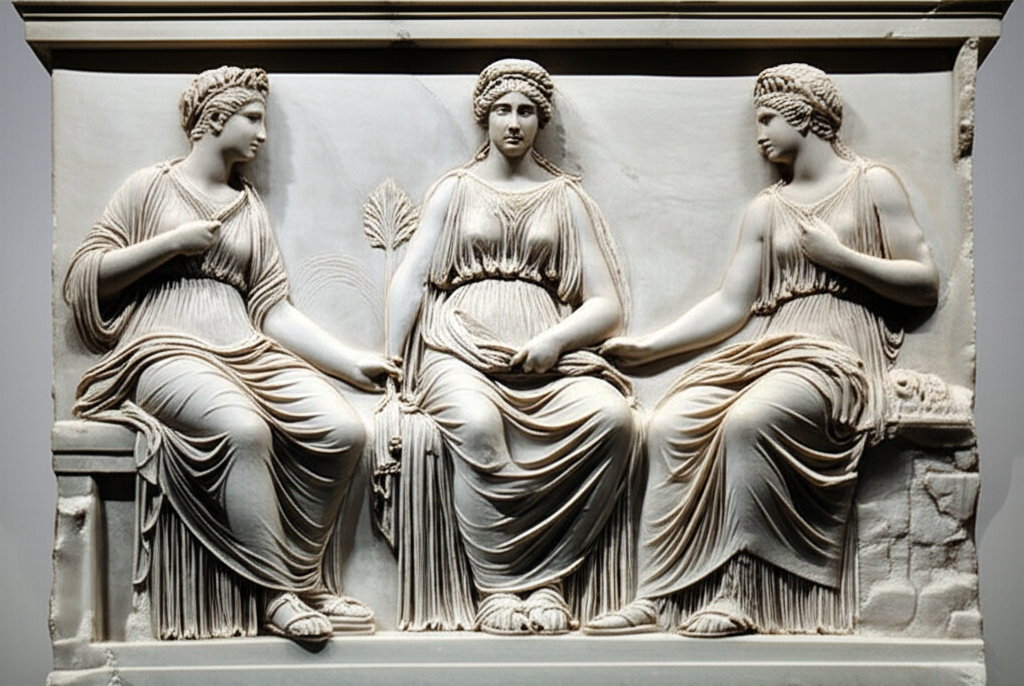 spinning, measuring, and cutting a thread, juxtaposed with a detailed ancient map or a battle scene from the Peloponnesian War, illustrating the intersection of predetermined destiny and historical human events.)
The Great Debate: Necessity Versus Contingency
The core of the philosophical tension between fate and history lies in the interplay of necessity and contingency.
- Necessity: This posits that certain events must occur; they are inevitable. If history is governed by necessity, then human choices are merely symptoms or instruments of a larger, predetermined process.
- Hegel's Philosophy of History: In his Phenomenology of Spirit and Lectures on the Philosophy of History, Georg Wilhelm Friedrich Hegel argued that history is the progressive unfolding of the Absolute Spirit towards self-consciousness and freedom. Individual actions, even wars and revolutions, are necessary stages in this grand, rational process.
- Marxist Historical Materialism: Building on Hegel, Karl Marx posited that history is driven by economic forces and class struggle, leading inevitably through specific stages (e.g., feudalism, capitalism, communism). The actions of individuals are largely determined by their class position and the prevailing mode of production.
- Contingency: This suggests that events could have happened differently; they are not inevitable but depend on chance, unforeseen circumstances, or free human choices. If history is fundamentally contingent, then human agency holds significant power to alter its course.
- Machiavelli's Fortuna and Virtù: In The Prince, Niccolò Machiavelli acknowledged the powerful role of fortuna (fortune or chance), which he likened to a wild river or a capricious woman. However, he also emphasized virtù (skill, courage, cunning) as the prince's ability to navigate or even bend fortune to his will, demonstrating human agency in the face of unpredictable events.
- The "What Ifs" of History: Historians often grapple with counterfactuals – what if a key battle had gone differently, or a crucial decision had not been made? These thought experiments highlight the contingent nature of many historical outcomes.
To illustrate this tension, consider the following:
| Aspect | View of Fate (Necessity) | View of History (Contingency) |
|---|---|---|
| Causality | Events are strictly determined by prior causes or a grand plan. | Events are influenced by multiple factors, including chance & choice. |
| Human Agency | Limited; individuals are instruments of a larger force. | Significant; individuals shape events through decisions and actions. |
| Meaning | Found in recognizing and aligning with the predetermined path. | Created through human striving, interpretation, and moral choice. |
| Predictability | Potentially high, if the underlying deterministic laws are known. | Low; future is open-ended and subject to change. |
Echoes from the Great Books: Illustrative Examples
The Great Books of the Western World provide a rich tapestry of perspectives on fate and history.
- Homer's Iliad and Greek Tragedy: The heroes of the Trojan War, like Achilles and Hector, often speak of their moira (fate), yet they also make choices that profoundly affect the narrative. The tragic plays, such as Sophocles' Oedipus Rex, powerfully depict an individual's struggle against an inescapable destiny, where every attempt to avoid fate only serves to fulfill it. This suggests a fatalistic necessity that even gods cannot fully circumvent.
- Augustine's City of God: Saint Augustine grappled with the problem of evil and divine providence. He reconciled God's omnipotence and foreknowledge (a form of necessity) with human free will. God knows what we will choose, but does not force our choice. History, for Augustine, is the unfolding of God's plan, culminating in the City of God, but human contingency and moral choices are essential to this journey.
- Tolstoy's War and Peace: Leo Tolstoy offers a profound meditation on the individual versus historical forces. He critiques the "great man" theory of history, suggesting that leaders like Napoleon are often swept along by the collective will and myriad small, often unseen, actions of millions. While not strictly fatalistic, Tolstoy emphasizes the limits of individual agency in the face of overwhelming historical currents, blurring the lines between necessity and individual contingency.
- Spinoza's Ethics: Baruch Spinoza presented a rigorous deterministic system where everything, including human thought and action, is a necessary consequence of God's (or Nature's) eternal and infinite attributes. Freedom, for Spinoza, is not the ability to choose otherwise, but the intellectual understanding of this necessity and acting in accordance with reason.
The Human Element: Agency, Meaning, and the Burden of Choice
If history is merely the unfolding of fate, what then is the purpose of human striving, moral choice, or even the study of history itself? This question leads us to consider the profound implications for human agency and the search for meaning.
Even in systems that emphasize necessity, there often remains a space for human response. For the Stoics, while external events were fated, our attitude towards them was within our control. For Augustine, free will, though known by God, still carries moral weight. For Hegel, understanding the Spirit's progression through history allows for a more conscious participation in its unfolding.
The belief in contingency, on the other hand, places a heavy burden of responsibility on humanity. If our choices matter, then we are accountable for the course of history. This perspective imbues human actions with profound significance, making the study of history not just an academic exercise, but a vital guide for future decisions. It fosters hope for change and the possibility of building a better future.
Conclusion: A Dynamic Interplay
The relationship between fate and history is not a simple binary. It is a dynamic, complex interplay where threads of necessity weave through the fabric of contingency. While certain broad patterns or ultimate ends might appear fated from a grand philosophical perspective, the specific details, the nuanced narratives, and the everyday struggles that constitute human history are often shaped by countless individual choices, unforeseen events, and the relentless march of time.
Ultimately, the enduring philosophical tension between fate and history compels us to reflect on our place in the cosmos. Do we observe history as a predetermined spectacle, or do we actively participate in its creation? Perhaps the truth lies in acknowledging both: that we are part of a larger, often inscrutable order, yet within that order, our choices and actions retain a vital, history-shaping significance. The Great Books remind us that this is a question not just for philosophers, but for every individual grappling with the meaning of their own life within the grand narrative of humanity.
YouTube Video Suggestions:
-
📹 Related Video: What is Philosophy?
Video by: The School of Life
💡 Want different videos? Search YouTube for: "Determinism vs Free Will Philosophy Explained"
2. ## 📹 Related Video: What is Philosophy?
Video by: The School of Life
💡 Want different videos? Search YouTube for: "Hegel Philosophy of History Summary"