

The Unfolding Tapestry: A Philosophical Inquiry into the Progress of Medicine
The history of medicine is often recounted as a triumphant march of discovery, a relentless pursuit of healing that has dramatically extended human lifespans and alleviated suffering. From ancient incantations to CRISPR gene editing, the progress of medicine appears undeniable. Yet, to truly grasp its significance, we must look beyond mere technological advancement and engage with the profound philosophical questions it raises concerning our understanding of Life and Death, and the very essence of human flourishing. This article explores the trajectory of medical evolution, examining the indispensable role of Science and reflecting on the deeper implications of our ever-increasing capacity to mend and modify the human form.
The Arc of Healing: From Superstition to Science
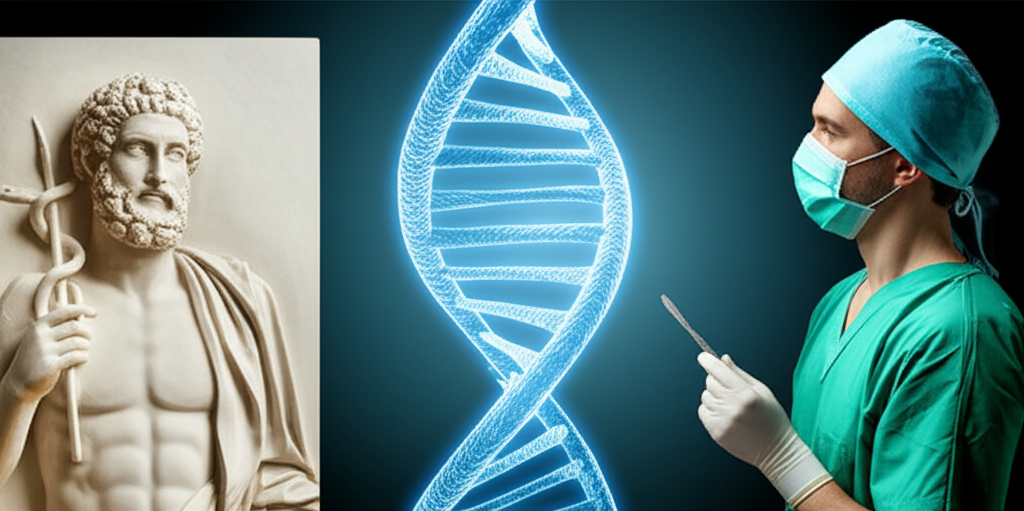
For millennia, the practice of healing was intertwined with mysticism, religion, and empirical observation, often without a clear understanding of causation. Ancient Egyptian physicians, for instance, meticulously documented ailments and treatments, while Hippocrates, a cornerstone figure in the Great Books of the Western World, began to systematically separate medicine from religious dogma, advocating for observation, diagnosis, and prognosis. His ethical principles, enshrined in the Hippocratic Oath, underscore a timeless commitment to patient welfare, a commitment that persists even as the tools and knowledge at our disposal have transformed beyond recognition.
The true inflection point, however, arrived with the Enlightenment and the ascendance of the scientific method. It was here that medicine began its gradual, yet irreversible, divorce from speculative philosophy and embraced empirical rigor.
- Ancient Empiricism: Observation-based, often holistic, limited by understanding of internal mechanisms.
- Medieval Scholasticism: Integration with theology, sometimes hindering anatomical progress due to religious proscriptions.
- Renaissance Anatomy: Vesalius and others revolutionized understanding of the human body through dissection.
- The Scientific Revolution: The systematic application of experimentation, leading to microbiology, anesthetics, and germ theory.
- Modern Biomedicine: Characterized by reductionism, molecular biology, genetics, and sophisticated diagnostics.
This journey highlights a fundamental shift: from treating symptoms to understanding underlying mechanisms, from passive observation to active intervention based on testable hypotheses.
The Engine of Progress: Science and Its Double Edge
The relentless march of medical progress is inextricably linked to the advancements in Science. It is the scientific method – the formulation of hypotheses, rigorous experimentation, peer review, and the constant revision of theories – that has unlocked the secrets of disease, revealing the intricate workings of the human body at molecular and cellular levels. From vaccination to antibiotics, from organ transplantation to targeted therapies, each breakthrough is a testament to humanity's capacity for rational inquiry and innovation.
However, this scientific prowess also presents a complex philosophical dilemma. As our ability to manipulate biological processes grows, so too does the ethical burden. The pursuit of longevity, the eradication of genetic predispositions, or the enhancement of human capabilities—all these raise profound questions about what it means to be human, what constitutes natural limits, and who decides the future direction of our species.
Table: Key Philosophical Shifts in Medical Thought
| Era/Concept | Dominant Approach | Philosophical Implication |
|---|---|---|
| Ancient Greek | Humoral theory, observation, ethical conduct | Harmony with nature, balance, virtue in practice |
| Renaissance | Anatomy, early experimentation | Human as a complex machine, empirical knowledge triumphs over dogma |
| Enlightenment | Scientific method, germ theory, public health | Reason as the ultimate arbiter, human control over disease |
| Modern Biomedicine | Molecular biology, genetics, personalized medicine | Redefinition of health/disease, ethical dilemmas of intervention |
Life and Death: Reshaped by Medical Progress
Perhaps the most profound impact of medical progress is its redefinition of Life and Death. Where once illness and early demise were accepted as immutable facts of existence, modern medicine offers the promise, and often the reality, of cure, remission, and extended life. Infant mortality rates have plummeted, infectious diseases that once decimated populations are now largely controlled, and chronic conditions are managed, allowing individuals to live longer, more productive lives.
Yet, this triumph over early death introduces new complexities:
- Prolonged Suffering: The ability to sustain life artificially, even when quality of life is severely diminished, forces agonizing decisions about end-of-life care and the definition of a "good death."
- Aging Populations: While a testament to success, the demographic shift strains healthcare systems and raises questions about societal responsibility for the elderly.
- The Pursuit of Immortality: As scientific frontiers push towards radical life extension, the very concept of mortality, a cornerstone of human meaning-making, comes into question. What kind of life are we prolonging, and at what cost to our understanding of its precious finitude?
The Enduring Ethical Imperative
The progress of medicine, while dazzling in its achievements, continually brings us back to fundamental ethical questions. Figures like Immanuel Kant, another luminary from the Great Books, would remind us of the categorical imperative—that individuals should be treated as ends in themselves, never merely as means. This principle remains vital in an era where genetic information, experimental treatments, and resource allocation present unprecedented moral challenges. The conversation about medicine is not merely about what can be done, but what should be done, and for whom.
The future of medicine promises even more astonishing breakthroughs, but it also demands a deeper philosophical engagement. We must constantly reflect on the purpose of our interventions, the balance between quantity and quality of life, and the equitable distribution of its benefits. For Henry Montgomery, the true measure of medical progress is not just in the diseases it conquers, but in the wisdom and humanity it fosters.
📹 Related Video: ARISTOTLE ON: The Nicomachean Ethics
Video by: The School of Life
💡 Want different videos? Search YouTube for: ""The Philosophy of Medicine: Ethics and Human Flourishing""
📹 Related Video: KANT ON: What is Enlightenment?
Video by: The School of Life
💡 Want different videos? Search YouTube for: ""Great Books of the Western World: Hippocrates and Ancient Medicine""