

The Ethical Dimension of War and Peace: A Philosophical Inquiry
The perennial questions surrounding War and Peace strike at the very core of human existence, forcing us to confront profound dilemmas of Ethics, Duty, and the ever-present struggle between Good and Evil. This article delves into the philosophical traditions that have grappled with these weighty issues, drawing insights from the Great Books of the Western World to illuminate the complex moral landscape of conflict and the enduring quest for a just and lasting peace. From ancient Greek inquiries into justice and the state to modern considerations of universal duty and perpetual peace, we explore how humanity has sought to impose moral order on the chaos of war and define the ethical responsibilities that bind us, even in the most extreme circumstances.
Navigating the Moral Minefield: An Introduction
To speak of ethics in the context of war might seem paradoxical. War, by its very nature, involves violence, destruction, and the suspension of normal moral rules. Yet, philosophers across millennia have insisted that even in the darkest hours of conflict, moral principles must apply. The ethical dimension of War and Peace is not merely about condemning violence but about understanding its justifications, its conduct, and its aftermath. It is about discerning when force is permissible, how it should be wielded, and what responsibilities fall upon individuals and states alike. This journey through philosophical thought reveals a persistent human desire to find meaning and morality amidst the brutality, to distinguish between necessary evil and wanton destruction, and to strive for a peace founded on justice rather than mere cessation of hostilities.
Ancient Echoes: Justice, Power, and the State
The earliest philosophical inquiries into conflict often intertwined with discussions of justice, the ideal state, and human nature.
- Plato, in his Republic, envisioned a state where justice prevailed, implying that war, if necessary, would be waged for the sake of preserving this just order. His concern was not just the act of war, but its purpose and the moral character of those who waged it – the guardians.
- Aristotle, in his Nicomachean Ethics and Politics, explored the virtues necessary for a flourishing life and a well-ordered state. He considered war a means to an end, specifically the preservation of the state and the pursuit of a good life for its citizens, but always subordinate to ethical considerations. War for its own sake was not virtuous.
- A starker perspective comes from Thucydides' History of the Peloponnesian War. While not a philosopher in the traditional sense, his detailed account and the famous "Melian Dialogue" lay bare the brutal realities of power politics, where the strong do what they can and the weak suffer what they must. This challenges the idealist notions of justice, forcing a confrontation with the pragmatic, often amoral, dimensions of international relations.
These ancient thinkers laid the groundwork for future discussions, establishing that the ethical evaluation of war must consider its causes, its execution, and its ultimate goals.
The Rise of Just War Theory: From Augustine to Aquinas
With the advent of Christian thought, the ethical framework for war evolved significantly, culminating in what is known as Just War Theory. This doctrine attempts to reconcile the moral imperative against killing with the realities of political conflict, providing criteria under which war might be considered morally permissible.
- St. Augustine of Hippo, in City of God, was among the first to articulate principles for a "just war." He argued that while peace was the ultimate ideal, war could be a necessary evil, undertaken by a legitimate authority to correct a grave wrong or restore peace. His emphasis was on the intent behind the war – it must be motivated by love and the desire for peace, not vengeance or conquest.
- St. Thomas Aquinas, building on Augustinian thought in his Summa Theologica, systematized Just War Theory into specific criteria, dividing them into two main categories: Jus ad bellum (justice in going to war) and Jus in bello (justice in the conduct of war).
Key Criteria of Just War Theory:
| Jus ad Bellum (Right to Go to War) | Jus in Bello (Right Conduct in War) |
|---|---|
| Just Cause: Must be to correct a grave public evil (e.g., aggression). | Discrimination: Distinction between combatants and non-combatants. Non-combatants must not be targeted. |
| Legitimate Authority: Declared by a proper governmental authority. | Proportionality: The harm inflicted must be proportional to the military advantage gained. |
| Right Intention: Pursued for just reasons, aiming for peace, not conquest or revenge. | Military Necessity: Actions must be necessary for achieving legitimate military objectives. |
| Probability of Success: Reasonable hope of achieving the war's objectives. | No Malice: Avoidance of unnecessary cruelty or targeting of civilians. |
| Proportionality: The good achieved by war must outweigh the harm. | Fair Treatment of POWs: Adherence to international conventions. |
| Last Resort: All peaceful alternatives must have been exhausted. |
These criteria represent a powerful attempt to impose ethical boundaries on the destructive force of war, guiding leaders and soldiers alike in their duty to uphold moral standards even in conflict.
The Question of Duty: Soldiers, States, and Moral Imperatives
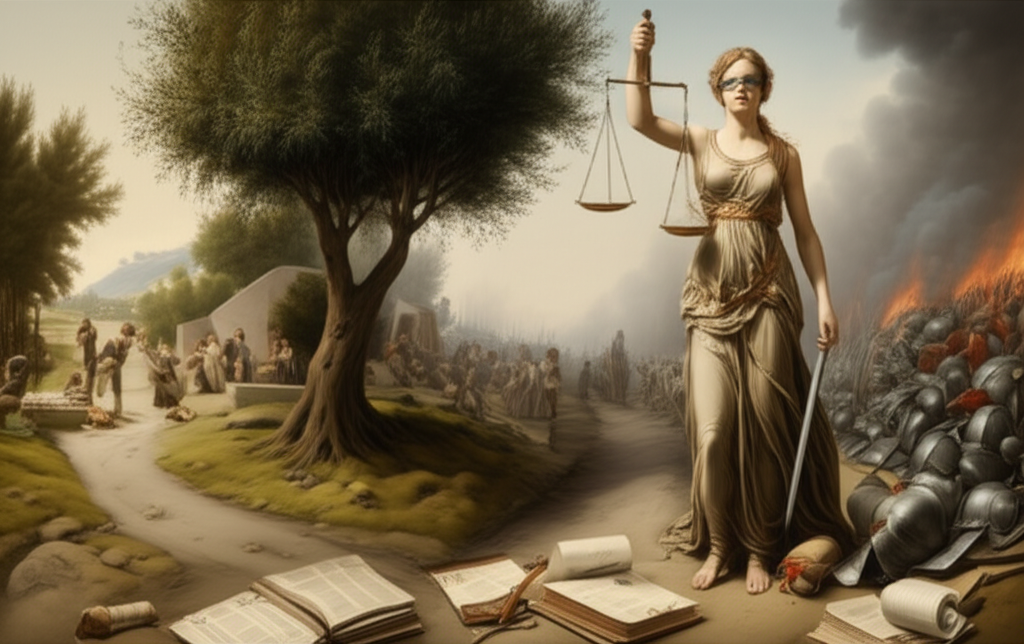
The concept of duty is central to the ethical dimension of War and Peace. For soldiers, duty often means obedience to command, loyalty to comrades, and sacrifice for country. But where does this duty intersect with individual moral conscience?
- Immanuel Kant, a towering figure in ethical philosophy, famously articulated the concept of duty in his Groundwork of the Metaphysics of Morals. For Kant, ethical actions are those performed out of duty, guided by universal moral laws (the categorical imperative). While Kant later argued for "perpetual peace," his emphasis on universal moral law poses a challenge to unquestioning obedience in war. If a command violates a universal moral principle (e.g., targeting civilians), does a soldier's duty to the state override their duty to humanity?
- Leaders, too, face a profound duty. Their duty to protect their citizens, to maintain state sovereignty, and to ensure national security often clashes with the ethical costs of war. Niccolò Machiavelli, in The Prince, presented a starkly different perspective, suggesting that a ruler's primary duty is to maintain power and the state, even if it requires actions considered immoral by conventional standards. For Machiavelli, the ends often justify the means, a view that profoundly challenges traditional ethics and the notion of inherent good and evil in statecraft.
The tension between individual moral autonomy and the demands of collective duty remains one of the most agonizing dilemmas in the ethics of war.
Confronting Good and Evil: The Human Cost
Ultimately, the ethical dimension of War and Peace forces us to confront the nature of Good and Evil. War often presents itself as a struggle between these forces, with each side claiming the moral high ground. But the reality is far more complex.
- The Dehumanization of the "Other": A common tactic in war is to portray the enemy as inherently evil, stripping them of their humanity. This makes violence easier to justify and perpetrate. Philosophers like Jean-Jacques Rousseau, in The Social Contract, suggested that true evil often stems not from individual malice but from corrupting social structures and the state of war itself.
- The Problem of Moral Injury: For those who participate in war, the experience can leave deep moral scars. Actions deemed necessary for survival or victory can violate one's deepest ethical convictions, leading to guilt, shame, and a questioning of one's own sense of good.
- Leo Tolstoy, in his epic novel War and Peace, offers a sweeping examination of human nature, destiny, and the moral chaos of war. He critiques the "great men" theory of history, suggesting that individual choices and the aggregate of small actions drive events, and that the true moral compass often lies with the common person rather than the powerful. His work implicitly asks where good and evil truly reside when the world is consumed by conflict.
Understanding the ethical dimensions of war requires acknowledging the potential for both immense courage and profound depravity, and recognizing that the lines between good and evil can become tragically blurred in the fog of war.
The Philosophical Pursuit of Peace
While war often dominates the discourse, the philosophical quest for peace is equally enduring and vital.
- Kant's "Perpetual Peace": In his essay Perpetual Peace, Kant outlined conditions necessary for a lasting global peace, advocating for republican constitutions, a federation of free states, and universal hospitality. His vision is rooted in the idea that rational beings, recognizing their duty to universal moral law, would eventually choose peace over war.
- The pursuit of peace is not merely the absence of war, but the presence of justice, stability, and mutual respect. It requires active engagement with diplomacy, international law, and the cultivation of understanding across cultures. The ethical dimension of peace demands that we not only cease hostilities but also address the root causes of conflict, uphold human rights, and build robust international institutions designed to prevent future wars.
The philosophical heritage of the Great Books of the Western World consistently reminds us that War and Peace are not just political or military phenomena; they are fundamentally ethical challenges that demand continuous reflection, moral courage, and an unwavering commitment to the ideals of justice and human flourishing.
YouTube Video Suggestions:
-
📹 Related Video: What is Philosophy?
Video by: The School of Life
💡 Want different videos? Search YouTube for: "Just War Theory explained philosophy"
-
📹 Related Video: KANT ON: What is Enlightenment?
Video by: The School of Life
💡 Want different videos? Search YouTube for: "Kant Perpetual Peace philosophy"