

The Unshakable Foundation: Exploring the Principle of Non-Contradiction
The Principle of Non-Contradiction (PNC) stands as one of the most fundamental tenets of logic and reasoning, a bedrock upon which all rational thought is built. Simply put, it asserts that something cannot both be and not be at the same time and in the same respect. It is a principle so ingrained in our understanding of reality that to deny it is to dismantle the very possibility of coherent thought, the pursuit of truth, or even meaningful communication. For centuries, from the ancient Greeks to modern philosophers, this principle has been recognized as indispensable, guiding our efforts to distinguish between what is real and what is impossible, what is true and what is false.
What is the Principle of Non-Contradiction?
At its core, the Principle of Non-Contradiction is a rule of inference and a metaphysical principle that dictates the impossibility of contradictory statements or states of affairs. Formally, it can be stated as:
- A cannot be B and not-B simultaneously.
- A cannot possess a property and the absence of that property at the same time and in the same relationship.
Consider a simple example: a door cannot be both open and closed at the same exact moment and in the same way. It can be partially open, or it can be open now and closed a moment later, but it cannot defy its own state in an instant. This seemingly obvious observation underpins all our attempts at rational discourse and the understanding of reality.
Key Aspects of the Principle
- Universality: It applies across all domains of knowledge and existence.
- Necessity: It is not merely a convention but a necessary condition for intelligibility.
- Self-Evidence: It is often considered a first principle, meaning it cannot be proven by other, more fundamental principles, because it is itself the foundation of all proof.
Historical Roots: Aristotle's Profound Insight
The most celebrated articulation and defense of the Principle of Non-Contradiction comes from Aristotle, particularly in his Metaphysics. Within the pages of the Great Books of the Western World, Aristotle delves into this principle, declaring it to be the "most certain of all principles." He argued that it is impossible for anyone to believe that the same thing can at the same time be and not be, stating:
"The same attribute cannot at the same time belong and not belong to the same subject and in the same respect."
— Aristotle, Metaphysics, Book Gamma, Chapter 3
Aristotle did not merely state the principle; he defended it by demonstrating the absurdity of its denial. He proposed that if one were to reject the PNC, then all statements would be equally true, or equally false, rendering reasoning utterly meaningless. Imagine trying to engage in a debate where "yes" and "no" could simultaneously be correct answers to the same question – communication would collapse. This historical emphasis cemented the PNC as a cornerstone of Western philosophy and logic.
Why Does it Matter? The Foundation of Truth and Reasoning
The significance of the Principle of Non-Contradiction cannot be overstated. It is the very engine that drives our pursuit of truth and the structure that holds our reasoning together.
Implications for Truth and Knowledge
If contradictions were permissible in reality or in our statements about it, then no statement could ever be definitively true or false. If "X is true" and "X is not true" could both hold simultaneously, then the concept of truth itself would dissolve into an incoherent jumble. The PNC allows us to:
- Identify Falsehoods: A statement that leads to a contradiction must be false.
- Establish Coherence: It ensures that our beliefs and propositions form a consistent whole.
- Ground Reality: It suggests that reality itself is structured in a non-contradictory way, at least at the fundamental level of identity.
The Bedrock of Rational Reasoning
Every act of reasoning, from solving a simple puzzle to conducting complex scientific research, implicitly relies on the PNC. Without it, logic would cease to function. Consider the following:
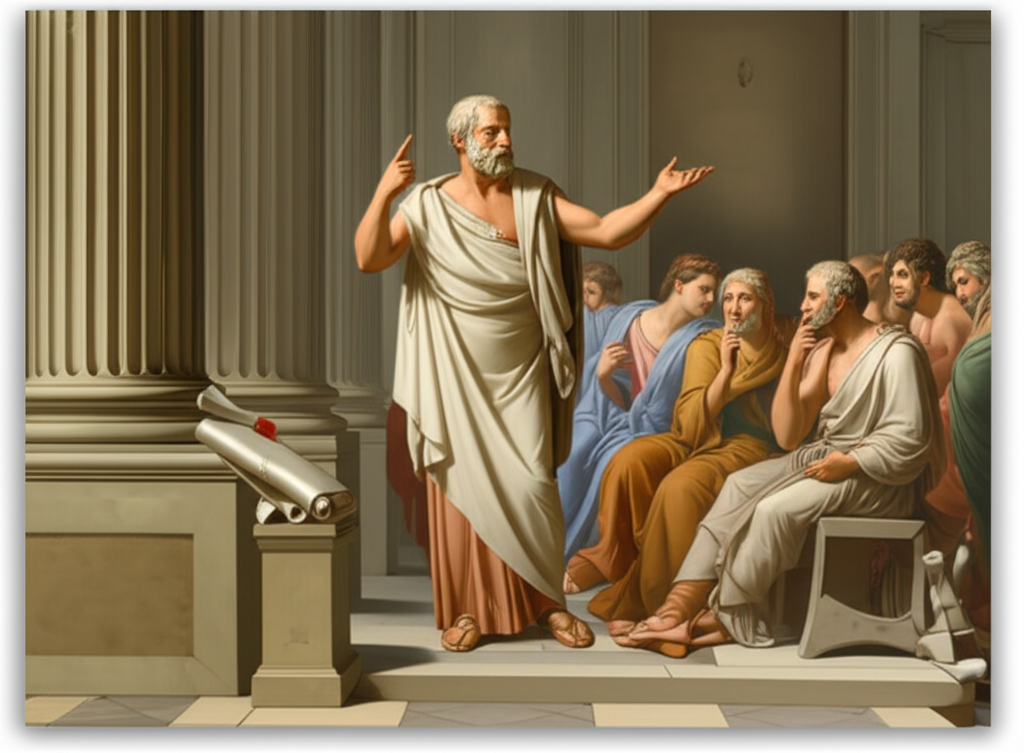
The PNC in Action:
- Argumentation: When we present an argument, we aim to show that our conclusion necessarily follows from our premises, and that opposing views lead to contradictions.
- Problem-Solving: Identifying a contradiction in a proposed solution indicates that the solution is flawed.
- Scientific Method: The process of falsification, where a hypothesis is rejected if it leads to contradictory experimental results, is a direct application of the PNC.
Applications Across Disciplines
The pervasive influence of the Principle of Non-Contradiction is evident across virtually all fields of human inquiry:
| Discipline | Application of PNC |
|---|---|
| Philosophy | Forms the basis for metaphysical realism, epistemology (theory of knowledge), and ethical reasoning. |
| Mathematics | Essential for proving theorems; a mathematical system that leads to a contradiction is considered unsound. |
| Science | Underpins hypothesis testing; contradictory observations invalidate theories. |
| Law | Crucial for establishing guilt or innocence; contradictory testimonies undermine credibility. |
| Everyday Life | Guides our decision-making, problem-solving, and understanding of the world around us. |
The Enduring Principle
While some philosophical traditions, particularly certain dialectical approaches, might appear to challenge the PNC, a closer examination often reveals that they are not denying the principle itself, but rather exploring how things change over time, or how different perspectives can exist simultaneously. The core principle that something cannot be A and not-A at the same time and in the same respect remains inviolable.
The Principle of Non-Contradiction is not merely an abstract philosophical concept; it is a practical necessity for navigating reality and constructing coherent thought. It is the silent guardian of truth, the unwavering guide of logic, and the fundamental principle that allows us to reason, understand, and communicate. As Daniel Sanderson, I posit that embracing this principle is not a limitation on thought, but rather the liberation of thought, allowing us to build robust frameworks for knowledge and understanding.
YouTube: "Aristotle Principle of Non-Contradiction Explained"
YouTube: "Why Contradictions are Impossible - Logic and Truth"
📹 Related Video: What is Philosophy?
Video by: The School of Life
💡 Want different videos? Search YouTube for: "The Principle of Non-Contradiction philosophy"