

The Enduring Enigma: Unpacking the Physics of Space and Time
The concepts of space and time are not merely backdrops against which the universe unfolds; they are fundamental constituents of reality, profoundly shaping our understanding of existence. This article delves into how physics, from classical mechanics to modern relativity and quantum theory, has continually redefined these concepts, compelling philosophy to re-evaluate its most cherished assumptions. We will explore how our understanding has evolved from intuitive, absolute notions to the complex, interwoven fabric of spacetime, emphasizing the profound philosophical implications of this scientific journey and the role of quantity in measuring and conceptualizing these ultimate dimensions.
The Philosophical Foundations of Our Cosmos
For millennia, thinkers have grappled with the nature of space and time. Is space an empty container, or is it defined by the objects within it? Is time an unyielding river, flowing uniformly and independently, or is it a subjective experience, malleable and intertwined with events? These questions, central to the Great Books of the Western World, laid the groundwork for scientific inquiry. Philosophers like Aristotle pondered the nature of "place" as the inner boundary of a surrounding body, and time as the "number of motion in respect of 'before' and 'after'". Plato, in his Timaeus, introduced the concept of a "receptacle" – a formless medium that receives all forms, hinting at a spatial substratum.
Classical physics, most famously articulated by Isaac Newton, inherited and solidified an absolute view. For Newton, Space was an infinite, immutable, and independent entity, a divine sensorium. Time was equally absolute, flowing uniformly without regard to anything external. Both were considered fundamental quantities, measurable and universal, providing the fixed stage upon which all physical events occurred.
The Revolution of Modern Physics: Space, Time, and Quantity Reimagined
The dawn of the 20th century shattered these classical certainties, ushering in a new era where physics radically reshaped our perception of reality.
Einstein's Relativity: A Unified Fabric
Albert Einstein's theories of relativity fundamentally altered our understanding of space and time.
-
Special Relativity (1905): This theory revealed that space and time are not absolute but relative to the observer's motion. The speed of light is constant for all observers, leading to astonishing consequences:
- Time Dilation: Time passes more slowly for objects in motion relative to a stationary observer.
- Length Contraction: Objects appear shorter in their direction of motion.
- Spacetime: Einstein unified space and time into a single, four-dimensional continuum known as spacetime. Events are not merely located in space and time but within this inseparable fabric. The quantity of time or space measured depends on the observer's frame of reference.
-
General Relativity (1915): This expanded on special relativity by incorporating gravity. Einstein proposed that gravity is not a force acting at a distance, but a manifestation of the curvature of spacetime caused by mass and energy. Massive objects, like planets and stars, warp the spacetime around them, and other objects (and light itself) follow these curves. This profound insight demonstrated that space and time are not passive backdrops but dynamic participants in the universe's unfolding, their geometry directly influenced by the matter and energy within them.
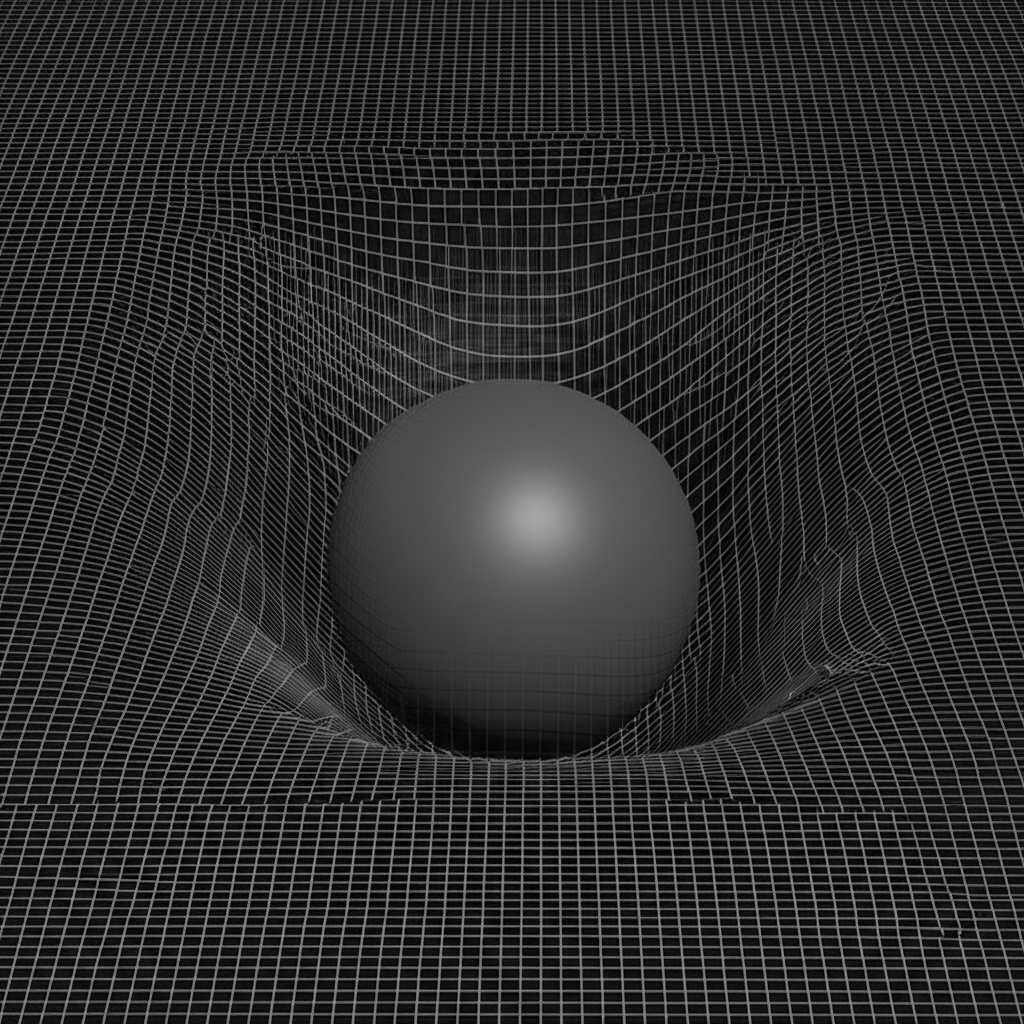 visibly warping or indenting the grid, showing the curvature of spacetime. Smaller objects or light rays are shown following the curved paths around the mass, illustrating gravitational lensing or orbital motion.)
Quantum Mechanics: Further Mysteries
While general relativity describes the macroscopic universe, quantum mechanics governs the microscopic realm. Here, the concepts of space and time become even more enigmatic. At the quantum level, position and momentum cannot be simultaneously known with perfect precision (Heisenberg's Uncertainty Principle), and particles can exist in multiple places at once until observed. The very notion of a continuous, well-defined trajectory through space and time breaks down. Some theories even suggest that space and time might be emergent properties, arising from more fundamental, non-spatial, non-temporal entities, rather than being foundational. The discrete quantities and probabilistic nature of quantum reality challenge our deepest intuitions about the continuous nature of the cosmos.
Philosophical Implications of Modern Physics
The scientific revolutions in physics have ignited a new wave of philosophical inquiry, forcing us to confront profound questions:
- The Reality of Time: If time is relative, does a universal "present" exist? Is the past truly gone, and the future not yet real, or do all moments exist simultaneously within the spacetime block? This challenges classical notions of free will and determinism.
- The Nature of Space: Is space truly empty, or is it a dynamic field with its own properties? If space can expand and curve, what is it expanding into? The concept of a vacuum is far from empty in modern physics, teeming with virtual particles and fields.
- The Observer's Role: In quantum mechanics, the act of observation seems to influence reality. Does consciousness play a role in shaping space and time, or is this merely an interpretational challenge?
- The Limits of Quantity: While physics relies heavily on measuring quantities of space and time, the fundamental nature of these concepts often transcends simple measurement. What does it mean for space to have "three dimensions" or for time to have an "arrow" pointing forward, if these are relative constructs?
Key Shifts in Understanding Space and Time:
| Feature | Classical View (Newtonian) | Modern View (Einsteinian/Quantum) |
|---|---|---|
| Space | Absolute, infinite, unchanging container | Relative, dynamic, curved by mass-energy, part of spacetime |
| Time | Absolute, uniform flow, independent of events | Relative, dependent on motion and gravity, part of spacetime |
| Relationship | Separate, independent dimensions | Unified as spacetime, interwoven and interdependent |
| Gravity | A force acting across space | Manifestation of spacetime curvature |
| Fundamental? | Yes, foundational quantities | Potentially emergent, problematic at quantum scales |
The Human Experience and the Cosmic Dance
Despite the abstract complexities of modern physics, our lived experience of space and time remains largely classical. We navigate a seemingly three-dimensional world through a linear progression of moments. Yet, the deep philosophical insight offered by physics is that this intuitive experience is but one facet of a far more intricate reality. Understanding the physics of space and time compels us to ponder not just the universe out there, but also the very structure of our perception and consciousness. It is a journey from the observable quantity to the unobservable essence, bridging the gap between scientific measurement and profound philosophical wonder.
Conclusion: An Ongoing Dialogue
The dialogue between physics and philosophy regarding space and time is far from over. Each scientific discovery opens new avenues for philosophical exploration, challenging old paradigms and demanding new conceptual frameworks. From the ancient Greek contemplation of quantity and dimension to Einstein's revolutionary spacetime and the quantum realm's mysteries, our understanding of these fundamental aspects of existence continues to evolve. The journey reveals that space and time are not simple, fixed entities, but rather dynamic, interconnected, and profoundly mysterious components of the cosmos, inviting endless inquiry and wonder from both the scientist and the philosopher.
YouTube Video Suggestions:
-
📹 Related Video: KANT ON: What is Enlightenment?
Video by: The School of Life
💡 Want different videos? Search YouTube for: ""Brian Greene The Fabric of the Cosmos Spacetime""
2. ## 📹 Related Video: KANT ON: What is Enlightenment?
Video by: The School of Life
💡 Want different videos? Search YouTube for: ""Sean Carroll The Nature of Time""