

The Enduring Opposition: Good and Evil in the World
The human experience is inextricably linked to a fundamental duality: the Opposition of Good and Evil. From ancient myths to modern ethics, this tension defines our moral landscapes, shapes our societies, and challenges our understanding of Being in the World. This article explores the philosophical interpretations of this profound struggle, drawing upon the rich tapestry of thought found within the Great Books of the Western World, seeking to understand whether evil is an active force, a mere absence, or a necessary counterpoint to good.
Unpacking the Dualism: Ancient Roots and Enduring Questions
The concept of opposing forces, one benevolent and one malevolent, is not new. It is a perennial theme that has occupied the greatest minds throughout history. Is evil a fundamental part of the cosmos, or is it a human construct, a flaw in our perception or our will?
Early Philosophical Inquiries into Goodness
In the classical Greek tradition, the pursuit of Good was often seen as the ultimate aim of human life.
- Plato, in works like The Republic, posited the "Form of the Good" as the highest reality, illuminating all other Forms and making knowledge possible. Evil, in this view, could be understood as a departure from this ultimate Good, a shadow cast by ignorance or imperfection. The cave allegory powerfully illustrates this: turning away from the light (knowledge of the Good) leads to a life of shadows and misunderstanding.
- Aristotle, in his Nicomachean Ethics, focused on eudaimonia (flourishing or living well) as the supreme Good, achieved through virtuous action. Evil, then, becomes a deviation from the mean, an excess or deficiency in character that prevents one from realizing their full potential as a rational Being.
The Monotheistic Perspective: Evil as Privation
With the rise of monotheistic thought, particularly as articulated by St. Augustine in Confessions and The City of God, the nature of evil took on a new dimension. If God is all-good and created everything, how can evil exist? Augustine famously argued that evil is not a substance or a positive Being, but rather a privation of good – an absence or corruption of what should be.
This perspective offers a powerful solution to the problem of evil:
- Evil is not created by God: Since it's a lack, it doesn't require a divine creator.
- It arises from free will: Human beings, endowed with the capacity for choice, can choose to turn away from the Good, leading to moral evil.
- Natural evil: Illness, decay, and disaster are seen as imperfections in a fallen World, or simply the absence of certain goods (e.g., health, order).
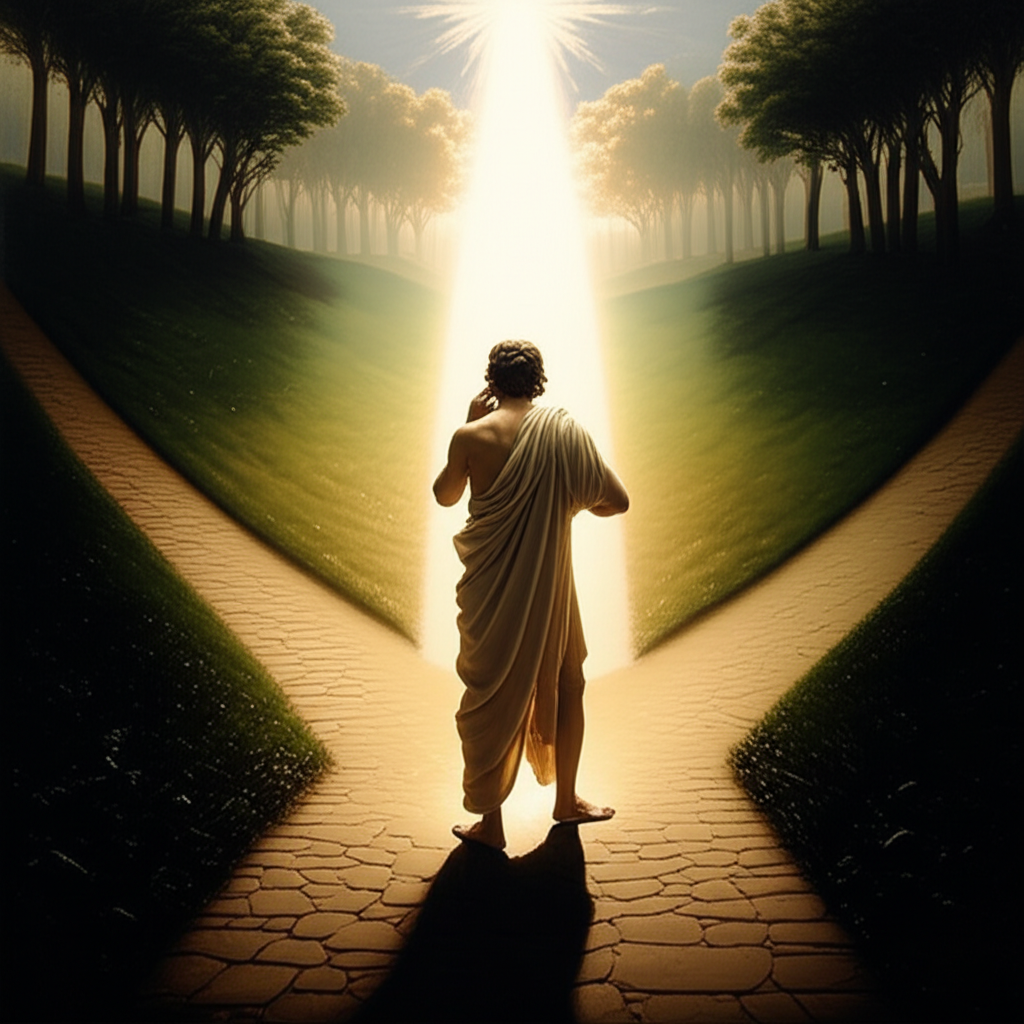
The Modern Dilemma: Good, Evil, and Human Agency
As philosophy moved into the Enlightenment and beyond, the focus shifted, often placing greater emphasis on human reason and autonomy in defining Good and Evil.
Kant and the Moral Imperative
Immanuel Kant, in his Groundwork of the Metaphysics of Morals, centered the concept of Good on duty and the "good will." For Kant, an action is morally good not because of its consequences, but because it is done from a sense of duty, in accordance with a universalizable moral law (the Categorical Imperative). Evil, in this framework, arises from acting against duty, from self-interest, or from using others as mere means to an end, rather than as ends in themselves. It is a failure of rational Being to adhere to universal moral principles.
Nietzsche's Revaluation of Values
A radical departure from traditional views came with Friedrich Nietzsche, particularly in Beyond Good and Evil and On the Genealogy of Morality. Nietzsche challenged the very definitions of Good and Evil, arguing that they are not objective truths but rather historical constructs born from power dynamics. He distinguished between:
| Concept | Master Morality (Noble) | Slave Morality (Ressentiment) |
|---|---|---|
| Origin | Created by the strong, the "masters" | Created by the weak, the "slaves" |
| "Good" Defined | Noble, strong, proud, powerful | Kind, humble, compassionate, suffering |
| "Evil" Defined | Base, weak, common, plebeian | Arrogant, cruel, powerful (the "master" is recast as evil) |
| Driving Force | Self-affirmation, will to power | Ressentiment, revenge against the powerful |
Nietzsche's work forces us to question the inherent nature of Good and Evil, suggesting that what we label as such might be culturally and historically contingent, a product of human interpretation rather than an absolute Opposition.
The Dynamic in the World: A Perpetual Struggle
The Opposition of Good and Evil is not merely an abstract philosophical concept; it plays out constantly in the concrete reality of the World. It is evident in:
- Individual moral choices: The daily decisions we make, from small acts of kindness to significant ethical dilemmas.
- Societal structures: Justice systems, laws, and cultural norms that attempt to curb evil and promote good.
- Historical conflicts: Wars, genocides, and movements for liberation all reflect clashes between perceived good and evil.
- The human condition: Our internal struggles with temptation, altruism, self-interest, and empathy.
Understanding this Opposition is crucial for navigating our existence. It compels us to define what we value, what principles we uphold, and what kind of Being we aspire to be in a complex and often contradictory World. Whether evil is a void, a choice, or a revaluation, its presence undeniably shapes the landscape of human experience and continues to demand our philosophical inquiry.
YouTube Video Suggestions:
-
📹 Related Video: PLATO ON: The Allegory of the Cave
Video by: The School of Life
💡 Want different videos? Search YouTube for: ""Plato Form of the Good Explained" for a visual explanation of Plato's metaphysics and ethics."
2. ## 📹 Related Video: KANT ON: What is Enlightenment?
Video by: The School of Life
💡 Want different videos? Search YouTube for: ""Nietzsche On the Genealogy of Morality Summary" to understand his critique of traditional good and evil."