

The Indispensable Path: The Necessity of Education for Knowledge
Education is not merely a desirable enhancement but a fundamental necessity for the acquisition and cultivation of genuine knowledge. Without structured inquiry, critical engagement, and the transmission of accumulated wisdom, the human mind remains largely tethered to fleeting perceptions and unexamined beliefs. This article explores how education, in its broadest sense, moves us beyond mere contingency to a necessary engagement with the world, shaping the mind and unlocking the profound depths of understanding.
The Inescapable Link Between Education and Knowledge
From the earliest philosophical inquiries, thinkers have grappled with the nature of knowledge itself. Is knowledge innate, acquired, or a blend of both? Regardless of one's stance on its origins, the consensus across centuries of thought, particularly evident in the Great Books of the Western World, points to education as the indispensable process through which potential knowing becomes actual knowledge. It is the crucible where raw intellectual capacity is forged into understanding, where observation transforms into insight, and where belief evolves into reasoned conviction. The journey from ignorance to enlightenment is, by its very nature, an educational one.
Defining the Terms: Education, Knowledge, and the Mind's Potential
To fully appreciate the necessity of education, we must first clarify our terms:
- Education: More than just schooling, education encompasses any process of teaching and learning that systematically cultivates the intellect, character, and skills. It involves the acquisition of information, the development of critical thinking, the assimilation of cultural heritage, and the refinement of judgment.
- Knowledge: This refers to justified true belief, as famously defined in Plato's Theaetetus. It is distinct from mere opinion or belief because it is supported by reason, evidence, or experience, and it aims at truth. Knowledge is structured, interconnected, and often built upon prior understandings.
- Mind: The faculty of consciousness and thought, responsible for perception, emotion, will, memory, and imagination. The mind is not a passive receptacle but an active instrument, shaped and refined by its experiences and, crucially, by education.
The potential for knowledge resides within the mind, but it is through education that this potential is actualized. Without the guidance and tools provided by education, the mind, much like a fertile field without cultivation, may yield only weeds instead of bountiful harvests of understanding.
The Necessity of Education: A Philosophical Inquiry
The question of whether education is necessary or merely contingent for knowledge lies at the heart of this discussion. Something is necessary if it cannot be otherwise; its absence makes the desired outcome impossible. Something is contingent if it happens to be the case but could have been otherwise.
While a raw, uneducated mind might stumble upon isolated facts or intuitive understandings, true, systematic, and justifiable knowledge—the kind that allows for prediction, explanation, and ethical action—is arguably impossible without education.
-
Beyond Innate Ideas: The Shaping of the Intellect
Philosophers like John Locke, in his An Essay Concerning Human Understanding, famously argued for the concept of tabula rasa—the mind as a blank slate at birth. For Locke, all knowledge is ultimately derived from experience, processed by the mind. If the mind truly begins as a blank slate, then systematic experience, guided and interpreted through education, becomes absolutely necessary to inscribe meaningful knowledge upon it. Without education, experiences remain fragmented and uninterpreted.Even for those who posit some form of innate ideas or structures, like Plato's theory of Forms or Kant's a priori categories of understanding, education plays a crucial role. For Plato, education (through the dialectic, as depicted in the Republic) is essential to recollect these eternal Forms and to lead the soul out of the "cave" of illusion into the light of true reality. For Kant, education is necessary to develop the rational faculties that apply our innate categories to empirical experience, thereby forming coherent knowledge. The innate potential requires cultivation to flourish.
Methods and Modalities of Knowledge Acquisition
Education facilitates the acquisition of knowledge through various indispensable mechanisms:
- Transmission of Accumulated Wisdom: Education is the primary vehicle for passing down the vast corpus of human knowledge—scientific discoveries, historical narratives, philosophical insights, ethical frameworks—from one generation to the next. Without this transmission, each individual would have to rediscover fundamental truths, an impossible and inefficient task.
- Development of Critical Thinking: Through logic, rhetoric, and dialectic (methods championed by Aristotle and Plato), education trains the mind to analyze, evaluate, synthesize, and construct arguments. This critical faculty is essential for distinguishing true knowledge from falsehood or mere opinion.
- Cultivation of Intellectual Virtues: Education fosters intellectual virtues such as curiosity, intellectual humility, perseverance, and intellectual courage—qualities necessary for the pursuit of knowledge.
- Exposure to Diverse Perspectives: By engaging with different ideas and cultures, education broadens the mind's horizons, allowing for a more nuanced and comprehensive understanding of complex issues.
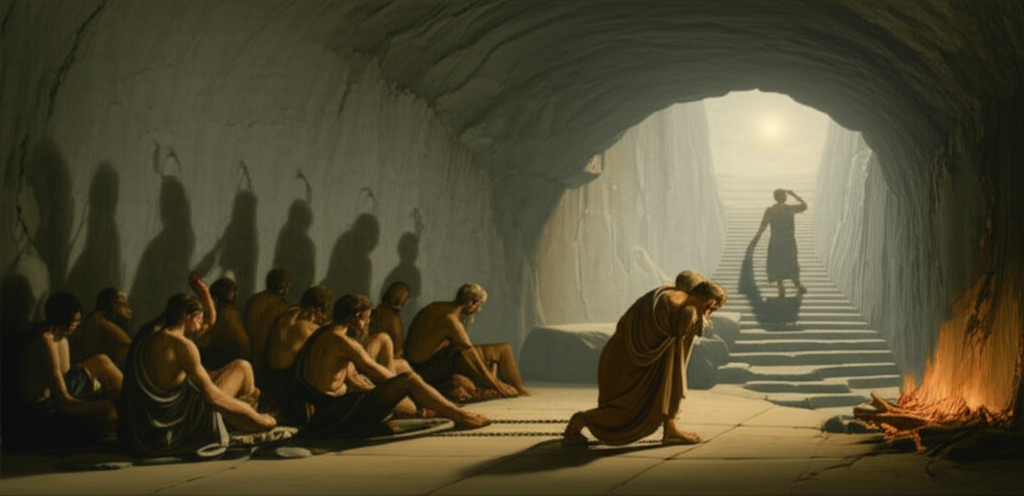
The Great Books as a Foundation for Necessary Knowledge
The Great Books of the Western World stand as a testament to the enduring necessity of education. Engaging with these foundational texts is, in itself, a profound educational experience. They offer:
- Primary Source Engagement: Direct interaction with the minds of history's greatest thinkers, rather than secondary interpretations.
- Conceptual Frameworks: Exposure to the fundamental questions and conceptual tools that have shaped human thought (e.g., Aristotle's categories, Descartes' method of doubt, Kant's moral imperative).
- Interdisciplinary Connections: The opportunity to see how philosophy, science, literature, and history are interconnected, fostering a holistic understanding of knowledge.
Through the rigorous study of these works, the mind is not just informed but transformed. It learns to reason, question, synthesize, and articulate, thereby becoming equipped to acquire and generate new knowledge in a truly meaningful way.
Conclusion: An Enduring Truth
The journey to knowledge is not a passive reception but an active, arduous, and fundamentally educational endeavor. While the mind possesses an innate capacity for understanding, it is education that provides the structure, the tools, and the accumulated wisdom necessary for that capacity to fully blossom. From the Socratic method to modern pedagogy, the consistent message throughout philosophical history is clear: education is not merely beneficial; it is the indispensable pathway to genuine knowledge, shaping the mind into an instrument capable of perceiving, understanding, and engaging with the truths of the world.
**## 📹 Related Video: PLATO ON: The Allegory of the Cave
Video by: The School of Life
💡 Want different videos? Search YouTube for: ""Plato's Allegory of the Cave explained by philosophers""**
**## 📹 Related Video: ARISTOTLE ON: The Nicomachean Ethics
Video by: The School of Life
💡 Want different videos? Search YouTube for: ""John Locke Tabula Rasa and Empiricism""**