

The Unyielding Spirit: Courage as the Bedrock of Liberty
A Foundation Forged in Fortitude
Liberty, that cherished ideal of self-determination and freedom from arbitrary constraint, is often discussed in terms of rights, laws, and societal structures. Yet, beneath these visible frameworks lies a less tangible, but no less crucial, foundation: courage. This article argues that courage is not merely an admirable trait, but a necessity for both the establishment and sustained flourishing of liberty. Without the individual and collective fortitude to confront challenges, resist oppression, and uphold principles, the grand edifice of freedom crumbles, leaving us vulnerable to the whims of power and the erosion of our most fundamental rights.
Courage: Beyond the Battlefield
When we speak of courage, our minds often conjure images of heroic acts on a battlefield or daring rescues. While these are certainly manifestations of bravery, the courage essential for liberty is far more nuanced and pervasive. It encompasses:
- Moral Courage: The strength to stand by one's convictions, even when unpopular or costly. This includes speaking truth to power, defending the vulnerable, and resisting unethical demands.
- Intellectual Courage: The willingness to question established norms, challenge prevailing dogmas, and pursue truth, even when it leads to uncomfortable conclusions. It's the courage to think critically and independently.
- Civic Courage: The readiness to participate actively in the public sphere, to engage in debate, to vote, protest, and organize, understanding that a free society demands active stewardship from its citizens.
As philosophers from the Great Books of the Western World have shown, courage (or andreia in Greek) is not merely the absence of fear, but the intelligent confrontation of fear for the sake of a greater good. Aristotle, in his Nicomachean Ethics, positions courage as a mean between rashness and cowardice, a virtue that enables us to act appropriately in the face of danger. Plato, in The Republic, identifies courage as the virtue of the "spirited" part of the soul, enabling it to uphold the dictates of reason against the pull of desires and fears.
Liberty: A Delicate Balance Maintained by Resolve
Liberty is rarely a static achievement; it is a continuous process of safeguarding and expansion. It exists in a dynamic tension with the State, which, while ideally designed to protect individual freedoms, also possesses the power to curtail them.
Consider the two primary facets of liberty:
- Negative Liberty: Freedom from external interference, such as arbitrary arrest, censorship, or coercion by the State or other individuals. This concept is central to thinkers like John Locke, who argued for natural rights that precede government.
- Positive Liberty: Freedom to achieve one's potential, to participate in self-governance, and to have the means and opportunities to act. This often involves the State providing certain conditions or resources.
Both forms of liberty require courage. Negative liberty demands the courage to resist encroachment, to say "no" to overreach. Positive liberty requires the courage to engage, to take responsibility, and to shape one's own destiny and the destiny of the community.
The Interplay of Necessity and Contingency
The relationship between courage and liberty is deeply embedded in the philosophical concepts of Necessity and Contingency.
- Necessity: There is a fundamental, almost inherent, human yearning for freedom. This desire can be seen as a necessity of the human spirit, a condition for genuine flourishing. Furthermore, certain actions are necessary to secure liberty – for example, the necessity of establishing a rule of law, or the necessity of citizens to hold their leaders accountable.
- Contingency: The threats to liberty, however, are often contingent. They arise from specific historical circumstances, the actions of particular individuals, economic shifts, or unforeseen crises. No society is permanently immune to the erosion of freedom.
It is precisely this interplay that makes courage indispensable. While the desire for freedom might be a necessity, and certain structural elements are necessary for a free society, the maintenance of that freedom against contingent threats demands a constant, courageous vigilance. When unforeseen challenges arise – be it a charismatic demagogue, an economic crisis used to justify authoritarian measures, or a subtle erosion of rights – courageous individuals and groups must step forward.
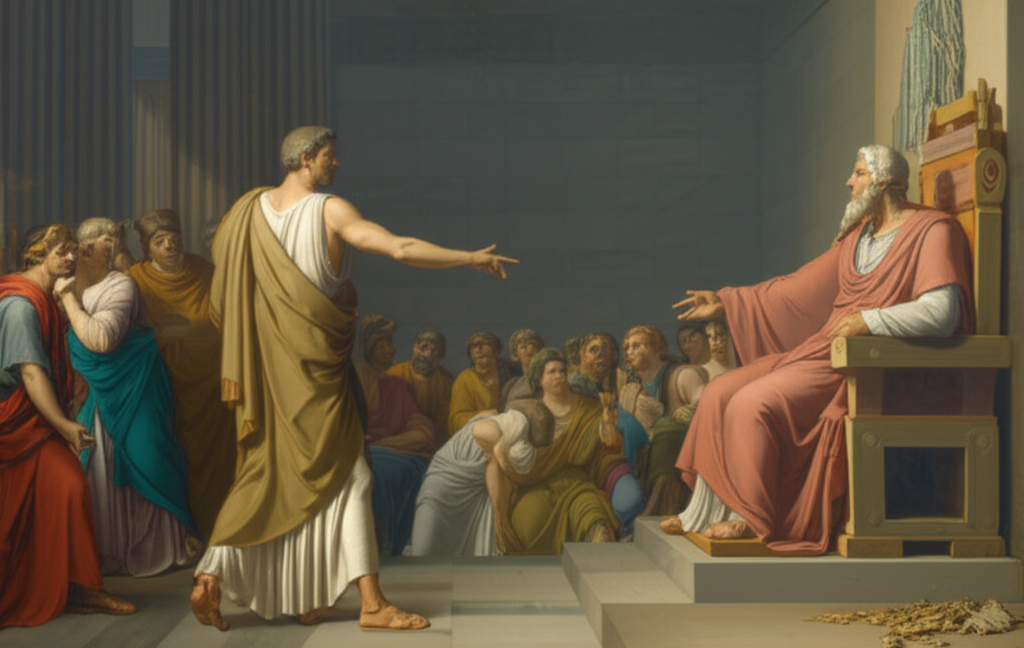
Courage Against the State: A Historical Imperative
History, particularly as chronicled in the Great Books, is replete with examples of individuals who demonstrated extraordinary courage in confronting the State or powerful interests to preserve or expand liberty.
| Historical Figure/Concept | Source (Great Books) | Act of Courage for Liberty |
|---|---|---|
| Socrates | Plato's Apology | Defied the Athenian jury rather than renounce his philosophical pursuit, choosing death over silence. |
| Magna Carta Barons | (Historical context) | Challenged King John's absolute power, laying groundwork for constitutional limits on monarchy. |
| John Locke's ideas | Two Treatises | Argued for the right of the people to resist tyrannical government that violates natural rights. |
| John Stuart Mill | On Liberty | Championed freedom of thought and expression against both state and societal oppression. |
These instances highlight that the State, while a necessary institution, also represents the most potent concentration of power. Courage is required not only to establish a just State but continually to hold it accountable, to challenge its overreach, and to ensure it remains a servant of the people, not their master. This includes:
- Courage to Dissent: To voice opposition, even when it means facing social ostracization, economic hardship, or legal repercussions.
- Courage to Organize: To band together with others, forming movements and institutions that can collectively resist oppressive forces.
- Courage to Uphold the Law: To insist on due process, fair trials, and the impartial application of justice, even when it is inconvenient or unpopular.
Cultivating the Courageous Citizen
If courage is indeed a necessity for liberty, then its cultivation becomes a paramount civic duty. This is not about training soldiers, but fostering citizens capable of moral and intellectual resilience.
- Education: A robust education that emphasizes critical thinking, historical understanding, and ethical reasoning prepares individuals to identify threats to liberty and empowers them to act. Studying the Great Books offers a timeless curriculum in this regard, exposing readers to diverse perspectives on justice, freedom, and human nature.
- Civic Engagement: Active participation in democratic processes, community service, and open dialogue strengthens the muscles of civic courage. It teaches individuals that their voice matters and that collective action can effect change.
- Moral Exemplars: Highlighting and celebrating individuals who have demonstrated courage in defense of liberty provides inspiration and a moral compass for future generations.
Conclusion: The Enduring Flame of Freedom
In an ever-changing world, the challenges to liberty are constant and multifaceted. From the insidious creep of surveillance to the overt displays of authoritarianism, freedom is always under threat. It is the necessity of courage – that unwavering spirit to uphold what is right, to speak truth, and to act in the face of fear – that ensures liberty remains not just an abstract ideal, but a lived reality. Without brave individuals willing to stand guard, to push back against injustice, and to participate actively in their own governance, the flame of freedom, no matter how brightly it burns, risks being extinguished by the winds of contingency. Courage, then, is not merely a virtue; it is the very breath of a free society.
YouTube: "Courage in Philosophy" "Plato's Republic Courage"
YouTube: "Liberty John Locke" "What is Negative and Positive Liberty"
📹 Related Video: What is Philosophy?
Video by: The School of Life
💡 Want different videos? Search YouTube for: "The Necessity of Courage for Liberty philosophy"