

The Unfolding Tapestry: The Necessity of Change in History
History is often perceived as a chronicle of events, a sequence of occurrences that happened. Yet, beneath this surface narrative lies a profound philosophical truth: change is not merely incidental to history, but its very necessity. From the ancient recognition of an ever-flowing world to modern dialectical theories, the continuous transformation of societies, ideas, and structures stands as an inescapable imperative. This article explores how necessity and contingency conspire to drive the relentless march of change, shaping the human story and underscoring its dynamic, rather than static, nature.
The Ever-Flowing River: Heraclitus's Enduring Insight
Long before the intricate historical analyses of later philosophers, the foundational insight into the necessity of change was articulated by the pre-Socratic philosopher Heraclitus. His famous dictum, "No man ever steps in the same river twice, for it's not the same river and he's not the same man," captures the essence of a world in perpetual flux. This isn't just about superficial alterations; it's about the inherent nature of existence itself.
- Panta Rhei (Everything Flows): This Heraclitean concept asserts that stability is an illusion, and that all things are in a constant state of becoming. The world is not a fixed entity but a dynamic process, a continuous unfolding.
- The Unity of Opposites: Change, for Heraclitus, often arose from the tension and interplay of opposing forces – war and peace, hot and cold, day and night. This inherent conflict is not destructive but constitutive of reality, driving continuous change.
This ancient wisdom from the Great Books of the Western World tradition reminds us that the fundamental philosophical starting point for understanding history must be the acknowledgment of its ceaseless motion.
Necessity and Contingency: The Engines of Historical Evolution
To speak of the necessity of change is not to deny the role of contingency – the accidental, the unpredictable, the "what if." Instead, history unfolds through a complex interplay where certain forces exert a necessary push, while specific outcomes can be shaped by contingent events.
-
Necessity in History: These are the deep-seated, structural forces that make certain transformations inevitable or highly probable. They include:
- Technological Innovation: The invention of the printing press, the steam engine, or the internet necessarily reshaped communication, economy, and social structures. Once a technological threshold is crossed, its societal implications are largely unavoidable.
- Demographic Shifts: Population growth, migration patterns, or aging societies exert necessary pressures on resources, governance, and cultural norms.
- Economic Structures: The inherent contradictions or evolutionary stages within economic systems (e.g., feudalism to capitalism) often drive necessary transformations.
- Environmental Pressures: Climate change, resource depletion, or natural disasters compel societies to adapt or perish, leading to necessary reconfigurations.
-
Contingency in History: While the necessity of change is constant, its specific manifestations are often influenced by contingent factors. These are the specific choices, chance occurrences, or individual actions that could have gone differently:
- A leader's decision during a crisis.
- The outcome of a single battle.
- A sudden natural phenomenon.
- The specific timing of a discovery.
The necessity of change ensures that the river always flows, but contingency determines the specific eddies, rapids, and turns it takes along its course through the world.
Dialectical Progress and the March of Ideas
Philosophers like Hegel and Marx, deeply rooted in the Great Books of the Western World canon, articulated sophisticated theories where change was not only necessary but often directional, driven by inherent contradictions or evolving ideas.
- Hegel's Dialectic: For Hegel, history is the unfolding of the Absolute Spirit, a process of ideas (thesis) clashing with opposing ideas (antithesis), leading to a new synthesis. This intellectual and spiritual change is necessary for the realization of freedom and self-consciousness. Each stage is a necessary progression, building upon the last.
- Marx's Historical Materialism: Marx viewed history as a series of class struggles, driven by the necessary evolution of economic modes of production. The internal contradictions within a mode of production necessarily lead to its overthrow and replacement by a new one, culminating in revolutionary social change.
Both frameworks, despite their differences, emphasize that change is not arbitrary but follows a discernible, often necessary, pattern, pushing societies and the world through distinct phases.
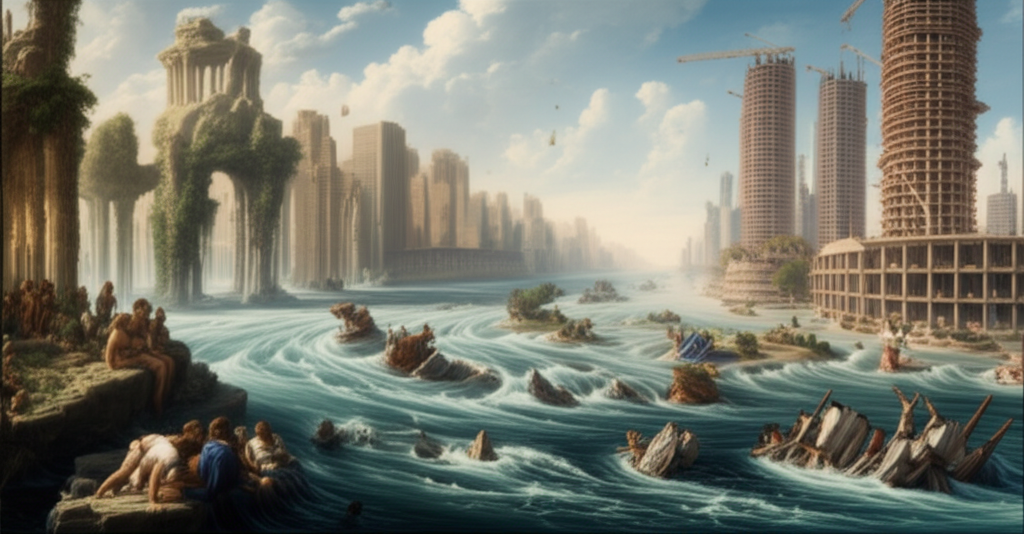
The Human Condition and the Imperative to Adapt
Beyond grand philosophical schemes, the necessity of change deeply impacts the human condition. Societies and individuals are constantly confronted with the imperative to adapt. Resistance to change often leads to stagnation or decline, while embracing it, however challenging, is crucial for survival and flourishing within the evolving world.
- Evolution of Institutions: Political systems, legal frameworks, and social norms necessarily evolve to meet new challenges posed by technological advances, demographic shifts, or global interactions.
- Re-evaluation of Values: What was once sacrosanct often undergoes scrutiny and change as societies develop new ethical understandings or face unprecedented dilemmas.
- Knowledge and Progress: The accumulation of knowledge and understanding necessarily leads to the questioning of old paradigms and the development of new ones, driving intellectual change.
The necessity of change is thus not merely an external force but an internal dynamic woven into the fabric of human existence, compelling constant re-evaluation and adaptation.
In conclusion, the notion that history is a static record of fixed events is a profound misreading of its very nature. From Heraclitus's ancient river to the dialectical machinations of modern thought, change emerges not as an occasional visitor but as the very necessity that animates the world. Driven by a complex interplay of deep structural forces (necessity) and specific unfolding events (contingency), history is a relentless process of becoming. To understand history is to understand change, to recognize its inevitability, and to engage philosophically with its ceaseless unfolding.
YouTube Video Suggestions:
-
📹 Related Video: What is Philosophy?
Video by: The School of Life
💡 Want different videos? Search YouTube for: "Heraclitus Philosophy of Change Explained"
-
📹 Related Video: ARISTOTLE ON: The Nicomachean Ethics
Video by: The School of Life
💡 Want different videos? Search YouTube for: "Hegel's Dialectic Explained History Necessity"