

The Enduring Enigma of Form (Eidos) in Metaphysics
The concept of Form, or Eidos, stands as a cornerstone in the grand edifice of metaphysics, profoundly shaping our understanding of reality, knowledge, and existence itself. At its heart, it grapples with the fundamental distinction between the fleeting, imperfect world we perceive through our senses and an underlying, perfect, and unchanging reality. This article delves into the Platonic Idea of Form, exploring its implications for the relationship between universal and particular entities, and its enduring legacy in philosophical thought, drawing insight from the Great Books of the Western World.
Plato's Realm of Perfect Archetypes
For Plato, the world we inhabit is but a pale imitation of a more fundamental reality. He posited the existence of eternal, non-physical, and perfect Forms (or Ideas) that exist independently of the sensory world. These Forms are not mere mental constructs but objective blueprints for everything that exists. For instance, while we encounter many beautiful things – a flower, a song, a person – none of them embody perfect beauty. Plato argued that true beauty resides in the Form of Beauty itself, an unchanging, absolute standard against which all particular beautiful things are measured.
Key Characteristics of Platonic Forms:
- Eternal: They exist outside of time, having no beginning or end.
- Unchanging: They are immutable; the Form of Justice is always just, never becoming unjust.
- Perfect: They represent the ultimate, ideal instantiation of a quality or object.
- Non-physical: They exist in a separate, intelligible realm, not accessible through the senses.
- Archetypal: They serve as the perfect models for all particular things in the sensible world.
Beyond the Cave: Seeing the True "Idea"
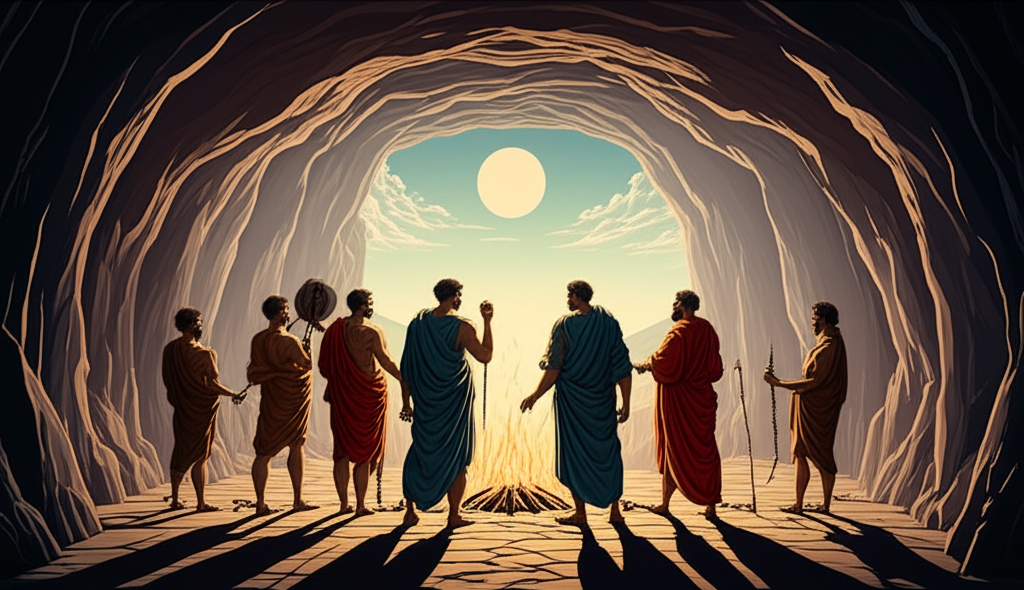
Plato's famous Allegory of the Cave vividly illustrates this distinction. The prisoners, chained and facing shadows, represent humanity confined to the world of sensory experience, mistaking appearances for reality. The journey out of the cave, towards the blinding light of the sun, symbolizes the ascent of the soul to grasp the Forms – the true Ideas – through philosophical contemplation and reason. It's a journey from ignorance to true knowledge, from the particular to the universal.
Metaphysics and the Structure of Reality
The Idea of Form is deeply metaphysical because it addresses the ultimate nature of reality. It proposes a dualistic cosmos: the intelligible realm of Forms (reality proper) and the sensible realm of particulars (mere appearances). This framework provided Plato with solutions to several philosophical dilemmas:
- Epistemology (Theory of Knowledge): If knowledge is of what is true and unchanging, then true knowledge must be of the Forms, not the ever-shifting sensory world. Our ability to recognize universals (like "triangularity" in different triangles) suggests an innate acquaintance with these perfect Forms.
- Ethics and Morality: Moral concepts like Justice, Goodness, and Courage are not relative but derive their meaning from their corresponding perfect Forms. To act justly is to align one's actions with the Form of Justice.
- Ontology (Theory of Being): The Forms explain why particular things are what they are. A particular horse is a horse because it participates in the Form of Horse.
Bridging the Divide: Universals and Particulars
One of the most profound contributions of Plato's Idea of Form is its attempt to explain the relationship between universals and particulars. A particular is an individual, concrete instance – this specific chair, that red apple. A universal is a quality or property that can be instantiated by many particulars – "chair-ness," "redness," "beauty."
The Participation of the Many in the One
Plato argued that particulars participate in or imitate the Forms. A particular chair is a chair because it partakes in the Form of Chair. It's imperfect and transient, but it derives its essence and intelligibility from the perfect, eternal Form. This concept grapples with the problem of how many individual things can share a common nature or quality. The Form provides the shared essence, the universal, that binds diverse particulars together.
Aristotle's Immanent Forms
While a student of Plato, Aristotle offered a significant reinterpretation of Form. He agreed that Forms (or essences) are crucial for understanding reality, but he disagreed with their separate existence. For Aristotle, the Form of a thing is not transcendent but immanent – it exists within the particular object itself. The Form of a horse is inseparable from individual horses; it is the structure, the essence, that makes a horse a horse, rather than residing in a separate, heavenly realm. This shift moved the focus of metaphysics from a dualistic cosmos to a more integrated view where form and matter are co-principles of being.
The Lingering Echo of Eidos
The Idea of Form (Eidos), whether in Plato's transcendent realm or Aristotle's immanent essences, laid the groundwork for centuries of philosophical inquiry into the nature of reality, truth, and knowledge. It compels us to ask: What constitutes the true nature of things? Are there objective standards for beauty, justice, and truth? How do we reconcile the diversity of individual experiences with the unity of shared concepts? These questions, born from the ancient Greek concept of Form, continue to resonate in contemporary metaphysics, challenging us to look beyond the surface of appearances to grasp the underlying Ideas that give our world meaning and structure.
YouTube: Plato Theory of Forms explained for beginners
YouTube: The Problem of Universals in Philosophy
📹 Related Video: What is Philosophy?
Video by: The School of Life
💡 Want different videos? Search YouTube for: "The Idea of Form (Eidos) in Metaphysics philosophy"