

The Unfolding Mystery: Navigating the Nature of Time and Eternity
The concepts of Time and Eternity stand as two of philosophy's most profound and enduring mysteries, captivating thinkers from antiquity to the cutting edge of Physics. From the fleeting moments of our daily lives to the cosmic scale of the universe, understanding their nature challenges our deepest intuitions. This article explores the multifaceted definitions of time, from its perceived linearity to its potential timelessness, examining how philosophy, theology, and science have grappled with its elusive reality and the transcendent notion of eternity. We'll journey through historical perspectives, delve into modern scientific theories, and ponder the implications for our understanding of existence itself.
The Elusive Nature of Time: A Human Predicament
We live within time, yet its essence remains stubbornly beyond our grasp. As St. Augustine famously pondered in his Confessions (a cornerstone of the Great Books of the Western World), "What then is time? If no one asks me, I know; if I wish to explain it to one who asks, I know not." This sentiment perfectly encapsulates humanity's enduring struggle with a concept so fundamental to our experience, yet so resistant to clear definition.
From a purely phenomenological perspective, time is the sequence of events, an irreversible flow from past to present to future. It dictates change, marks aging, and structures our narratives. But is this lived experience the objective reality?
Philosophical Lenses on Time
Throughout history, philosophers have offered diverse frameworks for understanding time:
- Aristotle's Time as Measurement: In his Physics (another essential text from the Great Books), Aristotle proposed that time is "the number of motion in respect of 'before' and 'after'." For him, time is not an independent entity but rather a measure of change or movement. If nothing changed, there would be no time. This relational view suggests time's existence is contingent on events.
- Newton's Absolute Time: Isaac Newton, in his Principia Mathematica (also within the Great Books canon), posited "absolute, true, and mathematical time" that "flows equably without relation to anything external." This view saw time as a universal, independent container in which all events occurred, unaffected by matter or motion. It was a foundational assumption for classical physics.
- Kant's Subjective Time: Immanuel Kant, in his Critique of Pure Reason (Great Books), revolutionized this by arguing that time is not an objective feature of the external world but an a priori intuition, a fundamental structure of the human mind through which we organize our sensory experiences. We cannot perceive anything outside of time because time is the very framework of our perception.
These differing views highlight a central debate: Is time an objective reality, a subjective construct, or something in between?
Eternity: Beyond the Bounds of Time
If time is a linear progression, what then is eternity? Often mistakenly equated with "endless time," true philosophical and theological eternity is typically understood as timelessness – an existence outside or independent of temporal succession.
- Boethius's Definition: In The Consolation of Philosophy (Great Books), Boethius provided a classic definition: "Eternity, therefore, is the simultaneously whole and perfect possession of interminable life." This means eternity is not an infinite duration but a single, indivisible "present" where all moments are simultaneously present to an eternal being.
- Divine Timelessness: For many theological traditions, God's nature is eternal in this sense. God does not experience a past, present, and future, but rather apprehends all of creation's temporal moments in an everlasting, simultaneous "now." This contrasts sharply with our human, linear experience of time.
This distinction is crucial:
- Everlastingness: Time that continues infinitely, without end.
- Eternity (Timelessness): Existence outside of any temporal sequence, a simultaneous totality.
Time, Physics, and the Block Universe
Modern physics, particularly Albert Einstein's theories of relativity, has profoundly reshaped our understanding of time.
- Spacetime Fabric: Einstein showed that time is not separate from space but interwoven with it, forming a four-dimensional fabric called spacetime. Crucially, time is relative. Its passage depends on the observer's motion and gravitational field. There is no single, universal "now" as Newton posited.
- The Block Universe: Many physicists interpret relativity as supporting a "block universe" model, a concept closely aligned with philosophical Eternalism. In this view, the past, present, and future are equally real and exist simultaneously within spacetime. Our perception of time "flowing" or events "happening" is merely our consciousness moving through this pre-existing block.
- Implications: If the block universe is true, then free will and the nature of causality are deeply challenged. Is everything already laid out?
- The Arrow of Time: Despite the potential timelessness suggested by general relativity, our universe undeniably exhibits an "arrow of time." This is largely explained by the Second Law of Thermodynamics, which states that entropy (disorder) in a closed system always increases. The universe moves from states of lower entropy (e.g., the Big Bang) to higher entropy. This irreversible increase in disorder gives time its direction, making the past different from the future.
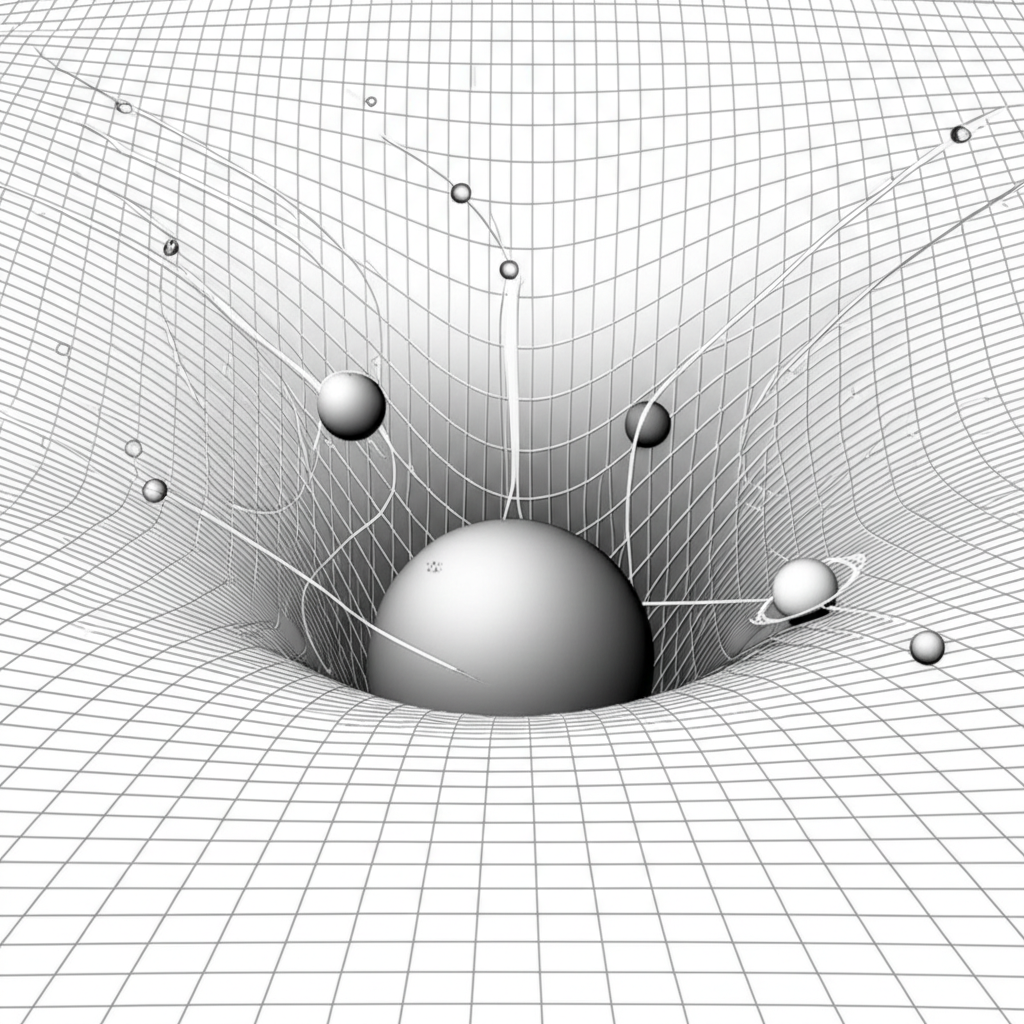 follow curved paths along this distorted fabric. The background is a deep cosmic blue, filled with distant stars and nebulae, emphasizing the vast, interconnected nature of space and time. A faint, almost imperceptible arrow points along one of the grid lines, subtly suggesting the directionality of time within this cosmic landscape.)
Reconciling Experience with Cosmic Reality
The chasm between our intuitive, linear experience of time and the profound implications of physics and philosophical concepts of eternity remains a fertile ground for inquiry. Is our experience of time's flow an illusion? Or is consciousness itself the key to understanding how a timeless reality can manifest as temporal experience?
The nature of time and eternity continues to be one of the most compelling and interdisciplinary questions, drawing insights from ancient philosophical texts to the latest cosmological models. It challenges us to rethink not just the universe, but our very place within it.
Further Exploration:
- YouTube: Search for "Augustine on Time Philosophy" for discussions on his famous paradox.
- YouTube: Search for "Block Universe Theory Explained Physics" to delve deeper into the implications of modern physics for time.
📹 Related Video: What is Philosophy?
Video by: The School of Life
💡 Want different videos? Search YouTube for: "The Nature of Time and Eternity philosophy"