

The Enigmatic Radiance: Exploring the Nature of Light from Ancient Philosophy to Quantum Physics
Summary: From the dawn of human inquiry, the nature of light has captivated philosophers and scientists alike, evolving from a mystical element to a cornerstone of modern physics. This article embarks on a historical and philosophical journey, tracing our understanding of light from ancient Greek contemplations of vision and illumination, through the classical mechanics of Newton and Maxwell, to the profound wave-particle duality revealed by quantum theory. We will uncover how each epoch, drawing from the wellspring of the Great Books of the Western World, reshaped our perception of this fundamental phenomenon, revealing light not just as something we see, but as a key to understanding the fabric of reality itself.
Early Philosophical Inquiries: Light as a Glimpse of Truth
Long before the advent of sophisticated scientific instruments, the nature of light was a profound subject for philosophical contemplation. Ancient thinkers, whose insights are preserved in the Great Books, often linked light directly to knowledge, truth, and the very structure of reality.
- Plato's Allegory of the Cave: In his Republic, Plato famously uses light as a metaphor for enlightenment. The prisoners, chained in a cave, perceive only shadows cast by a fire behind them. The journey out of the cave, into the blinding sunlight, represents the arduous ascent to true knowledge and understanding. Here, light is not merely a physical phenomenon but a symbol of ultimate truth and the element that reveals the Forms.
- Aristotle on Vision and the Transparent Medium: Aristotle, in works like On the Soul and Physics, grappled with the mechanics of sight. He posited that light is not a body or a flow of particles but rather the actualization of the transparent medium (like air or water) by a luminous body. It is a quality that enables color to be seen, a state rather than a substance. This early conceptualization laid groundwork for understanding light's interaction with its environment.
These early inquiries, though lacking the empirical rigor of modern physics, established light as a central theme in understanding perception, reality, and the very act of knowing.
The Dawn of Modern Physics: Light as a Particle
The scientific revolution brought a new empirical lens to the study of light, shifting focus from its philosophical implications to its physical properties. The 17th century saw intense debate about light's fundamental nature.
- Descartes' Mechanical Universe: René Descartes, in his Optics (part of his broader philosophical system), proposed a purely mechanical explanation for light. He viewed light as a pressure or tendency to move, transmitted instantaneously through a plenum (a space filled with subtle matter). This corpuscular view, though different from Newton's, sought to explain light's behavior through the collision and interaction of minute particles.
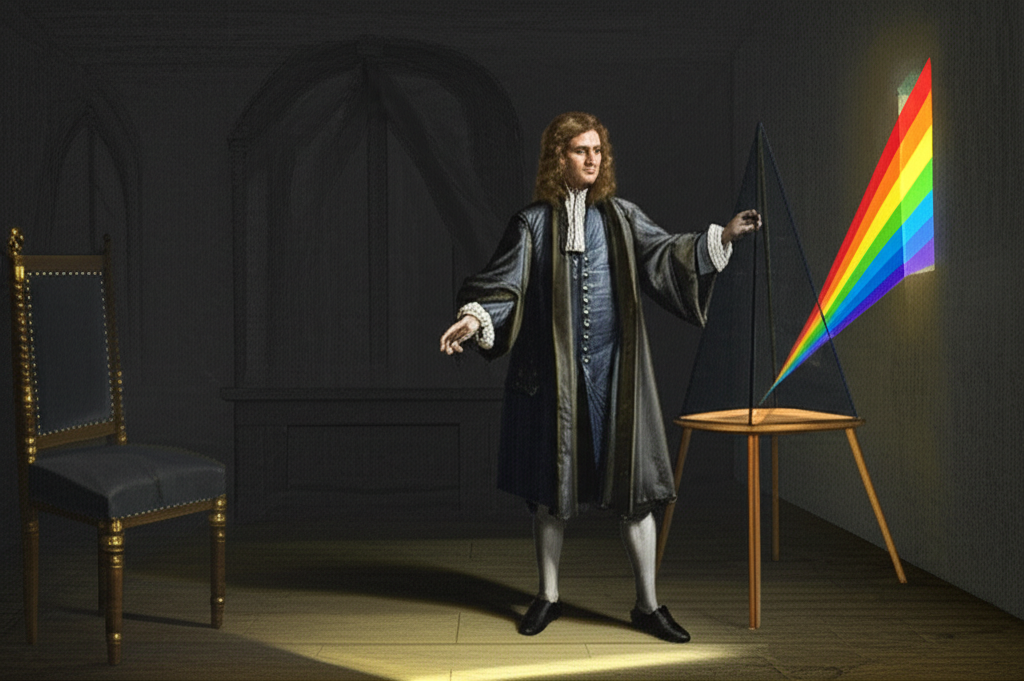
- Newton's Corpuscular Theory: Isaac Newton, whose groundbreaking work Opticks stands as a monumental contribution to physics, championed the idea that light consists of tiny particles, or corpuscles, emitted by luminous bodies. This theory successfully explained phenomena like reflection and refraction, treating light as subject to classical mechanics. His experiments with prisms, demonstrating the decomposition of white light into a spectrum of colors, were foundational.
Key Characteristics of Newton's Corpuscular Theory:
- Rectilinear Propagation: Light travels in straight lines.
- Reflection: Particles bounce off surfaces.
- Refraction: Particles change speed and direction when entering a new medium.
- Color: Different colors correspond to corpuscles of different sizes or properties.
The Ascendancy of the Wave: Unveiling Electromagnetic Mechanics
Despite Newton's formidable influence, alternative theories emerged, particularly the wave theory of light. While initially met with skepticism, the wave model gained traction, eventually leading to a profound unification in physics.
- Huygens' Wave Hypothesis: Christiaan Huygens, a contemporary of Newton, proposed that light was a wave phenomenon. His Treatise on Light explained reflection and refraction through wave propagation and interference, providing an alternative mechanics to Newton's corpuscles.
- Young and Fresnel's Empirical Support: Early 19th-century experiments by Thomas Young (double-slit experiment demonstrating interference) and Augustin-Jean Fresnel (diffraction) provided compelling evidence for the wave nature of light, seemingly refuting the corpuscular theory. Light exhibited properties typical of waves, such as interference and diffraction patterns.
- Maxwell's Electromagnetic Unification: The true triumph of the wave theory came with James Clerk Maxwell in the late 19th century. His groundbreaking Treatise on Electricity and Magnetism unified electricity, magnetism, and light into a single theoretical framework. Maxwell demonstrated that light is an electromagnetic wave, a propagating disturbance in electric and magnetic fields. This was a monumental achievement in physics, showing that light is not just an optical element but an integral part of a larger electromagnetic spectrum. The speed of these waves was predicted to be the speed of light, confirming the connection.
The Quantum Riddle: Light's Dual Nature
Just as the wave theory seemed definitively established, the early 20th century brought revolutionary insights that once again challenged our understanding of light's fundamental nature.
- Planck's Quanta: Max Planck, while studying black-body radiation, proposed that energy is emitted and absorbed in discrete packets, or "quanta." This was a radical departure from classical mechanics, where energy was thought to be continuous.
- Einstein's Photoelectric Effect and Photons: Albert Einstein, drawing on Planck's work, explained the photoelectric effect by proposing that light itself consists of discrete energy packets, which he later called photons. This effectively revived the particle nature of light, suggesting that light behaves as both a wave and a particle – a concept known as wave-particle duality.
- Quantum Electrodynamics: Modern physics, particularly quantum electrodynamics, describes light as quantized electromagnetic fields, where photons are the fundamental excitations of these fields. This complex mechanics reconciles the seemingly contradictory wave and particle aspects, confirming that light's nature is inherently dual.
Light: A Fundamental Element of Reality
Today, our understanding of light is deeply intertwined with the most profound theories in physics, from relativity to quantum mechanics. Light, in its dual nature as both wave and particle, is not just a medium for sight but a fundamental element of the universe, dictating the speed limit of causality, shaping the structure of matter, and illuminating the cosmos. The ongoing philosophical inquiry into its essence continues to push the boundaries of our knowledge, reminding us that even the most familiar phenomena hold endless depths of mystery.
YouTube:
- "The Philosophy of Light: From Plato to Quantum Mechanics"
- "Maxwell's Equations and the Nature of Light Explained"
📹 Related Video: What is Philosophy?
Video by: The School of Life
💡 Want different videos? Search YouTube for: "The Nature of Light in Physics philosophy"