

The Luminous Enigma: A Philosophical Journey Through the Nature of Light in Physics
Summary: The nature of light stands as one of the most profound and enduring mysteries in physics, continuously challenging our perceptions of reality. From ancient philosophical conjectures viewing it as a fundamental element to modern quantum mechanics describing its perplexing wave-particle duality, light has served as a crucible for scientific inquiry and philosophical contemplation. This article traces the historical evolution of our understanding of light, illuminating how its study has consistently pushed the boundaries of human knowledge and reshaped our comprehension of the universe.
The Ancient Glimmer: Light as an Element and Phenomenon
Since antiquity, the sheer ubiquity and profound impact of light have compelled thinkers to ponder its essence. Before the rigorous frameworks of modern physics emerged, light was often considered a primordial element or a divine emanation, intrinsically linked to sight, knowledge, and existence itself.
- Early Philosophical Speculations:
Philosophers like Plato, whose writings are foundational in the Great Books of the Western World, explored light not merely as a physical phenomenon but as an allegory for truth and understanding. In his Allegory of the Cave, the light outside the cave represents the illumination of true knowledge, starkly contrasting with the shadows of perceived reality. Aristotle, another titan from the Great Books, considered light as a mere quality or activity of a transparent medium, rather than a substance itself. He posited that light was the actualization of the transparent medium by the presence of fire or something similar, allowing us to see color. These early ideas, though lacking empirical verification, laid the conceptual groundwork for centuries of inquiry into light's fundamental nature.
The Newtonian Paradigm: Light as Particles
The Scientific Revolution brought a new rigor to the study of light, shifting the focus from purely philosophical speculation to empirical observation and mathematical description. Sir Isaac Newton, a towering figure whose works are also enshrined in the Great Books, championed a corpuscular theory of light in the 17th century.
-
Corpuscular Theory and its Mechanics:
Newton proposed that light consisted of tiny, discrete particles, or "corpuscles," emitted by luminous bodies. This model elegantly explained several observed phenomena:- Rectilinear Propagation: Light travels in straight lines.
- Reflection: Corpuscles bounce off surfaces like billiard balls.
- Refraction: Changes in speed as corpuscles enter a different medium, causing them to bend.
Newton's authority and the success of his mechanics in describing planetary motion lent immense weight to his particle theory. For a considerable period, the nature of light was largely understood through the lens of classical mechanics, where its interactions were akin to those of physical objects.
The Wave Unfurls: Light as a Disturbance
Despite Newton's dominance, an alternative view of light as a wave gained traction, championed by Christiaan Huygens. However, it was the early 19th century experiments that truly provided compelling evidence for the wave theory.
- Huygens, Young, and the Ether:
Huygens's principle described light as a series of waves propagating through an invisible medium called the "luminiferous aether." It wasn't until Thomas Young's double-slit experiment in 1801 that the wave nature of light became undeniable. Young demonstrated that light exhibits interference patterns, a phenomenon characteristic of waves, not particles. Later, James Clerk Maxwell unified electricity, magnetism, and light into a single electromagnetic theory, firmly establishing light as an electromagnetic wave traveling at a constant speed. This re-framed the physics of light, pushing it beyond simple mechanics into the realm of fields and oscillations.
The Quantum Leap: Light's Dual Nature
Just as the wave theory seemed to have definitively settled the nature of light, the dawn of quantum mechanics introduced an even more perplexing twist. The 20th century revealed that light refuses to be confined to a single description.
-
Einstein, Planck, and the Photon:
Experiments involving the photoelectric effect, explained by Albert Einstein (building on Max Planck's work), demonstrated that light energy is absorbed and emitted in discrete packets, or "quanta," which he called photons. These photons behave like particles, carrying momentum and energy. This led to the revolutionary concept of wave-particle duality: light exhibits properties of both waves and particles, depending on how it is observed.This duality isn't just an oddity; it's fundamental to quantum physics. It means that the nature of light is not a singular, fixed entity but rather a probabilistic manifestation that defies our classical intuitions. It's a profound challenge to our understanding of reality itself, echoing ancient philosophical debates about appearance versus essence.
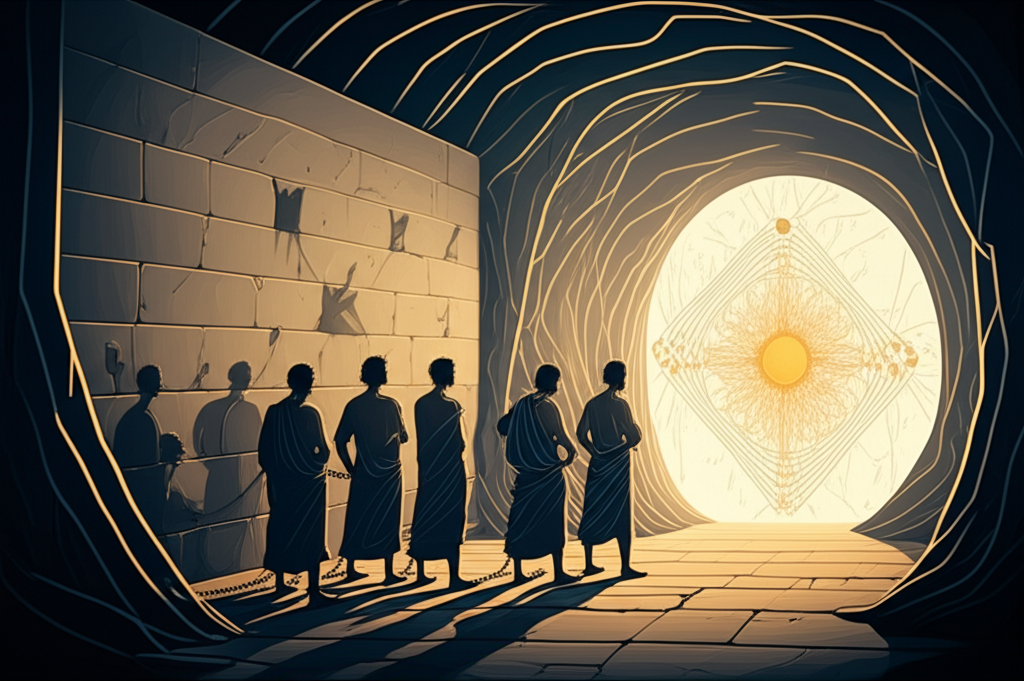 is visible at the cave's entrance, representing the dual nature of light and the journey towards understanding.)
Beyond the Visible: Light's Enduring Mystery
The journey to understand the nature of light in physics is far from complete. From gamma rays to radio waves, the electromagnetic spectrum is vast, and light in all its forms continues to be a cornerstone of modern science and technology. Yet, the philosophical implications of its wave-particle duality remain deeply unsettling and endlessly fascinating.
- Philosophical Echoes in Modern Physics:
The observation-dependent nature of light in quantum mechanics forces us to reconsider the very nature of reality and the role of the observer. Does light exist as a wave and a particle simultaneously, or does our act of measurement collapse its potential into a definite state? These questions resonate with ancient philosophical inquiries into perception, reality, and the limits of human knowledge, demonstrating that even the most cutting-edge physics continues to engage with foundational philosophical problems. The light we perceive, interact with, and study is not merely a physical phenomenon; it is a profound element that constantly redefines our cosmic perspective.
YouTube: "wave particle duality explained philosophy"
YouTube: "history of light theory great books"
📹 Related Video: What is Philosophy?
Video by: The School of Life
💡 Want different videos? Search YouTube for: "The Nature of Light in Physics philosophy"