

The Everlasting Riddle: Exploring the Nature of Eternity and Time
The concepts of Eternity and Time stand as twin pillars in the grand edifice of Metaphysics, inviting humanity to ponder not just what exists, but how it exists. This pillar page delves into the profound philosophical inquiries surrounding these fundamental aspects of reality, tracing their understanding from ancient Greek thought to contemporary debates. We will explore how philosophers have grappled with time as a linear progression and eternity as a timeless present, examining the intricate relation between the temporal and the atemporal, and the deep implications these distinctions hold for our understanding of existence, consciousness, and even the divine. Prepare to journey through the enduring questions that challenge our very perception of reality.
Time: Our Lived Experience and Philosophical Quandaries
Our everyday lives are inextricably bound to Time. We measure it, plan by it, and often feel its relentless march. Yet, upon closer philosophical inspection, this seemingly self-evident concept dissolves into a profound mystery.
The Arrow of Chronos: Linear Time and Human Perception
From the moment we wake, Time unfolds as a sequence of events: past, present, and future. This linear, unidirectional flow is often termed "Chronos," the personification of time in Greek mythology. For many, this is the intuitive understanding: a series of moments, one following another, never to return.
Ancient philosophers like Aristotle, whose works are foundational to the Great Books of the Western World, explored time not as an independent entity, but as a measure of motion or change. In his Physics, Aristotle posits that if there were no change, there would be no time. Time, for him, is intrinsically related to movement and the succession of "before" and "after" in phenomena. This perspective grounds time firmly within the empirical world, making it a property of events rather than a container for them.
Time's Subjectivity: Augustine's Dilemma
While Aristotle linked time to motion, others pondered its more elusive, subjective dimensions. Saint Augustine of Hippo, in his seminal Confessions, famously articulated the profound difficulty in grasping time: "What then is time? If no one asks me, I know what it is. If I wish to explain it to him who asks, I do not know."
Augustine grappled with the relation between time and the human mind. He argued that the past exists in memory, the future in expectation, and the present as a fleeting point of attention. For Augustine, time is less an objective feature of the cosmos and more a "distention of the soul" – a psychological reality deeply intertwined with consciousness. This introduces a crucial metaphysical question: Does time exist independently of an observer, or is it a construct of the mind?
Eternity: Beyond the Temporal Frame
If time is the realm of change and succession, Eternity often conjures images of something utterly different – a realm untouched by the ebb and flow of moments.
Divine Timelessness: Boethius and the Eternal Present
One of the most influential definitions of Eternity comes from Boethius in his Consolation of Philosophy. He defined eternity not as infinite duration (time without end), but as "the whole, perfect, and simultaneous possession of interminable life." This is a crucial distinction:
- Infinite Time: A line stretching endlessly in both directions, still composed of successive moments.
- Eternity (Boethius's sense): A single, unchanging, ever-present "now" where past, present, and future are simultaneously apprehended.
This concept is often applied to God, who is understood to exist outside of time, perceiving all moments of creation in one eternal gaze. This raises profound questions about divine foreknowledge and human free will, as an eternal being would "see" all our choices simultaneously, without necessitating them.
Plato's Forms and the Eternal Realm
Long before Boethius, Plato offered a vision of an eternal realm in his theory of Forms, as explored in works like the Republic and Phaedo. For Plato, the physical world we perceive is constantly changing and impermanent, a mere shadow of a higher, unchanging reality. The Forms – perfect, abstract archetypes of concepts like Beauty, Justice, or the Good – exist eternally and immutably. They are not in time; rather, they are the timeless truths that ground all temporal phenomena.
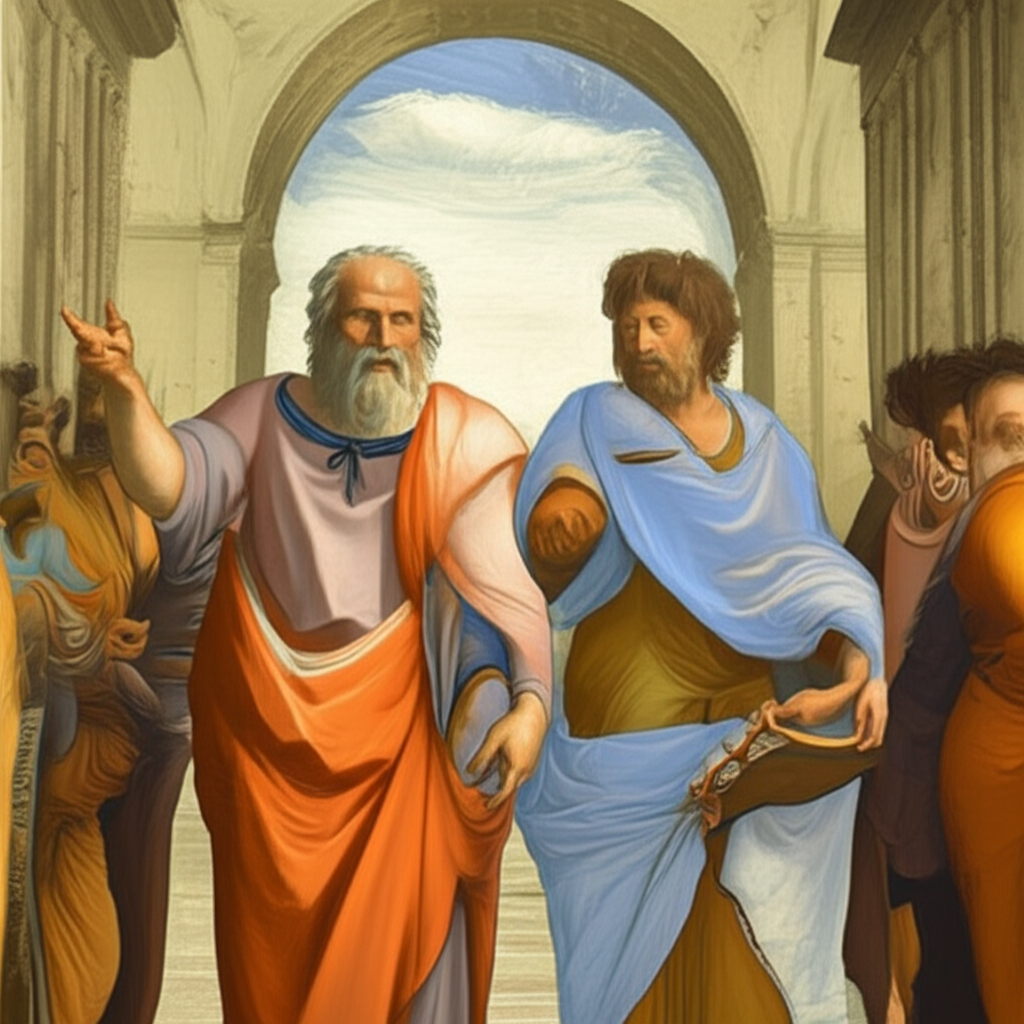
This Platonic notion of an eternal realm introduces the idea that true reality might lie beyond the fleeting nature of our temporal experience, offering a stable reference point for knowledge and being.
The Intricate Relation Between Eternity and Time
The most compelling philosophical challenge lies in understanding how these two seemingly disparate concepts – Eternity and Time – relate to one another. Are they fundamentally separate, or is one a derivative of the other?
Bridging the Divide: How the Eternal Touches the Temporal
Plato, in his Timaeus, famously described Time as a "moving image of Eternity." This suggests that time is not merely a lesser form of eternity, but a dynamic reflection of its static perfection. The universe, created by the Demiurge, is ordered according to eternal patterns, and time is the mechanism through which this order unfolds in the perceptible world.
This perspective highlights a fundamental tension:
- Time as a subset of Eternity: Suggests that eternity encompasses time, perhaps as an overarching reality within which temporal events occur.
- Time and Eternity as fundamentally distinct: Posits two separate modes of existence, with little direct interaction.
The philosophical debate often centers on whether there is a true relation between the temporal and the eternal, or if they represent different ontological categories entirely.
Modern Perspectives: From Newton to Einstein
The scientific revolution, particularly with Isaac Newton, profoundly shaped the metaphysics of Time. Newton conceived of time as absolute, flowing uniformly and independently of any external reference. This "absolute time" was seen as a universal, unchanging background against which all events unfolded, akin to an eternal, objective container.
| Philosopher/Concept | View of Time | View of Eternity | Relation |
|---|---|---|---|
| Aristotle | Measure of motion/change | Not explicitly a primary focus; implies an eternal cosmos, but time within it is sequential. | Time is a property of the eternal cosmos. |
| Augustine | Distention of the soul; subjective | God's timeless present | Human time is a reflection/experience of an eternal God. |
| Plato | Moving image of Eternity | Realm of unchanging Forms; true reality | Time is a dynamic manifestation of eternal principles. |
| Boethius | Sequential, finite for creatures | Whole, perfect, simultaneous possession of interminable life (God) | God's eternity encompasses all of time in a single 'now'. |
| Newton | Absolute, flowing independently | Not explicitly defined as distinct from absolute time, but implies an eternal, unchanging background. | Time is a universal, objective framework, potentially eternal in its own right. |
| Einstein | Relative, interwoven with space (spacetime) | No distinct "Eternity" as a separate realm; spacetime itself has a beginning/end. | Time is a dimension of reality, not distinct from its spatial aspects. |
However, the 20th century brought a radical shift with Albert Einstein's theories of relativity. Einstein demonstrated that time is not absolute but relative to the observer's motion and gravity. Time became interwoven with space, forming a four-dimensional spacetime continuum. This scientific advancement profoundly impacted metaphysics, challenging the notion of a universal "now" and forcing philosophers to reconsider the relation between time and the fabric of the universe itself. In this view, the concept of a separate, timeless Eternity becomes even more complex, often giving way to questions about the beginning and end of spacetime itself.
The Metaphysical Implications: Why Does It Matter?
Understanding the nature of Eternity and Time is not merely an academic exercise; it touches upon some of the most profound questions of human existence.
Free Will, Destiny, and the Eternal Gaze
The concept of an eternal God who sees all moments simultaneously raises intense debates about free will. If God's knowledge is eternal and unchanging, does this mean our future actions are predetermined? Philosophers throughout history, from Boethius to contemporary thinkers, have wrestled with this relation between divine foreknowledge and human agency. Is our time-bound freedom compatible with an eternal decree? This metaphysical puzzle remains a cornerstone of theological and philosophical inquiry.
Our Place in the Cosmos
Ultimately, our understanding of Eternity and Time shapes our worldview. Are we ephemeral beings living in a fleeting moment, or do our lives participate in something larger, more enduring? The contemplation of these concepts can offer solace, inspire awe, or provoke existential angst. It challenges us to consider the limits of our perception and the vastness of realities that may lie beyond our immediate experience. The ongoing philosophical journey into the Nature of Eternity and Time invites us to continually re-evaluate our place in the cosmos and the deeper meaning of our existence.
Further Exploration
📹 Related Video: What is Philosophy?
Video by: The School of Life
💡 Want different videos? Search YouTube for: "The Philosophy of Time: Crash Course Philosophy #28"
📹 Related Video: What is Philosophy?
Video by: The School of Life
💡 Want different videos? Search YouTube for: "Boethius and the Consolation of Philosophy: Great Books"