

The Unseen Backbone: The Nature of Courage in Civic Life
In an age often characterized by its complexities and divisions, the concept of courage tends to be narrowly confined to acts of physical bravery on battlefields or in moments of crisis. Yet, as the great thinkers of the Western tradition have tirelessly reminded us, the true nature of courage extends far beyond the physical, finding its most profound and often most challenging expression in the quiet, persistent duty of the citizen within the civic sphere. This article explores how courage, understood as a cardinal virtue, underpins the health and vitality of any flourishing society, demanding intellectual rigor, moral fortitude, and an unwavering commitment to the common good.
Redefining Courage: More Than Mere Bravery
When we speak of courage, our minds often conjure images of heroes confronting visible threats. However, the philosophical tradition, particularly as found in the Great Books of the Western World, offers a more nuanced and expansive understanding. Plato, in his dialogue Laches, grapples with defining courage, demonstrating its elusive quality and the difficulty in distinguishing it from mere rashness or confidence. For Plato, true courage involves knowledge – knowing what is truly to be feared and what is not.
Aristotle, in his Nicomachean Ethics, further refines this, positioning courage as a mean between rashness and cowardice. It is not the absence of fear, but the ability to act rightly in the face of fear, for a noble cause. This distinction is crucial for understanding civic courage: it is not about reckless defiance, but about principled action rooted in a rational assessment of the situation and a commitment to justice.
Key Distinctions of Courage:
- Physical Courage: Facing bodily harm or death.
- Moral Courage: Upholding ethical principles despite social pressure, ridicule, or personal cost.
- Intellectual Courage: Challenging established beliefs, pursuing truth, and engaging in critical self-reflection.
- Civic Courage: Acting for the common good, even when it is unpopular, inconvenient, or dangerous.
The Citizen's Imperative: Duty and the Polis
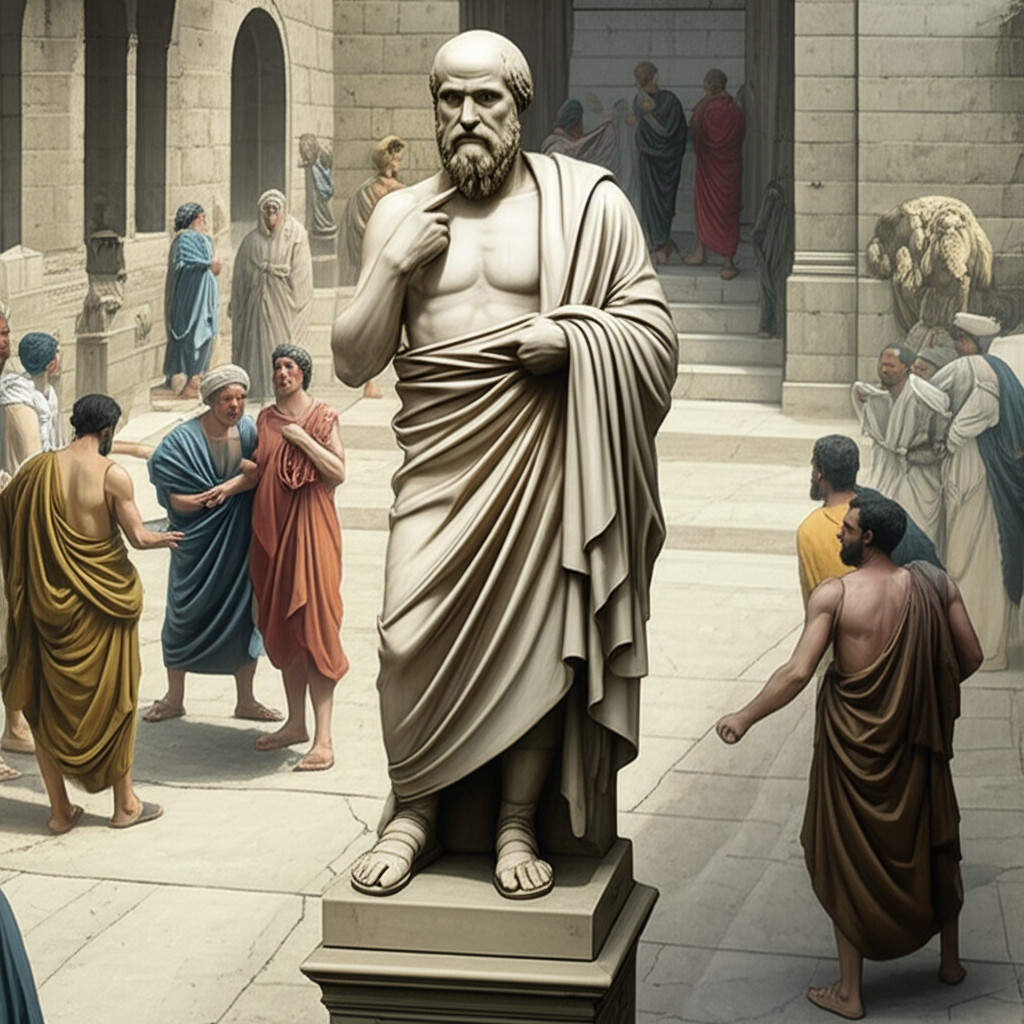
The concept of the citizen carries with it an inherent duty, a responsibility to contribute to the well-being of the polis or community. This duty is not passive; it often requires courageous action. Thucydides, in his History of the Peloponnesian War, through Pericles' Funeral Oration, extols the Athenian ideal of active citizenship, where individuals are expected to participate in public life and speak truth to power. This requires a form of courage distinct from that displayed on the battlefield – a moral fortitude to stand for what is right, even when it means confronting the majority or challenging powerful interests.
Cicero, in his On Duties, elaborates on the importance of civic virtue, emphasizing that courage must always be tempered by justice and prudence. A courageous act that serves injustice is not truly virtuous. Thus, the nature of courage in civic life is inextricably linked to ethical considerations and the pursuit of a just society. It is the courage to:
- Speak out against injustice: Even when it is easier to remain silent.
- Defend unpopular truths: When public opinion sways towards error or falsehood.
- Participate actively in democratic processes: Even when they are imperfect or frustrating.
- Hold power accountable: Regardless of personal or political cost.
- Engage in difficult conversations: With respect and a commitment to understanding.
Cultivating Courage in Modern Civic Life
In contemporary society, the avenues for civic courage are myriad, yet often subtle. It is the courage of the whistleblower, the journalist pursuing an inconvenient truth, the activist advocating for marginalized communities, or simply the individual who stands up to bullying or prejudice in their daily interactions. These acts, though they may lack the dramatic flair of military heroism, are the sinews that strengthen the fabric of a free and just society.
To foster this essential virtue, we must look to the foundations laid by the Great Books. We need education that encourages critical thinking, debate, and an understanding of ethical principles. We need public spaces, both physical and digital, where genuine dialogue can occur without fear of immediate reprisal. And perhaps most importantly, we need to recognize and celebrate acts of civic courage, providing models for future generations. The nature of courage, when properly understood as a civic virtue, is not merely about individual fortitude, but about the collective strength of a society willing to uphold its highest ideals.
YouTube Video Suggestions:
- Plato Laches Summary
- Aristotle Nicomachean Ethics Courage
📹 Related Video: What is Philosophy?
Video by: The School of Life
💡 Want different videos? Search YouTube for: "The Nature of Courage in Civic Life philosophy"