

The Enigma of Animal Consciousness: Exploring the Mind Beyond Our Own
Summary
The question of animal consciousness stands as one of philosophy's most profound and persistent challenges, inviting us to peer beyond the human experience and consider the rich, complex inner lives of other beings. This pillar page delves into the multifaceted nature of animal consciousness, exploring its historical philosophical interpretations, contemporary scientific insights, and the profound ethical implications that arise from acknowledging a shared landscape of mind. From ancient Greek inquiries into the anima to modern neuroscience, we navigate the arguments for and against the existence of non-human sentience, self-awareness, and the various forms of subjective experience that might inhabit the diverse tapestry of the animal kingdom. Our journey will reveal that understanding animal consciousness is not merely an academic exercise, but a crucial step in redefining our place within the grander scheme of Nature and our responsibilities towards its inhabitants.
I. Unpacking the Concept: What is Consciousness, Anyway?
Before we can even begin to ponder animal consciousness, we must first grapple with the notoriously slippery concept of consciousness itself. For centuries, philosophers have wrestled with defining this elusive quality, often finding it easier to describe what it does rather than what it is. Is it merely the ability to perceive and react? Or does it entail a subjective, "what-it's-like" experience?
Historically, the Western philosophical tradition, as chronicled in the Great Books, often placed human mind on a pedestal, distinct and superior. René Descartes, a pivotal figure, famously posited a radical dualism: humans possessed a res cogitans (thinking substance), while animals were mere res extensa (extended substance)—complex biological machines, devoid of genuine thought or feeling. This perspective, deeply influential, framed animal behavior as purely mechanistic, a series of reflexes without inner sensation.
However, earlier thinkers like Aristotle, in De Anima (On the Soul), offered a more nuanced view, distinguishing between vegetative, sensitive, and rational souls. While reserving the rational soul for humans, he acknowledged that animals possessed a sensitive soul, capable of perception, sensation, and even a rudimentary form of memory and desire. This laid a groundwork for understanding a spectrum of mental capacities.
Today, contemporary philosophy and science typically differentiate several facets of consciousness:
- Phenomenal Consciousness: The subjective, qualitative experience – the "raw feels" or qualia (e.g., the redness of red, the pain of a cut). This is often considered the hardest problem.
- Access Consciousness: The ability to access and report on mental states, to use information for reasoning, speech, and action.
- Self-Awareness: The capacity to recognize oneself as an individual, distinct from others and the environment.
- Sentience: The capacity to feel, perceive, or experience subjectively, particularly pleasure and pain. This is often seen as the baseline for moral consideration.
The question then becomes: which of these, if any, do animals possess?
II. Echoes of Mind: The Philosophical Debate Over Animal Minds
The debate over animal minds is not new, but its intensity and sophistication have grown exponentially. Philosophers, drawing on both logic and empirical observation, have presented compelling arguments for and against the existence of robust animal consciousness.
A. The Cartesian Legacy and Its Challengers
Descartes' view of animals as unthinking automata, while influential, was not universally accepted even in his time. Michel de Montaigne, for instance, in his Apology for Raymond Sebond (found within essays that echo the spirit of the Great Books), questioned human arrogance, suggesting that animals might possess reason and understanding we simply fail to perceive.
Later, David Hume, in his Treatise of Human Nature and Enquiry Concerning Human Understanding, argued strongly for a continuity between human and animal mind. He observed that animals learn from experience, form expectations based on habit, and exhibit forms of reasoning that, while perhaps less complex, are analogous to human faculties. "No truth appears to me more evident," Hume wrote, "than that beasts are endow'd with thought and reason as well as men." This marked a significant departure from Cartesian exceptionalism.
B. The Problem of Other Minds Applied to Animals
A core philosophical challenge is the "problem of other minds"—how can we truly know what another being is experiencing, given that we only have direct access to our own subjective states? When extended to animals, this problem becomes even more acute. We cannot ask a bat what it's like to echolocate, nor can a dog articulate its dreams.
This epistemic gap leads to two main approaches:
- Behavioral Analogies: If animals behave in ways that, in humans, would indicate pain, joy, fear, or problem-solving, is it reasonable to infer similar internal states?
- Neurological Similarities: If animals possess brain structures and neurochemical pathways analogous to those in humans associated with consciousness, does this suggest similar subjective experiences?
C. Sentience, Sapience, and Self-Awareness: A Spectrum of Consciousness
It's increasingly clear that "consciousness" is not an all-or-nothing phenomenon. Rather, it likely exists on a spectrum.
| Aspect of Consciousness | Description | Potential Animal Examples |
|---|---|---|
| Sentience | Capacity to feel pleasure and pain; to have subjective experiences. | Virtually all vertebrates; many invertebrates (octopuses, crabs, insects). |
| Perception | Ability to interpret sensory information. | All mobile animals. |
| Emotion | Experience of feelings like joy, fear, grief, anger. | Mammals (dogs, elephants, primates); some birds (crows, parrots). |
| Memory | Ability to recall past events or learned information. | Many animals (elephants' long-term memory, birds' spatial memory). |
| Problem-Solving | Capacity to devise solutions to novel challenges. | Primates, corvids, octopuses. |
| Self-Awareness | Recognition of oneself as a distinct individual (e.g., mirror self-recognition). | Great apes, dolphins, elephants, some birds (magpies). |
| Theory of Mind | Ability to attribute mental states (beliefs, desires, intentions) to others. | Limited evidence in some primates, possibly corvids (understanding what another animal "knows"). |
This table illustrates the complexity and diversity of mind across the animal kingdom, challenging simplistic dichotomies.
III. The Scientific Lens: Evidence from Ethology and Neuroscience
While philosophy provides the conceptual framework, science offers empirical data to illuminate the nature of animal consciousness. The fields of ethology (the study of animal behavior) and cognitive neuroscience have provided compelling evidence that pushes back against the notion of animals as mere automatons.
- Complex Behaviors: Observations of animals demonstrating tool use (crows, chimpanzees), elaborate communication systems (dolphins, bees), empathetic responses (elephants, primates), and complex social structures suggest more than just instinctual programming. These behaviors often imply planning, memory, and an understanding of cause and effect.
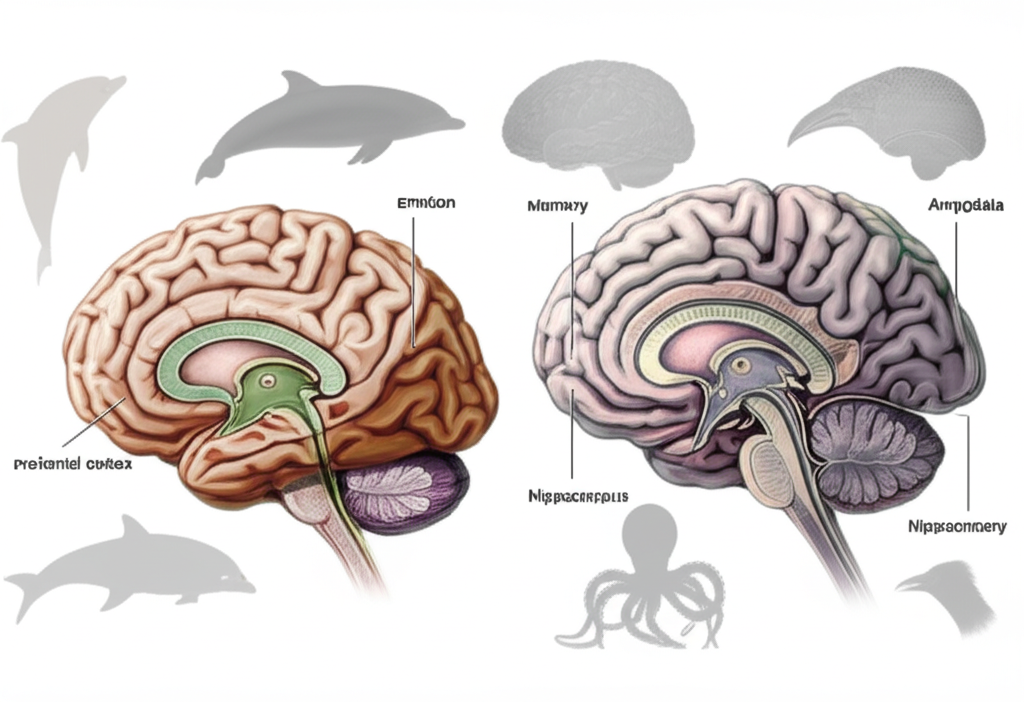
- Neurological Structures: Comparative neuroanatomy reveals striking similarities between human brains and those of many animals, particularly mammals and birds. Structures associated with emotion (amygdala), memory (hippocampus), and executive function (prefrontal cortex) are present and functionally analogous. The presence of spindle neurons in great apes, elephants, and cetaceans—cells linked to empathy and social cognition in humans—is particularly intriguing.
- The Cambridge Declaration on Consciousness (2012): This landmark scientific statement, signed by a prominent group of neuroscientists, declared that "nonhuman animals, including mammals and birds, and many other creatures, including octopuses, also possess the neurological substrates of consciousness." This consensus among neuroscientists marks a significant shift, affirming that the scientific evidence strongly supports the existence of conscious experience in a wide range of animals.
IV. Ethical Imperatives: Our Moral Relationship with Animal Nature
If we accept, even tentatively, that animals possess some form of consciousness and the capacity for subjective experience, the ethical implications are profound. Our traditional human-centric moral frameworks, often rooted in the idea of human exceptionalism (a concept challenged by Darwin in The Descent of Man), come under intense scrutiny.
Jeremy Bentham, an early utilitarian philosopher whose ideas resonate through the Great Books, famously argued: "The question is not, Can they reason? nor, Can they talk? but, Can they suffer?" If an animal can suffer, then its suffering warrants moral consideration. This utilitarian perspective suggests that we should aim to maximize pleasure and minimize pain for all sentient beings.
More recent philosophical developments, such as those articulated by animal rights advocates, argue that sentient beings, particularly those capable of self-awareness, may possess inherent moral rights, not merely utility. This shifts the focus from preventing suffering to respecting their right to life and freedom.
Considering the nature of our shared planet, and the interconnectedness of all life forms, acknowledging animal consciousness forces us to re-evaluate:
- Animal Agriculture: The ethics of factory farming and consumption of animal products.
- Animal Experimentation: The justification for using animals in scientific research.
- Wildlife Conservation: Our responsibility to protect species and habitats, not just for human benefit, but for the intrinsic value of the conscious lives within them.
- Pet Ownership: The duties and responsibilities we owe to companion animals.
YouTube: The Problem of Other Minds - Philosophy Tube
YouTube: Do Animals Have Consciousness? - Kurzgesagt – In a Nutshell
V. The Unfolding Mystery: Continuing the Inquiry into Animal Consciousness
Despite significant progress, the nature of animal consciousness remains an unfolding mystery. We are still grappling with the "hard problem" of consciousness—how physical processes give rise to subjective experience—and this problem is only compounded when applied to non-human minds.
Future philosophical and scientific endeavors will undoubtedly continue to push the boundaries of our understanding. Questions that remain include:
- Varieties of Consciousness: How does consciousness differ across species? Is a bird's subjective world qualitatively different from a fish's, or a human's?
- Evolutionary Origins: How and why did consciousness evolve? What adaptive advantages did it confer?
- Measuring Consciousness: Can we develop more robust, non-invasive methods to assess conscious states in animals?
- Invertebrate Consciousness: Expanding the inquiry beyond vertebrates to insects, crustaceans, and other less-studied groups.
The journey to understand animal consciousness is a testament to our own intellectual curiosity and our evolving ethical sensibilities. It is a profound philosophical quest that urges us to transcend anthropocentric biases and embrace the vast, diverse, and perhaps surprisingly familiar inner worlds that populate our shared Nature. As we continue to learn, our understanding of mind itself expands, reminding us that the boundaries of sentience are far wider and more wondrous than we once dared to imagine.
📹 Related Video: What is Philosophy?
Video by: The School of Life
💡 Want different videos? Search YouTube for: "The Nature of Animal Consciousness philosophy"