

The Mechanics of Light and Time: A Philosophical Interrogation of Reality
Summary
At the confluence of physics and philosophy lies the profound relationship between light and time. This article delves into how our understanding of the mechanics of light, from its ancient symbolic significance to its modern role as a universal constant, fundamentally reshapes our perception of time and space. Drawing from the enduring insights of the Great Books of the Western World, we explore how scientific advancements, particularly Einstein's theories of relativity, have transformed abstract philosophical queries into concrete physical realities, challenging our most basic assumptions about the fabric of existence.
Unveiling the Cosmic Dance: Light, Time, and the Human Gaze
From the dawn of human thought, time has been an elusive phantom, a relentless river carrying all things into oblivion, yet simultaneously the very medium through which existence unfolds. Light, its ethereal counterpart, has served as both the illumination of knowledge and the messenger of the cosmos. But what happens when we examine the intricate mechanics that bind these two fundamental phenomena? What happens when the cold, hard data of physics begins to unravel the philosophical tapestry we’ve woven around them?
This journey is not merely an intellectual exercise; it is an attempt to peer into the very bedrock of reality, to understand how the speed of light dictates the passage of time, how space curves under the weight of existence, and what these revelations mean for our place within the grand, unfolding narrative of the universe. It is a dialogue between the ancient sages pondering the nature of being and the modern physicist dissecting the very fabric of spacetime.
The Ancient Gaze: Time, Motion, and Being
Long before laboratories and particle accelerators, philosophers grappled with time not as a measurable quantity, but as an inherent aspect of change and existence. Aristotle, in his Physics, posited time as "the number of motion with respect to before and after." For him, without change, there could be no time. This perspective anchors time firmly within the realm of mechanics – the mechanics of the cosmos, of celestial bodies, of life itself. The sun's passage, the moon's phases, the turning of seasons – these were the clocks of antiquity, intimately tied to observable motion.
Key Philosophical Questions on Time:
- Is time absolute and independent of events, or is it merely a measure of change? (Aristotle vs. Newton, implicitly)
- Does time flow, or is it a dimension we move through? (Augustine's subjective experience vs. modern block universe)
- What is the origin of time? Did it begin with the universe? (Plato's Timaeus touches on this, linking time to creation)
Augustine, in his Confessions, famously confessed, "What then is time? If no one asks me, I know; if I wish to explain it to him who asks, I know not." This profound statement highlights the subjective and deeply experiential nature of time, a concept that stands in fascinating contrast to the objective, measurable time that physics would later seek to define. For these thinkers, light was often a metaphor for truth, knowledge, or divine presence, rather than a physical entity with measurable properties.
Light's Enigma: From Perception to Universal Constant
The shift from time as a philosophical construct to a physics problem began with a deeper understanding of light. For centuries, light was considered instantaneous, its speed immeasurable. It was the medium through which we perceived the world, the very definition of "seeing." But the scientific revolution began to unveil its true mechanics. From Galileo's early attempts to Ole Rømer's observations of Jupiter's moons, the finite speed of light slowly came into focus.
The 19th century brought Maxwell's equations, demonstrating light as an electromagnetic wave traveling at a constant speed, c. This was a monumental leap, but it posed a profound dilemma: constant with respect to what? This question led directly to the most revolutionary re-evaluation of time and space in human history.
Einstein's Symphony: Relativistic Mechanics of Time and Space
Albert Einstein's theories of Special and General Relativity fundamentally reshaped our understanding of time, space, and the very mechanics of the universe. The constant speed of light (c) became the ultimate arbiter, the cosmic speed limit, and the foundation upon which the fabric of spacetime is woven.
The Core Tenets of Relativistic Mechanics:
- The Constancy of Light Speed: Regardless of the observer's motion, light always travels at c in a vacuum. This seemingly simple postulate has mind-bending implications.
- Time Dilation: For the speed of light to remain constant, time itself must be relative. Observers in relative motion will experience time passing at different rates. A clock moving rapidly relative to you will tick slower.
- Length Contraction: Similarly, objects moving at high speeds appear to contract in the direction of motion.
- Spacetime Curvature: In General Relativity, mass and energy warp the fabric of spacetime, and this curvature is what we perceive as gravity. Light, too, follows these curves.
This is where physics truly informs philosophy. Time is no longer an absolute, universal drumbeat but a personal experience, inextricably linked to one's frame of reference and velocity through space. The mechanics of light dictate the mechanics of time itself.
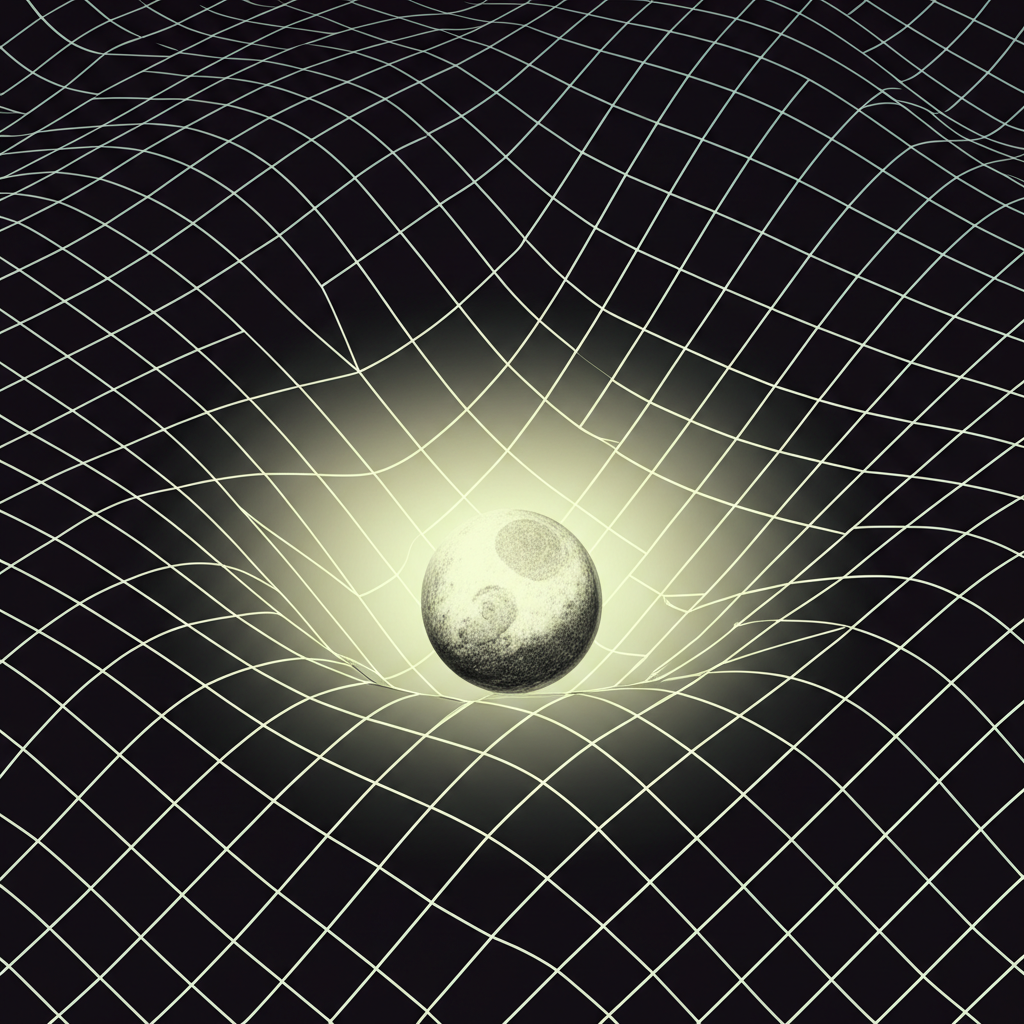 causing a visible depression or curve in the grid. Rays of light are shown bending around the curved spacetime, illustrating gravitational lensing, while a clock face at the edge of the depression appears subtly distorted or slowed, symbolizing time dilation in a strong gravitational field. The background is a cosmic tapestry of stars and nebulae, blending ancient wonder with modern scientific understanding.)
The Paradox of Simultaneity and the Arrow of Time
One of the most profound implications of light's finite and constant speed is the breakdown of absolute simultaneity. Two events that appear simultaneous to one observer might occur at different times for another observer in relative motion. This challenges our intuitive grasp of "now" and suggests that the universe isn't unfolding uniformly for everyone.
Furthermore, the "arrow of time" – the unidirectional flow from past to future – remains a deep philosophical and physics puzzle. While the mechanics of light reveal time's flexibility, they don't inherently explain why time only moves forward. This often leads to discussions about entropy, the second law of thermodynamics, and the initial conditions of the universe, pushing the boundaries of what physics can explain and what philosophy must continue to ponder.
Beyond the Equations: Philosophical Reverberations
The scientific understanding of "The Mechanics of Light and Time" forces us to re-evaluate fundamental philosophical questions:
- Reality: If time is relative and space is dynamic, what is the true nature of reality? Is there an objective "now" or a fixed "place"?
- Free Will vs. Determinism: If spacetime is a fixed, four-dimensional block (the "block universe" theory often associated with relativity), does this imply a predetermined future, challenging notions of free will?
- Human Experience: How does this profound scientific understanding impact our lived experience of aging, memory, and anticipation? Does it diminish or enhance the wonder of existence?
The Great Books of the Western World provide a rich context for these modern dilemmas. The ancient Greek quest for universal truths, the medieval theological debates on creation and eternity, the Enlightenment's emphasis on reason and objective measurement – all these historical currents flow into our contemporary understanding, making the dialogue between physics and philosophy more vibrant than ever.
📹 Related Video: PLATO ON: The Allegory of the Cave
Video by: The School of Life
💡 Want different videos? Search YouTube for: ""Philosophical implications of Einstein's relativity""
📹 Related Video: What is Philosophy?
Video by: The School of Life
💡 Want different videos? Search YouTube for: ""What is time? Ancient philosophy vs modern physics""
Conclusion: An Ever-Unfolding Mystery
The mechanics of light and time are not merely abstract concepts confined to textbooks of physics. They are the very threads from which our universe is woven, dictating the dance of galaxies, the birth and death of stars, and the fleeting moments of our own lives. From Aristotle's observations of motion to Einstein's revolutionary insights, the journey to understand these intertwined forces continues to challenge our intellect and expand our sense of wonder. As we delve deeper, we discover that the universe is far stranger, more beautiful, and more intricately connected than our everyday experience suggests, reminding us that the greatest questions often lie at the intersection of scientific discovery and philosophical contemplation.