

The Enduring Dance of Thought: Unpacking the Logic of Universal and Particular
Indeed, few distinctions are as foundational to the very fabric of Logic and Reasoning as that between the Universal and Particular. This seemingly simple dichotomy, explored with profound depth in the pages of the Great Books of the Western World, underpins not only our formal systems of thought but also our everyday understanding of the world, how we categorize, how we speak, and ultimately, how we seek truth.
At its core, this article will illuminate the critical definition and interplay of universal concepts and particular instances. We will journey through its historical development, examine its pivotal role in various forms of reasoning, and reflect on why grasping this distinction remains indispensable for anyone seeking clarity in thought.
The Foundational Distinction: What Are We Talking About?
To speak of the universal and the particular is to address the very nature of things and our apprehension of them. It is the difference between a general category and a specific member of that category, between a type and its tokens.
Defining the Universal
A Universal refers to a general concept, a property, or a relation that can be predicated of many individual things. It represents a class, a kind, or a common attribute shared by multiple particulars.
-
Characteristics of Universals:
- Generality: They apply to more than one instance.
- Abstractness: They are often concepts or ideas rather than concrete physical objects.
- Predicability: They can be "said of" or attributed to particulars.
-
Examples:
- "Humanity" (applies to all individual humans)
- "Redness" (a quality shared by all red objects)
- "Justice" (an ideal or principle applicable to many actions)
- "Tree" (the general concept encompassing all individual trees)
Defining the Particular
Conversely, a Particular refers to an individual, specific instance, a unique entity that exists at a certain place and time. It is the concrete manifestation of a universal.
-
Characteristics of Particulars:
- Individuality: They are distinct and unique.
- Concreteness: They are often physical objects or specific events.
- Subjectivity: They are the subjects to which universals are attributed.
-
Examples:
- "Socrates" (a specific human being)
- "This very apple" (a specific red object)
- "The verdict delivered in yesterday's trial" (a specific act related to justice)
- "The oak in my backyard" (a specific tree)
Historical Roots in the Great Conversation
The distinction between universal and particular is not a modern innovation but a cornerstone of Western philosophy, debated and refined by the greatest minds.
Plato's Forms: Universals as Ultimate Reality
For Plato, as chronicled in dialogues like Phaedo and Republic, Universals — which he called Forms or Ideas — held a superior reality. The Form of "Beauty" or "Justice" existed independently, perfectly, and eternally in a transcendent realm. Particular beautiful objects or just actions in our sensible world were merely imperfect copies or participants in these perfect Forms. For Plato, true knowledge (episteme) was knowledge of these unchanging Universals, not of the fleeting Particulars.
Aristotle's Substance and Predication: Universals in Particulars
Aristotle, Plato's most famous student, offered a different, yet equally profound, perspective. In his Categories and Metaphysics, he posited that primary Substance (the individual particular, like "this man" or "this horse") is the most fundamental reality. Universals, for Aristotle, do not exist independently in a separate realm but rather in the particulars themselves, as their essences or common properties.
Aristotle's logical system, particularly his theory of the syllogism, hinges entirely on the relationship between universals and particulars. A classic example demonstrates this:
- Universal Premise: All men are mortal.
- Particular Premise: Socrates is a man.
- Particular Conclusion: Therefore, Socrates is mortal.
Here, "man" and "mortal" are universals, while "Socrates" is a particular. The logical power comes from correctly relating the particular to the universal class.
The Logic of Reasoning: From General to Specific and Back
The distinction between universal and particular is not merely an ontological one (about the nature of being) but a deeply practical one for understanding and structuring our reasoning. It informs the very types of arguments we construct.
Categorical Propositions: The Language of Logic
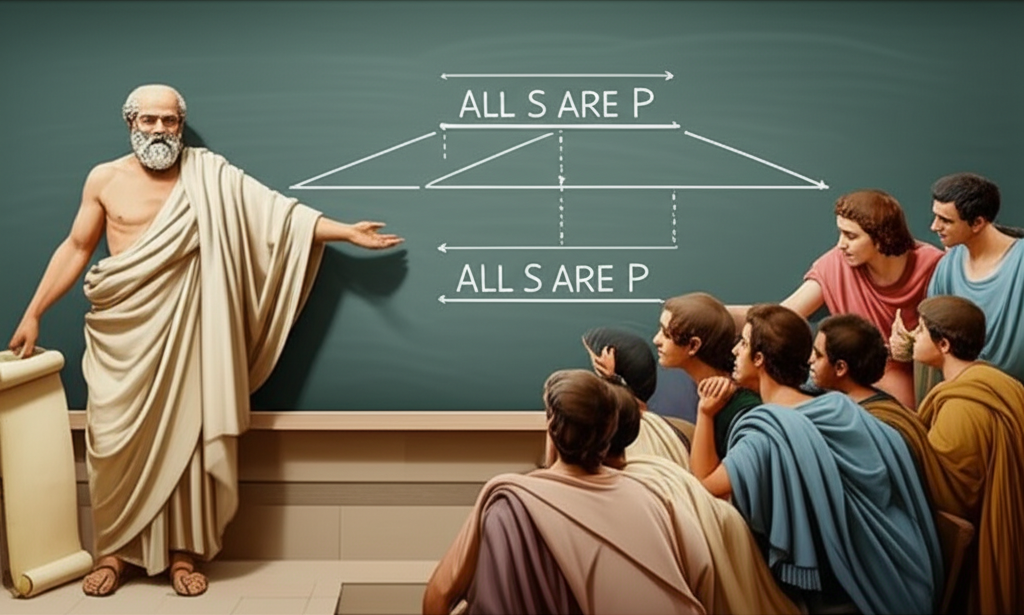
In formal logic, particularly Aristotelian categorical logic, propositions are classified based on their quantity (universal or particular) and quality (affirmative or negative). This gives us four standard forms:
| Type | Quantity | Quality | Form | Example |
|---|---|---|---|---|
| A | Universal | Affirmative | All S are P | All philosophers are thinkers. |
| E | Universal | Negative | No S are P | No dogs are cats. |
| I | Particular | Affirmative | Some S are P | Some students are diligent. |
| O | Particular | Negative | Some S are not P | Some birds are not swans. |
Understanding these forms is crucial for evaluating the validity of arguments, as they specify the scope of the claim being made.
Induction and Deduction: Two Paths of Reasoning
The universal-particular distinction is paramount in understanding the two primary modes of logical reasoning: Deduction and Induction.
Deduction: From Universal to Particular
Deductive reasoning moves from general premises (often universal statements) to a specific conclusion. If the premises are true and the argument form is valid, the conclusion is guaranteed to be true.
-
Structure:
- Start with a universal truth or generalization.
- Apply it to a particular case.
- Derive a particular conclusion.
-
Example:
- All mammals have fur (Universal).
- My dog is a mammal (Particular).
- Therefore, my dog has fur (Particular).
Induction: From Particular to Universal
Inductive reasoning, conversely, moves from specific observations or particular instances to a general conclusion or universal generalization. The conclusion is probable, not certain, even if the premises are true.
-
Structure:
- Observe many particular instances.
- Identify a pattern or commonality.
- Formulate a universal generalization (hypothesis).
-
Example:
- Every swan I have ever seen is white (Particular observations).
- Therefore, all swans are white (Universal generalization).
- (Note: This generalization was famously disproven by the discovery of black swans in Australia, illustrating the probabilistic nature of induction.)
| Feature | Deduction | Induction |
|---|---|---|
| Movement | Universal to Particular | Particular to Universal |
| Certainty | Conclusion is certain if premises are true | Conclusion is probable, not certain |
| Purpose | To test theories, confirm hypotheses | To generate theories, formulate hypotheses |
| Risk | None if valid | Generalization might be false (e.g., black swans) |
Why This Matters: Beyond Abstract Definitions
The logic of universal and particular is not confined to dusty philosophical tomes. It is the very framework through which we make sense of our world.
- Critical Thinking: Understanding this distinction helps us identify fallacies (e.g., hasty generalization, where one draws a universal conclusion from too few particulars).
- Scientific Method: Science relies heavily on induction (observing particulars to form universal laws) and deduction (testing those laws against new particulars).
- Legal Reasoning: Laws are universal principles, applied to particular cases, requiring careful deductive and inductive processes.
- Language and Communication: Our ability to classify, categorize, and communicate relies on our innate understanding of types and tokens, universals and particulars.
Conclusion: The Enduring Relevance
From the towering intellects of ancient Greece to the meticulous scholasticism of the medieval era, the distinction between the Universal and Particular has remained a central preoccupation of philosophy and Logic. The Great Books of the Western World serve as our indispensable guide, revealing how this fundamental definition shapes our understanding of reality, grounds our systems of Reasoning, and informs the very structure of our knowledge.
To grasp this distinction is to gain a deeper appreciation for the intricate dance between the general and the specific, the abstract and the concrete, and to sharpen our own tools for discerning truth in a complex world. It reminds us that while we encounter the world in particulars, we often seek to understand it through universals.
YouTube Video Suggestions:
-
📹 Related Video: ARISTOTLE ON: The Nicomachean Ethics
Video by: The School of Life
💡 Want different videos? Search YouTube for: "Aristotle Logic Universal Particular Syllogism"
2. ## 📹 Related Video: PLATO ON: The Allegory of the Cave
Video by: The School of Life
💡 Want different videos? Search YouTube for: "Plato Theory of Forms Explained Great Books"