

The Enduring Dance of Distinction: Unpacking the Logic of Same and Other in Metaphysics
The very fabric of reality, as we perceive and attempt to understand it, hinges on our ability to distinguish between what is identical and what is different. In the realm of Metaphysics, this fundamental act of discerning Same and Other isn't merely a semantic exercise; it is a foundational Logic that underpins our conception of Being itself. This article delves into how this crucial distinction has shaped philosophical thought, from ancient Greek inquiries into the nature of existence to its continued relevance in understanding what it means for something to be.
A Primal Dichotomy: Why Same and Other Matter
At its core, Metaphysics grapples with the fundamental questions of existence: What is real? What is the nature of reality? How do things exist? To even begin to answer these, we must first establish a framework for identifying individual entities and understanding their relationships. This framework is built upon the Logic of Same and Other. Without the ability to say "this is this" (Same) and "this is not that" (Other), our world would dissolve into an undifferentiated, incomprehensible blur. Philosophers, from the earliest pre-Socratics to contemporary thinkers, have wrestled with the implications of this distinction, recognizing its profound impact on our understanding of identity, change, and the very structure of Being.
Ancient Echoes: The Genesis of Distinction
The earliest stirrings of this Logic can be found in the pre-Socratic philosophers, who laid the groundwork for Western Metaphysics.
- Parmenides and the Unchanging Same: Parmenides famously argued for the absolute unity and immutability of Being. For him, what is simply is, and what is not cannot be conceived. Change, multiplicity, and difference were illusions. His "Being" was the ultimate Same, eternal and indivisible. To introduce "Other" was to introduce "non-Being," which was illogical.
- Heraclitus and the Eternal Other: In stark contrast, Heraclitus posited that "everything flows" (panta rhei). For him, reality was characterized by constant change and flux. The river you step into twice is never the same river, nor are you the same person. Here, "Otherness" – constant transformation and difference – was the fundamental truth of Being. The "Same" was merely a fleeting moment in an unending process of becoming.
This initial tension established the philosophical battlefield, forcing subsequent thinkers to reconcile these seemingly contradictory views.
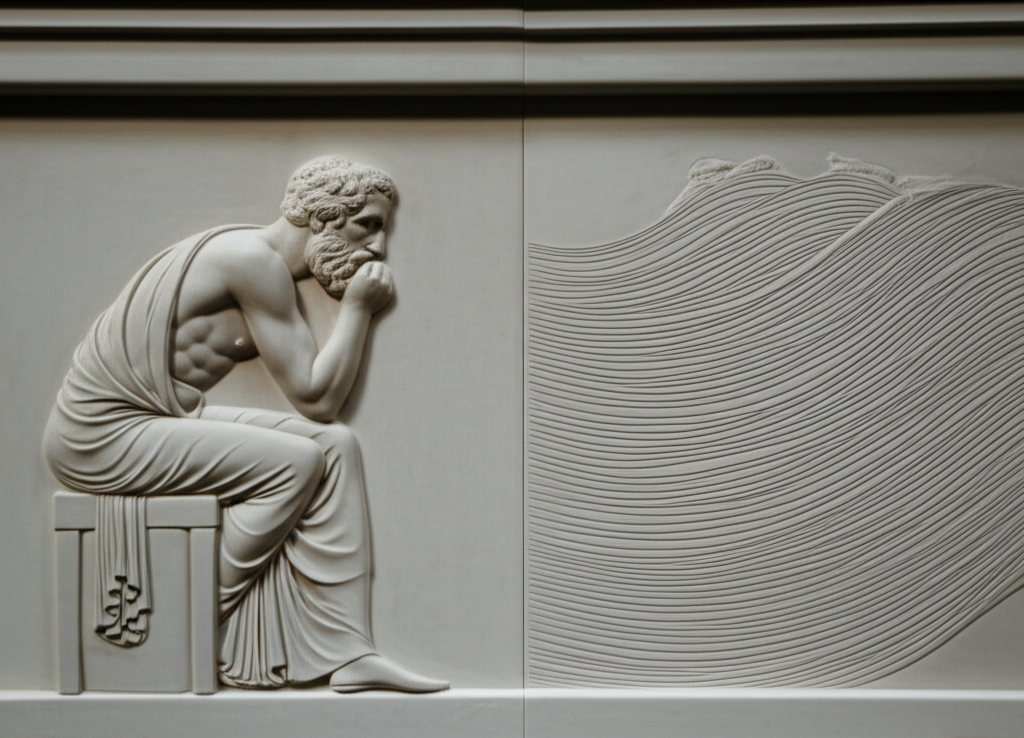
Plato's Synthesis: Forms, Participation, and Difference
Plato, deeply influenced by both Parmenides and Heraclitus, sought a more comprehensive solution. He introduced the realm of Forms (or Ideas), which represented perfect, unchanging essences – the ultimate Same. A particular chair in the physical world is "other" than the Form of Chairness, yet it participates in that Form.
Plato's exploration of Same and Other became particularly sophisticated in his dialogue Sophist. Here, he argues that "difference" is not simply "non-being" in the Parmenidean sense, but rather a distinct kind of Being. To say something is "other" than something else is not to say it is not at all, but that it is different. This was a crucial logical breakthrough, allowing for multiplicity and distinction within the realm of Being without falling into the trap of absolute non-existence.
Consider these Platonic distinctions:
- The Same: The eternal, unchanging Forms (e.g., the Form of Justice).
- The Other (Difference): The distinction of one Form from another (e.g., Justice is other than Beauty) and the distinction of particular things from their Forms (e.g., a just act is other than the Form of Justice, yet participates in it).
This allowed Plato to account for both the stability of knowledge (through Forms) and the changing nature of the sensible world.
Aristotle's Substance and Accidents: Refining the Distinction
Aristotle, Plato's most famous student, further refined the Logic of Same and Other through his theory of substance and accidents.
- Substance (The Primary Same): For Aristotle, the primary substance is the individual, particular thing (e.g., Socrates). This substance is what is primarily; it is the underlying Being that persists through change. It is "the same" individual, even as its properties change.
- Accidents (The Other): Accidents are the qualities, quantities, relations, etc., that belong to a substance but are not essential to its Being (e.g., Socrates is pale, Socrates is tall). These are "other" than the substance itself, dependent on it, and can change without the substance ceasing to be what it is.
Aristotle's categories of Being are essentially a detailed map of how things are the Same (in their substance, their essence) and how they are Other (in their accidental properties, their relations). This provided a powerful framework for understanding change, identity, and the various ways things can exist.
Here's a simplified breakdown of how these concepts manifest:
| Aspect of Being | Focus on "Same" | Focus on "Other" |
|---|---|---|
| Identity | An entity's core essence, what makes it it. | Distinctions from other entities, unique properties. |
| Change | The underlying substance that persists. | The accidental properties that transform. |
| Classification | Shared characteristics defining a species/genus. | Differentiating features between members or groups. |
| Knowledge | Universal concepts, principles, and Forms. | Particular instances, empirical observations. |
The Enduring Logical Imperative
The Logic of Same and Other is not confined to ancient Greece; it permeates all subsequent philosophical inquiry into Metaphysics.
- Medieval Philosophy: The distinction between God's immutable Being (the ultimate Same) and the created, contingent Being of the world (the Other) was central. Debates about universals – whether common natures (Same) exist independently or only in particulars (Other) – were paramount.
- Modern Philosophy: Thinkers like Descartes grappled with the Same of the thinking self (the cogito) versus the Other of the extended world. Kant's distinction between the noumenal (the thing-in-itself, perhaps an unknowable Same) and the phenomenal (how it appears to us, always differentiated and "other" through our categories) highlights its continued relevance.
- Contemporary Thought: Post-structuralism and postmodern philosophy often challenge the very notion of a stable "Same" (e.g., a fixed identity or universal truth), emphasizing instead the fluidity of "Otherness," difference, and multiplicity.
Conclusion: The Unavoidable Foundation of Understanding
From the stark pronouncements of Parmenides and Heraclitus to the nuanced systems of Plato and Aristotle, and through the entire sweep of philosophical history, the Logic of Same and Other remains an indispensable tool for navigating the complexities of Metaphysics. It is the fundamental intellectual operation that allows us to carve reality into intelligible segments, to identify entities, to track change, and to understand the very nature of Being. To engage with Metaphysics is, in essence, to engage with this profound and perennial dance between what is identical and what is distinct, recognizing that both are crucial for a coherent understanding of the world and our place within it.
📹 Related Video: PLATO ON: The Allegory of the Cave
Video by: The School of Life
💡 Want different videos? Search YouTube for: ""Plato Sophist Same Other Difference Being" or "Aristotle Substance Accidents Metaphysics""