

The Role of Hypotheses in Astronomy
By Benjamin Richmond
The vastness of the cosmos, from the delicate dance of celestial bodies to the enigmatic origins of the universe, has always captivated the human mind. Yet, our understanding of this grand spectacle isn't merely a product of observation; it is fundamentally driven by the formulation, testing, and refinement of the hypothesis. This article explores how hypotheses serve as the bedrock of astronomical inquiry, guiding our reasoning and propelling the entire endeavor of science forward, transforming speculative ideas into profound insights about our place in the universe.
The Guiding Light of Scientific Inquiry
At its core, astronomy is an empirical science, but empiricism without direction is mere data collection. The hypothesis provides this crucial direction. It is an educated guess, a provisional explanation for observed phenomena, or a prediction of future observations, framed in a way that allows for testing through experiment or further observation. Without a hypothesis, our gaze upon the stars would lack focus, our instruments would lack purpose, and our reasoning would wander without a compass.
From Ancient Speculation to Modern Science
The journey of astronomy is a testament to the power of evolving hypotheses. Early civilizations, observing the predictable movements of the sun, moon, and stars, developed rudimentary models to explain these phenomena. These initial explanations, though often intertwined with mythology, were in essence, early hypotheses about the cosmic order.
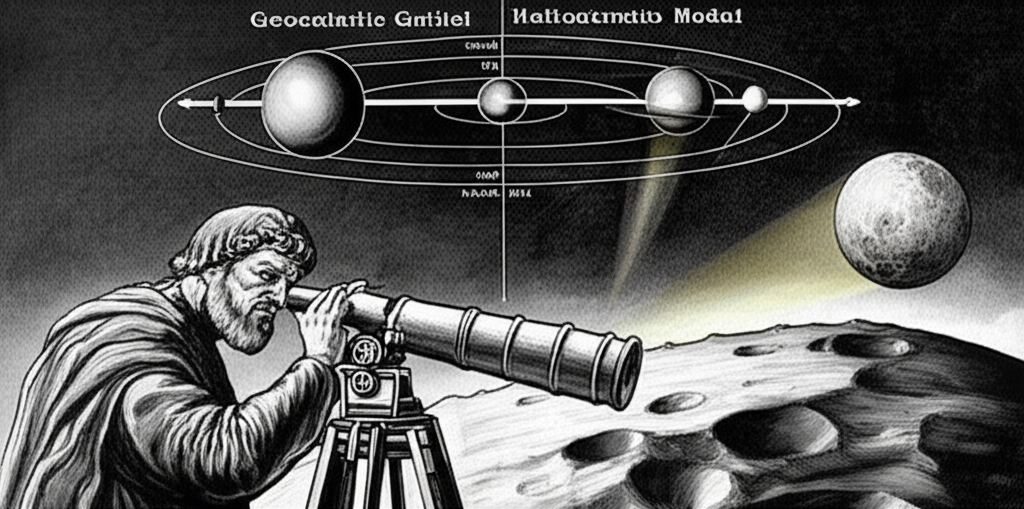
Consider the profound shift from a geocentric to a heliocentric worldview, a cornerstone of Western thought illuminated in the Great Books of the Western World. For centuries, the Ptolemaic system, with Earth at its center, was the dominant hypothesis. It was a complex but remarkably predictive model, explaining planetary motions with epicycles and deferents. However, as observations grew more precise, particularly with figures like Copernicus, Galileo, and Kepler, the simpler, more elegant heliocentric hypothesis began to gain traction.
- Geocentric Hypothesis (Ptolemy): Earth is the stationary center of the universe; celestial bodies orbit Earth.
- Heliocentric Hypothesis (Copernicus): The Sun is the center of the solar system; Earth and other planets orbit the Sun.
This transition wasn't instantaneous; it was a grueling process of data accumulation, mathematical refinement, and courageous reasoning that ultimately favored the hypothesis that better explained the observed reality and offered greater predictive power.
The Anatomy of an Astronomical Hypothesis
A good hypothesis in astronomy shares characteristics with those in any other science: it must be testable, falsifiable, and grounded in existing knowledge. It serves as a bridge between the unknown and the known, a proposed explanation awaiting validation or refutation.
Key Characteristics:
- Testability: There must be a way to gather evidence (observational or experimental) that either supports or refutes the hypothesis.
- Falsifiability: It must be possible to conceive of an observation or experiment that could prove the hypothesis wrong. A hypothesis that can't be disproven isn't scientific.
- Explanatory Power: It should offer a plausible explanation for existing observations.
- Predictive Power: It should be able to predict new observations or phenomena.
The Scientific Method in the Stars
The scientific method, a systematic approach to inquiry, is where the hypothesis truly shines in astronomy.
Steps in Astronomical Inquiry:
- Observation: Noticing a phenomenon or pattern (e.g., the anomalous rotation curves of galaxies).
- Question: Posing a question about the observation (e.g., "Why do galaxies rotate faster than visible matter suggests?").
- Hypothesis Formulation: Proposing a testable explanation (e.g., "There exists an unseen form of matter—dark matter—that provides additional gravitational pull.").
- Prediction: Deducing specific, observable consequences if the hypothesis is true (e.g., "If dark matter exists, then gravitational lensing effects around galaxy clusters should be stronger than predicted by visible matter alone.").
- Testing (Observation/Experiment): Designing and conducting observations or experiments to check the predictions (e.g., measuring gravitational lensing around galaxy clusters).
- Analysis and Conclusion: Evaluating the results. Does the evidence support or refute the hypothesis?
- Revision/Refinement: If results refute, revise or discard the hypothesis. If results support, strengthen the hypothesis and formulate new predictions.
This iterative process, fueled by rigorous reasoning, is how astronomy builds its robust understanding of the universe.
The Power of Reasoning in Hypothesis Development
Reasoning is the invisible scaffolding upon which hypotheses are built and tested. Both inductive and deductive reasoning play critical roles.
- Inductive Reasoning: Moving from specific observations to general principles. For example, observing the consistent patterns of planetary motion led Kepler to hypothesize his laws of planetary motion.
- Deductive Reasoning: Moving from general principles to specific predictions. Once a hypothesis is formed (e.g., Einstein's theory of general relativity), deductive reasoning allows us to predict specific phenomena (e.g., the bending of starlight around massive objects), which can then be tested.
Without sound reasoning, a hypothesis is merely a guess; with it, it becomes a powerful tool for scientific discovery.
Modern Astronomical Hypotheses and Future Exploration
Today, astronomy continues to push the boundaries of knowledge through groundbreaking hypotheses.
| Hypothesis | Description | Current Status |
|---|---|---|
| Dark Matter | An invisible, non-baryonic form of matter that accounts for the anomalous rotation of galaxies and galaxy clusters. | Strong observational evidence, but direct detection remains elusive. |
| Dark Energy | A mysterious force causing the accelerated expansion of the universe. | Observational evidence from supernovae and cosmic microwave background. Nature unknown. |
| Cosmic Inflation | A period of extremely rapid expansion in the early universe, explaining its flatness and homogeneity. | Supported by cosmic microwave background anisotropies. |
| Exoplanetary Life | The hypothesis that life exists beyond Earth, particularly on exoplanets within habitable zones. | Active area of research; no definitive proof yet, but increasing evidence of suitable environments. |
| Multiverse Theory | The hypothesis that our universe is just one of many, possibly infinite, universes. | Highly speculative, difficult to test directly, but explored theoretically. |
These hypotheses are not static; they are dynamic frameworks constantly being challenged, refined, or potentially overturned by new data. They represent the frontier of our understanding, driving the development of new telescopes, missions, and theoretical models.
📹 Related Video: KANT ON: What is Enlightenment?
Video by: The School of Life
💡 Want different videos? Search YouTube for: ""Great Books of the Western World Astronomy""
📹 Related Video: SOCRATES ON: The Unexamined Life
Video by: The School of Life
💡 Want different videos? Search YouTube for: ""Scientific Method in Astronomy""
Conclusion: The Unending Quest
The hypothesis is more than just a starting point in astronomy; it is the very engine of progress. From the ancient reasoning of the Greeks to the cutting-edge theories of today, every significant leap in our understanding of the cosmos has been predicated on the bold, testable propositions that define scientific inquiry. As we continue to gaze skyward, armed with ever more sophisticated instruments and minds, it is the humble yet profound hypothesis that will continue to guide our journey through the stars, unveiling the universe's deepest secrets, one reasoned step at a time. The pursuit of science in astronomy is an unending quest, eternally driven by the spirit of inquiry encapsulated in every new hypothesis.