

The Logic of Opposition: A Cornerstone of Philosophical Inquiry
By Emily Fletcher
The notion of opposition is not merely a linguistic quirk but a fundamental principle underpinning much of our Logic, Reasoning, and the very progression of thought itself. From the ancient Greeks to modern analytical philosophy, understanding how ideas, statements, and concepts stand in relation to their contraries or contradictions has been essential for discerning truth, constructing arguments, and navigating the complexities of reality. This article delves into the enduring significance of opposition, exploring its historical trajectory and its vital role in the Dialectic of intellectual progress.
Unpacking the Essence of Opposition
At its core, opposition describes the relationship between two propositions that cannot both be true, or cannot both be false, or both. It is through the rigorous examination of these opposing forces that we refine our understanding, challenge assumptions, and forge new knowledge. Without the capacity to identify and analyze opposition, our Reasoning would lack the critical edge necessary for intellectual growth, leaving us with a monolithic and unchallenged view of the world.
Ancient Echoes: The Genesis of Opposing Ideas
The philosophical exploration of opposition dates back to the very dawn of Western thought. Thinkers like Heraclitus famously asserted that "the path up and the path down are one and the same," highlighting a universe in constant flux, driven by the tension of opposites. Parmenides, on the other hand, argued for a singular, unchanging reality, implicitly defining "being" by contrasting it with "non-being."
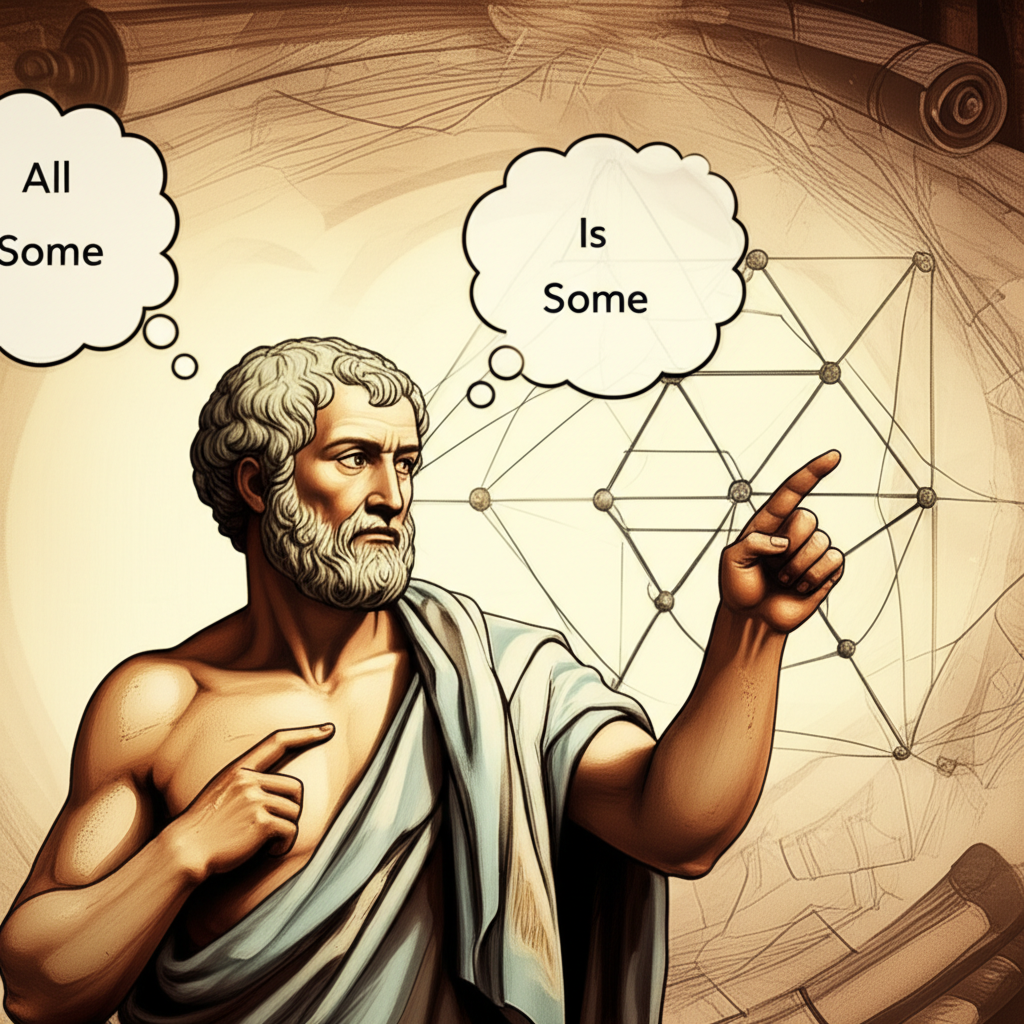
However, it was Aristotle, a towering figure in the Great Books of the Western World, who systematically laid the groundwork for understanding logical opposition. In his Organon, particularly in On Interpretation, he meticulously categorized the relationships between propositions, giving us the enduring framework of the Square of Opposition.
Aristotle's Square of Opposition
Aristotle's Square of Opposition illustrates the logical relationships between four types of categorical propositions:
| Type of Proposition | Relationship | Example |
|---|---|---|
| A: Universal Affirmative | All S are P | All dogs are mammals. |
| E: Universal Negative | No S are P | No dogs are cats. |
| I: Particular Affirmative | Some S are P | Some dogs are brown. |
| O: Particular Negative | Some S are not P | Some dogs are not brown. |
Within this square, several key relationships emerge:
- Contradictories (A & O; E & I): These propositions cannot both be true and cannot both be false. If "All S are P" is true, then "Some S are not P" must be false, and vice-versa.
- Contraries (A & E): These propositions cannot both be true, but can both be false. "All S are P" and "No S are P" cannot simultaneously be true, but it could be false that all S are P and also false that no S are P (meaning some S are P and some S are not P).
- Subcontraries (I & O): These propositions cannot both be false, but can both be true. "Some S are P" and "Some S are not P" can both be true (e.g., some fruit is red, some fruit is not red), but cannot both be false.
- Subalterns (A & I; E & O): The truth of the universal proposition (A or E) implies the truth of its corresponding particular proposition (I or O), but not vice-versa. If "All S are P" is true, then "Some S are P" must also be true.
This meticulous classification by Aristotle provided a robust tool for analyzing arguments and identifying fallacies, cementing Logic as a foundational discipline.
The Dialectic: Opposition as a Catalyst for Progress
While Aristotle focused on the static relationships of opposition, later philosophers, particularly within the German idealist tradition, saw opposition as a dynamic force driving intellectual and historical development. Immanuel Kant, for instance, grappled with antinomies – pairs of contradictory propositions, both seemingly provable – in his exploration of pure reason, highlighting the inherent tensions within human understanding.
However, it was G.W.F. Hegel who most famously elevated Dialectic to the central method of philosophical inquiry, where opposition is not merely an obstacle but the very engine of progress.
Hegel's Dialectical Method
Hegel's Dialectic describes a process where ideas evolve through a series of oppositions and resolutions:
- Thesis: An initial concept, idea, or state of affairs. This is a partial truth, often incomplete or one-sided.
- Antithesis: The opposing idea or concept that emerges from the limitations or contradictions inherent in the thesis. It challenges the initial proposition.
- Synthesis: A new, more comprehensive idea that resolves the tension between the thesis and antithesis, incorporating elements of both into a higher truth. This synthesis then becomes a new thesis, restarting the process.
For Hegel, this ongoing cycle of opposition and resolution is not just a method of philosophical Reasoning but the very structure of reality and history itself, leading towards an ever-greater understanding of the Absolute Spirit. This dynamic view transformed how philosophers approached problems, seeing conflict not as an end, but as a necessary step towards deeper insight.
The Enduring Relevance of Opposition in Reasoning
Today, the principles of opposition remain indispensable across various fields. In critical thinking, identifying contradictory statements is crucial for evaluating arguments. In scientific inquiry, hypotheses are often tested against null hypotheses, embodying a form of opposition. In ethical dilemmas, we often weigh opposing values or duties.
Understanding the Logic of opposition allows us to:
- Clarify Concepts: By defining what something is, we often implicitly define what it is not.
- Identify Inconsistencies: Recognizing contradictions is the first step towards resolving them in our beliefs or arguments.
- Facilitate Debate: Productive debate hinges on presenting and analyzing opposing viewpoints.
- Drive Innovation: The tension between existing solutions and their perceived limitations often sparks new ideas and advancements.
In essence, embracing the Logic of opposition means embracing the dynamic nature of knowledge. It teaches us that truth is often found not in the absence of conflict, but in the intelligent engagement with it. It is through this perpetual dance of ideas that our Reasoning evolves, pushing the boundaries of what we know and how we understand the world.
YouTube Video Suggestions:
-
📹 Related Video: ARISTOTLE ON: The Nicomachean Ethics
Video by: The School of Life
💡 Want different videos? Search YouTube for: ""Aristotle Square of Opposition Explained""
-
📹 Related Video: KANT ON: What is Enlightenment?
Video by: The School of Life
💡 Want different videos? Search YouTube for: ""Hegel Dialectic Explained Thesis Antithesis Synthesis""