

The Cradle of Thought: Unpacking the Philosophical Role of the Family
Summary: The family, often seen as a mere social unit, holds a profound and complex philosophical role, serving as the foundational nexus where individuals first encounter ethics, custom and convention, and the nascent structures that precede the State. This article explores how philosophers, from ancient Greece to the Enlightenment, have grappled with the family's influence on personal identity, moral development, and its intricate relationship with larger societal and political formations, drawing insights from the Great Books of the Western World.
Introduction: The Enduring Significance of the Family in Philosophy
The very notion of "family" conjures images of belonging, intimacy, and shared history. Yet, beneath these immediate associations lies a rich tapestry of philosophical inquiry. For centuries, thinkers have pondered the family's fundamental nature, its purpose, and its undeniable impact on human experience. Is it a natural institution, a social construct, or perhaps something in between? As Philosophy seeks to understand the deepest truths of existence, the Family emerges as a crucial lens through which to examine morality, societal order, and the human condition itself. Its ubiquitous presence across cultures and throughout history, as documented in the Great Books of the Western World, underscores its irreplaceable role in shaping human thought and society.
The Family as the First School of Philosophy
Long before formal education or civic engagement, the family unit serves as the primary crucible for an individual's development, shaping their initial understanding of the world, ethics, and social interaction. It is here that the seeds of philosophical thought are often sown, albeit unconsciously.
Early Moral Development and Identity
Within the family, children learn their first lessons in justice, fairness, love, and obligation. These aren't abstract concepts but lived experiences: sharing toys, resolving sibling disputes, understanding parental authority, and receiving care. These interactions lay the groundwork for a personal moral compass. Philosophers like Aristotle, whose work is foundational in the Great Books of the Western World, recognized the household (oikos) as the primary unit where virtues are cultivated, essential for the later flourishing of the citizen within the polis. The family thus becomes the initial laboratory for ethical conduct, influencing an individual's sense of self and their place in the world. This early shaping of character is a profound philosophical function, as it precedes and informs all subsequent moral reasoning.
Transmitting Values, Customs, and Conventions
The family is a powerful conduit for the transmission of cultural heritage, values, and traditions. From table manners to religious observances, from linguistic nuances to historical narratives, it is through familial bonds that custom and convention are first internalized. This process is not merely rote memorization but an active shaping of worldview. These inherited frameworks provide the initial interpretative lens through which individuals begin to make sense of society and their role within it. The enduring nature of these familial transmissions highlights their philosophical weight in defining communal identity and continuity across generations, linking individuals to a broader historical and cultural narrative.
The Family and the State: A Contested Relationship
The relationship between the family and the State has been a perennial subject of philosophical debate, often characterized by tension, interdependence, and evolving definitions of authority and responsibility.
Foundational Perspectives from the Great Books
Philosophers featured in the Great Books of the Western World have offered diverse perspectives on this dynamic:
- Aristotle: Viewed the family as the most basic association, naturally leading to the village, and ultimately to the State (the polis). For Aristotle, the household was crucial for supplying the needs of life, while the polis existed for the sake of the good life. The family's purpose was inherently tied to sustaining and preparing individuals for citizenship.
- Plato: In his Republic, Plato famously proposed a radical restructuring of the family for the guardian class, advocating for communal child-rearing to ensure ultimate loyalty to the State, rather than private familial affections. This extreme view underscores the perceived tension between private family loyalties and public civic duty.
- John Locke: In his Two Treatises of Government, Locke posited the family as a natural society based on consent and natural law, preceding the State. While acknowledging parental authority, he also emphasized the temporary nature of this power, which eventually gives way to individual liberty and the need for government by consent.
- Jean-Jacques Rousseau: In The Social Contract, Rousseau explored how the family, while the oldest of all societies, is the only natural one. However, he argued that even familial bonds become conventional once children grow up and are no longer dependent. For the State to function, individuals must transition their primary allegiance from the family to the general will of the community.
These varying perspectives highlight the philosophical questions surrounding the locus of authority, the nature of rights, and the delicate balance between private life and public good.
Key Philosophical Intersections: Family, State, and Individual
| Philosophical Concept | Role of the Family | Relationship with the State |
|---|---|---|
| Moral Education | Primary agent for teaching virtues, ethics, and social norms. | Lays groundwork for responsible citizenship; can either align with or challenge state-mandated morality. |
| Social Reproduction | Ensures continuation of society through procreation and upbringing. | Provides new citizens/subjects; state often regulates marriage, birth, and inheritance. |
| Identity Formation | Shapes individual's initial sense of self, belonging, and cultural heritage. | Influences loyalty to the state vs. family; state seeks to integrate individual identity into national identity. |
| Economic Unit | Often functions as a unit of production or consumption, providing mutual support. | Interacts with state economic policies (taxes, welfare); can be a source of economic stability or dependency. |
| Custom & Convention | Repository and transmitter of traditions, rituals, and social practices. | Can either reinforce or conflict with state laws and official culture; source of cultural diversity and historical continuity. |
Custom and Convention: The Family's Enduring Foundation
The structure and function of the family are deeply interwoven with custom and convention. These unwritten rules, inherited practices, and societal expectations often dictate everything from marriage rites to inheritance laws, from gender roles to child-rearing practices.
Social Norms and Family Structures
Philosophers exploring the concept of Custom and Convention recognize that while some aspects of family might appear "natural" (e.g., biological parentage), many of its most profound characteristics are products of human agreement and historical development. What constitutes a "family" has varied immensely across cultures and epochs, reflecting prevailing social norms, economic realities, and religious beliefs. These conventions are not arbitrary; they often serve to maintain social order, provide stability, and define acceptable behavior within a community. They represent a collective philosophical understanding of how society ought to be structured.
Evolution of Family Concepts
From polygamy to monogamy, from extended clans to nuclear units, the very definition of family is a testament to the power of custom and convention. Modern philosophical discussions often grapple with the implications of evolving family structures (e.g., same-sex partnerships, single-parent households) for established legal frameworks, ethical considerations, and the very fabric of society. This ongoing evolution challenges us to re-examine our assumptions about the "natural" and the "conventional" in family life, pushing the boundaries of what Philosophy considers essential to human flourishing and societal well-being.
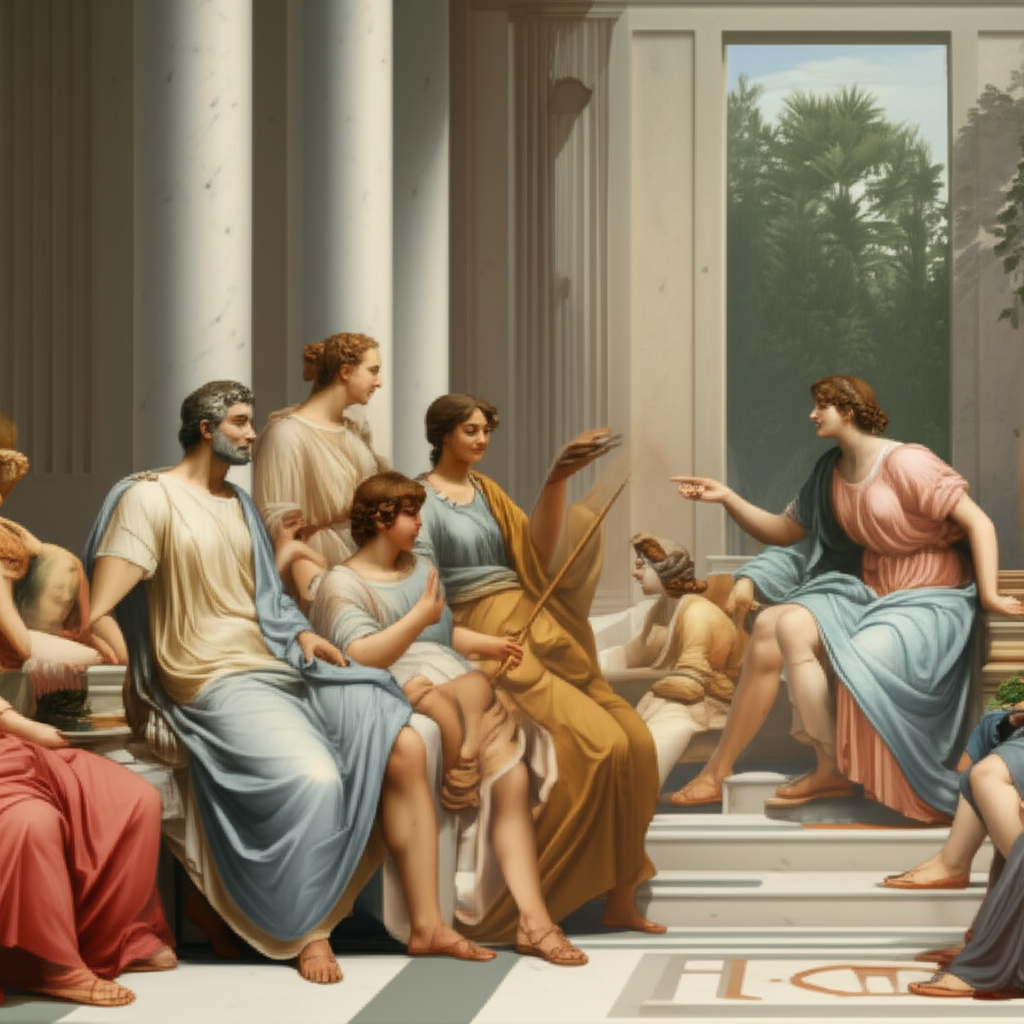 observing or engaging with family members, subtly highlighting the educational and societal role of the household. The scene should convey a sense of order, learning, and the transmission of values, with children engaged in simple tasks or listening to elders, set against an architectural backdrop that suggests the broader societal context of the polis.)
The Family as a Site of Ethical Inquiry
Beyond its social and political dimensions, the family remains a potent site for profound ethical inquiry. Concepts such as love, duty, sacrifice, loyalty, and forgiveness are often experienced most intensely and complexly within familial relationships.
- Love and Obligation: What is the nature of parental love, filial duty, or spousal commitment? Are these obligations freely chosen, naturally endowed, or socially constructed, and what are their ethical implications?
- Sacrifice and Selflessness: The family often demands personal sacrifice for the well-being of others, raising questions about altruism, egoism, and the limits of individual autonomy.
- Justice within the Household: How are resources distributed, decisions made, and conflicts resolved fairly within the family? These micro-ethical dilemmas often mirror larger societal questions of justice and fairness.
These intimate dynamics provide rich ground for Philosophy to explore the very essence of human connection and moral responsibility, offering a lived experience of ethical dilemmas that often transcend abstract theory.
Conclusion: The Enduring Philosophical Significance
The Family, far from being a simple biological or social unit, stands as a cornerstone of Philosophy, deeply implicated in the formation of individual identity, the development of moral character, and the intricate relationship with the State. Through its role in transmitting custom and convention, and by serving as the primary arena for ethical experience, the family continues to challenge and inform our understanding of what it means to be human, to live a good life, and to build a just society. Its enduring presence in the Great Books of the Western World is a testament to its irreplaceable philosophical significance in the human story, proving that the deepest questions often begin at home.
**## 📹 Related Video: PLATO ON: The Allegory of the Cave
Video by: The School of Life
💡 Want different videos? Search YouTube for: ""Aristotle family state philosophy" or "Plato family republic philosophy""**