

The Logic of Induction and Deduction: Paths to Knowledge
At the heart of all human understanding, from the simplest observation to the most profound scientific theory, lie two fundamental modes of reasoning: induction and deduction. These are the twin pillars of logic that we employ, often unconsciously, to construct our knowledge of the world. While seemingly distinct, grasping their individual strengths and limitations is crucial for anyone seeking to navigate the complexities of thought and build a robust framework for truth. This article will explore these essential logical processes, tracing their philosophical lineage and illuminating their indispensable role in both everyday life and the grand pursuit of philosophical inquiry.
Unpacking the Fundamentals: A Brief Overview
In essence, deduction moves from the general to the specific, guaranteeing its conclusions if its premises are true. It's the realm of certainty, where logic dictates an undeniable outcome. Induction, conversely, travels from the specific to the general, using particular observations to formulate broader theories or predictions. It's the engine of discovery, though its conclusions, while highly probable, never achieve the absolute certainty of deduction. Together, they form the bedrock upon which all our systems of knowledge are built.
Deduction: The Unyielding Structure of Logic
Deductive reasoning is often considered the gold standard of logic because of its ability to guarantee the truth of its conclusions, provided its premises are true and the argument is valid. It's a method that moves from general principles or universal truths to specific instances.
Characteristics of Deductive Arguments:
- Validity: A deductive argument is valid if its conclusion logically follows from its premises. If the premises are true, the conclusion must be true.
- Soundness: A deductive argument is sound if it is valid and all its premises are true. A sound argument always yields a true conclusion.
- Certainty: When a deductive argument is sound, its conclusion is certain.
A classic example, often attributed to Aristotle in the Great Books of the Western World, is the syllogism:
- Premise 1: All men are mortal. (General principle)
- Premise 2: Socrates is a man. (Specific instance)
- Conclusion: Therefore, Socrates is mortal. (Specific, guaranteed outcome)
In this example, if the first two premises are accepted as true, the conclusion is inescapable. The logic here is airtight. Deductive reasoning is foundational to mathematics, formal logic, and any field where certainty and consistency are paramount. It allows us to apply established rules and definitions to new situations with confidence, expanding our knowledge within defined boundaries.
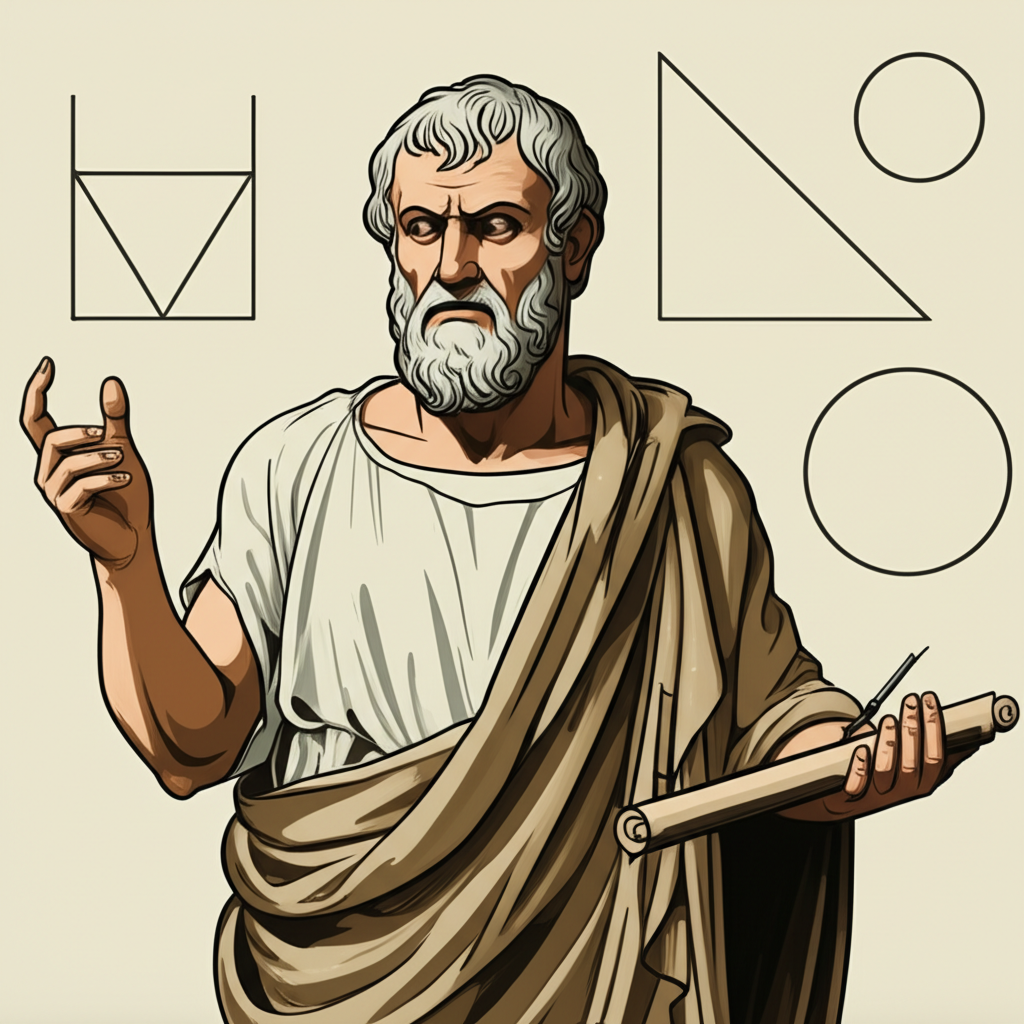 subtly depicted in the background, symbolizing the foundational nature of his logical contributions.)
Induction: The Leap of Experience and Knowledge
While deduction offers certainty within its confines, induction is the engine of discovery, allowing us to venture beyond what is explicitly known. Inductive reasoning involves drawing general conclusions or making predictions based on specific observations or experiences. It moves from the particular to the general, building knowledge by identifying patterns and making generalizations.
Characteristics of Inductive Arguments:
- Probability: Inductive conclusions are probable, not certain. Even with true premises, the conclusion could still be false.
- Generalization: It often involves making generalizations from a limited set of observations.
- Predictive Power: It allows us to predict future events based on past patterns.
Consider the following inductive argument:
- Observation 1: Every swan I have ever seen is white.
- Observation 2: Every swan observed by my colleagues is white.
- Conclusion: Therefore, all swans are white.
Historically, this was a widely accepted "truth" until the discovery of black swans in Australia. This example perfectly illustrates the inherent limitation of induction: even a vast number of confirming observations does not guarantee the absolute truth of the generalization. David Hume, another giant from the Great Books of the Western World, famously highlighted the "problem of induction," pointing out that our belief in the uniformity of nature (that future events will resemble past ones) is itself an inductive leap, not a deductively provable truth.
Despite this inherent uncertainty, inductive reasoning is indispensable for scientific inquiry, everyday decision-making, and the very expansion of our knowledge. It allows us to formulate hypotheses, build theories, and learn from experience, constantly refining our understanding of the world.
Comparing the Two: Distinct Roads to Reasoning
To better appreciate the unique contributions of induction and deduction, let's consider their key differences:
| Feature | Deductive Reasoning | Inductive Reasoning |
|---|---|---|
| Direction | From general principles to specific conclusions | From specific observations to general conclusions |
| Conclusion | Guaranteed if premises are true and argument is valid | Probable, but not guaranteed, even with true premises |
| Scope | Narrows down to a specific truth | Broadens to a general theory or prediction |
| Risk | Low risk of error in conclusion (if premises are true) | Higher risk of error in conclusion (future observations) |
| Primary Use | Proving, verifying, applying known rules | Discovering, hypothesizing, generalizing, predicting |
| Example | Syllogisms, mathematical proofs | Scientific experiments, statistical analysis |
Both forms of logic are crucial. Deduction provides the framework and internal consistency for our theories, while induction provides the empirical data and the impetus for new theories. Without induction, we would have no new premises for deduction, and without deduction, our inductive generalizations would lack rigorous testing and internal coherence.
The Philosophical Implications: Building Knowledge, Facing Uncertainty
The interplay between induction and deduction has profound implications for how we construct knowledge. Philosophy, from its earliest days, has grappled with how we can reliably know anything. The Great Books of the Western World are replete with attempts to solidify our understanding of truth, from Plato's forms to Kant's critiques of pure reason.
Our capacity for reasoning is what elevates us, enabling us to move beyond mere sensation. Deduction offers us a path to certainty within a closed system, a comfort in a world often defined by ambiguity. Induction, on the other hand, embraces that ambiguity, pushing the boundaries of our knowledge through observation and generalization, even if it means accepting a degree of uncertainty. The scientific method itself is a testament to this collaborative dance: inductive observations lead to hypotheses, which are then tested deductively, leading to refined inductive generalizations.
To truly understand the world, we must master both. We must appreciate the unyielding power of deductive logic to verify and structure our thoughts, and simultaneously embrace the adventurous spirit of inductive reasoning to explore, discover, and expand the very horizons of our knowledge. The journey of inquiry is not a choice between these two, but a masterful orchestration of their unique strengths.
YouTube: "What is Deduction vs Induction?"
YouTube: "The Problem of Induction Explained"
📹 Related Video: What is Philosophy?
Video by: The School of Life
💡 Want different videos? Search YouTube for: "The Logic of Induction and Deduction philosophy"