

The Logic of Definition and Essence: Unpacking the What Is
A Journey into the Heart of Understanding
Summary: This article delves into the profound philosophical interplay between Logic, Definition, and Essence, exploring how our attempts to define things are fundamentally an endeavor to grasp their true Being. Drawing on centuries of philosophical inquiry, we examine how the disciplined application of Logic guides us in formulating precise Definitions that aim to capture the immutable Idea or intrinsic nature of a subject, revealing its very Essence.
The Enduring Quest: To Define is to Understand
From the ancient agora, where Socrates relentlessly pursued the definition of virtues like justice and courage, to the systematic treatises of Aristotle categorizing all Being, humanity has been driven by an insatiable desire to understand what things are. This pursuit is not merely an academic exercise; it is the very foundation upon which all coherent thought, communication, and knowledge are built. Without clear definitions, our concepts remain nebulous, our arguments crumble, and our understanding of the world remains superficial.
At the core of this quest lies the inseparable relationship between Logic, Definition, and Essence. To define something is to delineate its boundaries, to articulate its distinguishing characteristics, and ultimately, to reveal its fundamental Being.
The Logical Framework of Definition
Logic provides the indispensable tools for constructing sound definitions. It teaches us the principles of clear thought, identifying fallacies and ensuring that our intellectual structures are robust. A definition, in its most rigorous sense, is an attempt to capture the Essence of a thing – that which makes it what it is, and without which it would cease to be that particular thing.
Consider the classical approach to definition, often articulated as genus proximum and differentia specifica:
- Genus (Kind): The broader category to which the thing belongs.
- Differentia (Difference): The specific characteristic that distinguishes it from all other members of that genus.
Example:
- Human:
- Genus: Animal
- Differentia: Rational (or, as some might argue, tool-making, language-using, etc.)
This logical structure helps us to systematically narrow down the Idea of a thing, stripping away accidental properties to reveal its essential core. The challenge, of course, lies in identifying that truly essential differentia.
Essence: The Unseen Core of Being
The concept of Essence is perhaps one of the most profound and contested in philosophy. It refers to the intrinsic nature or indispensable properties that constitute a thing's identity. When we speak of the Essence of a triangle, we mean its three-sided, three-angled nature; remove any of these, and it ceases to be a triangle.
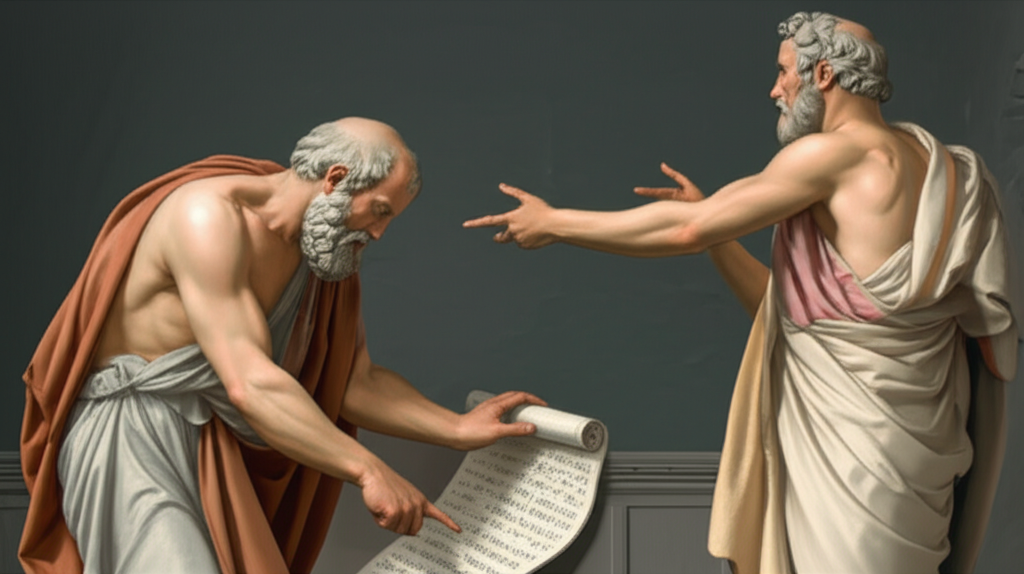
Philosophers across the ages, from Plato's eternal Forms to Aristotle's concept of substance, have grappled with how to access and describe this Essence. Is Essence something inherent in the thing itself, independent of our minds, or is it a construct of our Idea?
The Great Books of the Western World are replete with such inquiries:
- Plato's Forms: Suggest that true Essences (Forms or Ideas) exist independently in a perfect, unchanging realm, and the physical world merely participates in them. Our definitions are attempts to recollect or approximate these perfect Forms.
- Aristotle's Substance: Argued that Essence is immanent within the particular thing itself, not separate. Definition then becomes the process of abstracting this immanent Essence through observation and Logic.
- Descartes' Clear and Distinct Ideas: Emphasized that true Essences are grasped through rational intuition, leading to Ideas that are so clear and distinct they cannot be doubted.
The Role of Idea in Shaping Definition
Our Ideas are the mental representations we form of things. They are the raw material with which Logic works to forge definitions of Essence. The quality of our definitions, therefore, is intimately tied to the clarity and accuracy of our underlying Ideas.
| Philosophical Approach | Relationship of Idea to Essence | Impact on Definition |
|---|---|---|
| Realism | Ideas correspond to objective Essences | Definitions aim to discover and reflect inherent truths |
| Conceptualism | Essences are mental constructs | Definitions are descriptions of our concepts |
| Nominalism | No universal Essences, only names | Definitions are conventions for grouping particulars |
The ongoing dialogue between these perspectives highlights the profound challenge: how do we ensure that our subjective Ideas, shaped by our experiences and language, accurately reflect the objective Essence of Being? This is where the rigorous application of Logic becomes paramount, acting as a critical filter for our Ideas.
The Practical Implications of Sound Definition
The pursuit of clear definition and the understanding of Essence is not confined to the ivory tower. Its implications permeate every aspect of human endeavor:
- Science: Precise definitions of phenomena, elements, and laws are fundamental to scientific progress.
- Law: The definition of crimes, rights, and responsibilities forms the bedrock of justice.
- Ethics: Defining good, evil, duty, and virtue is essential for moral reasoning.
- Everyday Communication: Misunderstandings often stem from differing definitions of the same term.
To engage in the Logic of Definition is to engage in the very act of knowing. It is to move beyond superficial appearance and strive for a deeper comprehension of Being itself. This rigorous intellectual discipline, honed through centuries of philosophical debate, remains our most potent tool for clarifying our Ideas and articulating the Essence of the world around us.
Further Exploration
-
📹 Related Video: ARISTOTLE ON: The Nicomachean Ethics
Video by: The School of Life
💡 Want different videos? Search YouTube for: "Aristotle Categories and Metaphysics essence"
-
📹 Related Video: PLATO ON: The Allegory of the Cave
Video by: The School of Life
💡 Want different videos? Search YouTube for: "Plato Theory of Forms explained"