

The Limitless Nature of Infinity: A Philosophical Inquiry
The concept of infinity stands as one of the most profound and perplexing ideas ever contemplated by the human mind. Far from being a mere abstract mathematical construct, infinity permeates our understanding of reality, stretching the very fabric of thought from the smallest subatomic particles to the grandest cosmological scales. This article delves into the multifaceted nature of infinity, exploring its critical role in mathematics, its deep implications for metaphysics, and its enduring power as a philosophical idea that challenges the limits of human comprehension. We will journey through its historical development, examine its various manifestations, and ultimately contend that infinity is not just a concept, but a fundamental lens through which we attempt to grasp the boundless.
The Mathematical Ascent: Quantifying the Unquantifiable
Our most tangible encounters with infinity often begin in the realm of mathematics. From the endless sequence of natural numbers (1, 2, 3...) to the intricacies of calculus, mathematicians have grappled with the notion of endlessness and the infinitely small.
Early Encounters and Paradoxes
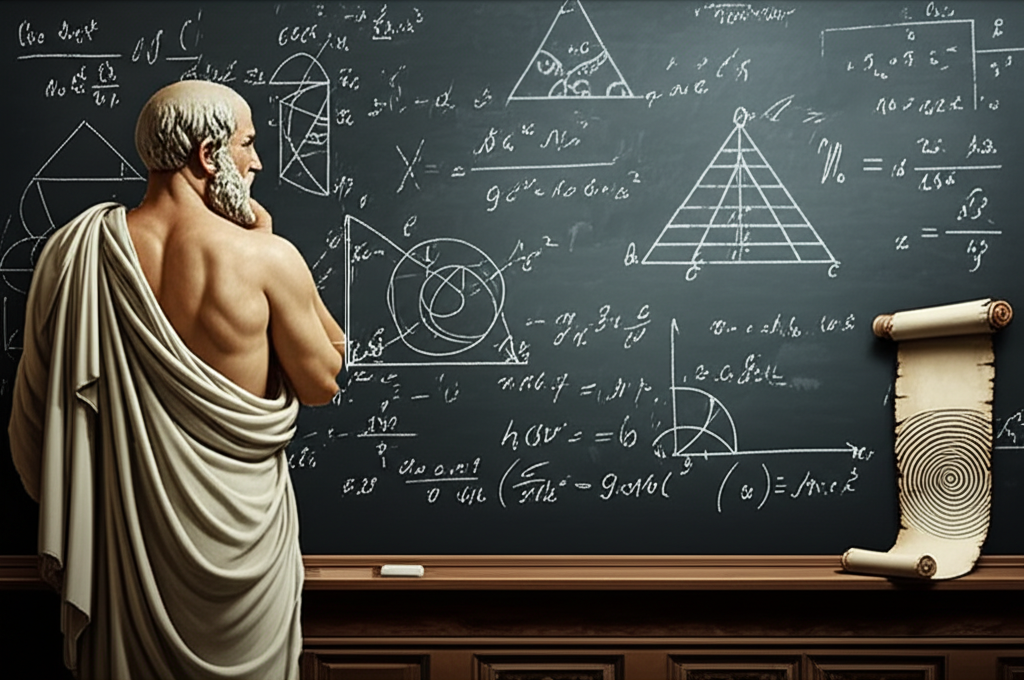
Ancient Greek thinkers, as chronicled in the Great Books of the Western World, wrestled with the idea of infinity primarily as a potentiality. Aristotle, for instance, distinguished between potential infinity (something that can always be added to, like a number sequence) and actual infinity (a completed, boundless whole), largely denying the latter in the physical world. Zeno's paradoxes, such as Achilles and the Tortoise, ingeniously highlighted the challenges of dealing with infinite divisions of space and time, demonstrating how intuitive understandings break down when confronted with the boundless.
Cantor's Revolution: Infinities of Different Sizes
It was not until the 19th century that Georg Cantor revolutionized our understanding of mathematical infinity. Cantor demonstrated, counter-intuitively, that there are different "sizes" of infinity. He showed that the set of real numbers, for example, is "larger" than the set of natural numbers, even though both are infinite. This groundbreaking work introduced concepts like transfinite numbers and continuum hypothesis, forever changing the landscape of mathematics and forcing a re-evaluation of what "limitless" truly means.
Key Mathematical Concepts of Infinity:
- Countable Infinity: The size of the set of natural numbers (ℵ₀ - Aleph-null).
- Uncountable Infinity: The size of the set of real numbers (c - the continuum), demonstrably larger than countable infinity.
- Transfinite Numbers: Numbers that are "beyond" all finite numbers but are not absolute infinity.
Metaphysical Horizons: Infinity in the Fabric of Reality
Beyond the precise calculations of mathematics, the idea of infinity extends into the realm of metaphysics, shaping our deepest inquiries into the nature of existence, divinity, and the cosmos itself.
The Infinite God and the Boundless Universe
Many philosophical and theological traditions, drawing from texts like those found in the Great Books, conceive of God as an infinite being – infinite in power, knowledge, and goodness. This idea of an infinite creator informs our understanding of divine transcendence and immanence. Similarly, the question of an infinite universe has captivated thinkers for millennia. Is the cosmos spatially infinite? Has it existed for an infinite duration? These questions probe the limits of our empirical observation and push us toward speculative thought.
Philosophers like Plotinus, whose work is foundational in Neoplatonism, spoke of "The One" as an utterly transcendent and infinite source from which all reality emanates. For Aquinas, synthesizing Aristotelian thought with Christian theology, God's infinity was a necessary attribute of a perfect being, distinct from the potential infinities found in creation.
The Problem of the Absolute Infinite
The notion of an "absolute infinite" – an infinity so vast that nothing can be added to it – represents the ultimate challenge to our conceptual faculties. This is where metaphysics truly grapples with the ungraspable. Can such an entity truly exist, or is it merely a regulative idea that guides our thought towards ultimate completeness? The very act of conceiving the absolute infinite highlights the tension between our finite minds and the boundless reality we attempt to apprehend.
Infinity as a Philosophical Idea: The Boundless in Human Thought
Ultimately, infinity is more than a mathematical quantity or a metaphysical attribute; it is a fundamental idea that informs our entire philosophical landscape, influencing epistemology, ethics, and our very self-conception.
The Limit of Knowledge and the Infinite Regress
In epistemology, the idea of infinity often arises in discussions about the foundations of knowledge. The problem of infinite regress, where every justification requires a prior justification, forces us to confront the limits of rational demonstration. This philosophical puzzle asks whether our knowledge can ever truly be grounded without recourse to an infinite chain of reasons, or if some foundational, non-inferential beliefs must exist.
Ethical and Aesthetic Dimensions
The idea of infinity also subtly shapes our ethical considerations. Concepts like infinite value (e.g., the infinite worth of a human life) or the infinite perfectibility of humanity draw upon this notion of boundlessness. In aesthetics, the sublime often evokes a sense of the infinite – the overwhelming grandeur of nature, the vastness of the cosmos, or the profound depth of human emotion – which transcends our finite capacity for comprehension.
Embracing the Boundless
The human mind, being finite, struggles to fully grasp infinity. Yet, it is precisely this struggle that makes the idea of infinity so profoundly enriching. It forces us to acknowledge the limitations of our perception and understanding, while simultaneously inspiring us to transcend them. Whether through the rigorous proofs of mathematics, the grand narratives of metaphysics, or the deep introspection of pure philosophy, infinity remains a beacon, reminding us that reality extends far beyond our current grasp, inviting endless contemplation and discovery.
YouTube Video Suggestions:
-
📹 Related Video: What is Philosophy?
Video by: The School of Life
💡 Want different videos? Search YouTube for: ""infinity mathematics philosophy Cantor paradoxes""
-
📹 Related Video: PLATO ON: The Allegory of the Cave
Video by: The School of Life
💡 Want different videos? Search YouTube for: ""Plato Aristotle infinite universe metaphysics""