

The Enduring Enigma: A Journey into the Immortality of the Soul
The concept of the immortality of the soul stands as one of humanity's most profound and persistent inquiries, deeply embedded in the annals of metaphysics and religion. This article delves into the rich philosophical tapestry surrounding the soul's nature and its potential for eternal existence, drawing insights from the enduring wisdom contained within the Great Books of the Western World. From ancient Greek contemplation to theological doctrines and modern philosophical challenges, we explore the arguments, questions, and enduring fascination with what lies beyond our mortal coil.
Plato's Ethereal Vision: The Soul's Unbreakable Nature
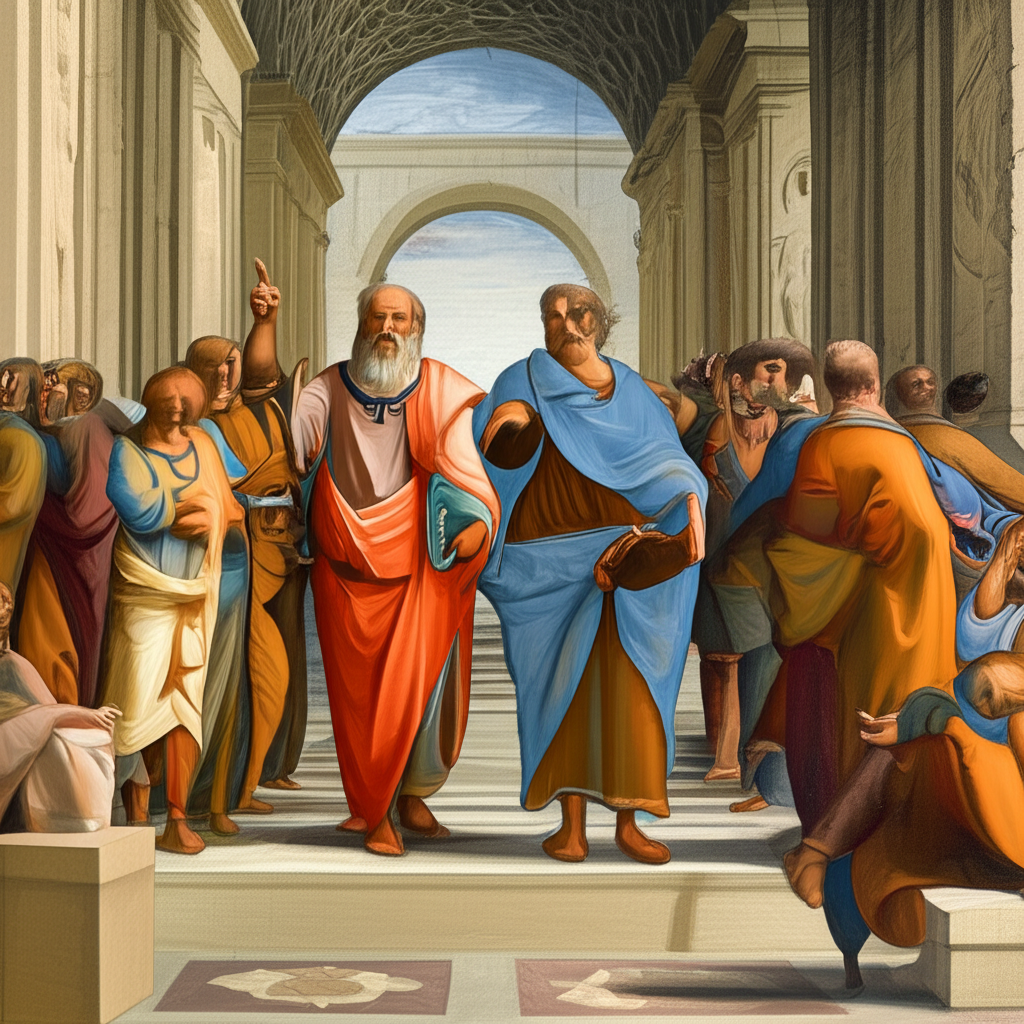
Our journey into the immortal soul invariably begins with Plato, whose dialogues, particularly the Phaedo and Meno, lay foundational arguments for its eternal nature. For Plato, the soul is not merely an epiphenomenon of the body but a distinct, divine, and imperishable entity.
Plato's arguments often hinge on several key ideas:
- The Argument from Recollection (Anamnesis): As seen in the Meno, Plato posits that learning is not acquiring new knowledge but recalling truths the soul knew before birth. This implies the soul existed prior to its embodiment.
- The Argument from Opposites: In the Phaedo, Socrates argues that just as life comes from death, and sleep from waking, so too must death lead to life, suggesting a cyclical existence for the soul.
- The Argument from Simplicity: The soul, being simple and indivisible, cannot be broken down and thus cannot perish. It is akin to the Forms – eternal, unchanging, and perfect – which the soul apprehends.
- The Argument from Affinity: The soul, being invisible and intelligible, is more akin to the divine and immortal Forms than to the visible and perishable body.
Plato's vision offers a compelling framework where the soul is the true self, merely temporarily housed in a body, destined to return to the realm of Forms. This perspective profoundly shaped Western thought.
Aristotle's Nuance: Soul as the Form of the Body
While a student of Plato, Aristotle offered a more integrated view of the soul in his De Anima. He posited that the soul is the form of the body – the principle of life and organization that makes a body a living thing. For Aristotle, the soul is not a separate entity imprisoned within the body but rather its animating principle.
He identified different types of souls:
- Nutritive Soul: Possessed by plants, responsible for growth and reproduction.
- Sensitive Soul: Possessed by animals, adding sensation and locomotion to the nutritive functions.
- Rational Soul: Unique to humans, encompassing all the functions of the lower souls, plus reason and intellect.
Aristotle's view makes the concept of a separable, immortal soul more complex. While he suggested that the active intellect might be separable and immortal, the soul, as the form of the body, generally perishes with the body. This more empirical approach presented a significant counterpoint to Plato's dualism.
The Theological Embrace: Soul in Western Religion
The concept of the immortal soul found fertile ground in the Abrahamic religions, becoming a cornerstone of Christian, Jewish, and Islamic theology. Thinkers like Augustine of Hippo and Thomas Aquinas, both deeply influenced by Greek philosophy, integrated the idea of an immortal soul into their theological systems.
- Augustine: Drawing heavily from Plato, Augustine saw the soul as distinct from the body, created by God, and destined for either eternal communion with God or eternal damnation. The soul's immortality was central to the Christian understanding of salvation and divine justice.
- Aquinas: Synthesizing Aristotle with Christian doctrine, Aquinas argued that the human soul, being rational, possesses an inherent capacity for independent intellectual operation that does not rely on bodily organs. This rational soul, being a subsistent form, is therefore incorruptible and immortal, capable of existing after the death of the body. He posited that the soul is the substantial form of the human being, uniting with the body to create a single substance, yet capable of separate existence.
For religious thought, the soul's immortality provides the basis for an afterlife, moral accountability, and the ultimate purpose of human existence, transcending the finitude of earthly life.
Descartes and the Mind-Body Problem
With René Descartes in the 17th century, the discussion of the soul took a distinctive turn, solidifying what is now known as Cartesian dualism. In his Meditations on First Philosophy, Descartes famously distinguished between two fundamentally different substances:
- Res Cogitans (Thinking Substance): The mind or soul, characterized by thought and lacking spatial extension.
- Res Extensa (Extended Substance): The body, characterized by extension in space and lacking thought.
Descartes argued that because the mind is an unextended, thinking thing, it is distinct from the extended, non-thinking body. This distinction, he believed, proved the immortality of the soul, as its essence is not tied to the physical properties of the body. However, this radical separation also introduced the perennial "mind-body problem": how do these two distinct substances interact? This question continues to challenge metaphysics today.
Contemporary Perspectives and Metaphysical Queries
In the modern era, the concept of the immortal soul faces considerable scrutiny, particularly from scientific and materialist perspectives. Neurophilosophy, for instance, often views consciousness and mental states as emergent properties of the brain, rather than the product of a distinct, non-physical soul.
Despite these challenges, the philosophical debate persists, grappling with fundamental metaphysical questions:
- What constitutes personal identity? If the soul is immortal, what aspects of our individual selves persist?
- How does consciousness relate to matter? Is consciousness reducible to brain activity, or is there an irreducible, non-physical component?
- The Problem of Universals: Do abstract concepts like justice or goodness exist independently, suggesting a realm that a non-physical soul might inhabit?
The quest for understanding the soul's nature and potential immortality continues to push the boundaries of human inquiry, blending ancient wisdom with contemporary scientific and philosophical tools.
The Enduring Quest for Immortality
From the ancient Greeks seeking truth in ideal forms to the theological assurances of an afterlife, and the modern philosophical wrestling with consciousness, the idea of the immortality of the soul remains a central pillar of human thought. It speaks to our deepest hopes, fears, and our innate desire to transcend the ephemeral nature of existence. Whether through philosophical reasoning, religious faith, or scientific exploration, the human mind continues its relentless pursuit of understanding the ultimate fate of the self. The Great Books remind us that this is not a new question, but one that has defined our intellectual and spiritual journey for millennia.
📹 Related Video: PLATO ON: The Allegory of the Cave
Video by: The School of Life
💡 Want different videos? Search YouTube for: ""Plato Phaedo Immortality Soul Summary""
📹 Related Video: KANT ON: What is Enlightenment?
Video by: The School of Life
💡 Want different videos? Search YouTube for: ""Descartes Dualism Mind Body Problem Explained""