

Summary: From the earliest stargazers to the most advanced observatories, astronomy has been a relentless sculptor of humanity's understanding of the 'world.' This article explores how our evolving comprehension of the cosmos has fundamentally reshaped our philosophical outlook on space, time, and our place within an ever-expanding, often humbling, universe. The journey through the Great Books of the Western World reveals a continuous dialogue between observation and introspection, where each celestial discovery has necessitated a re-evaluation of what we mean by 'world' itself.
The Ancient Cosmos: A Geocentric World of Order
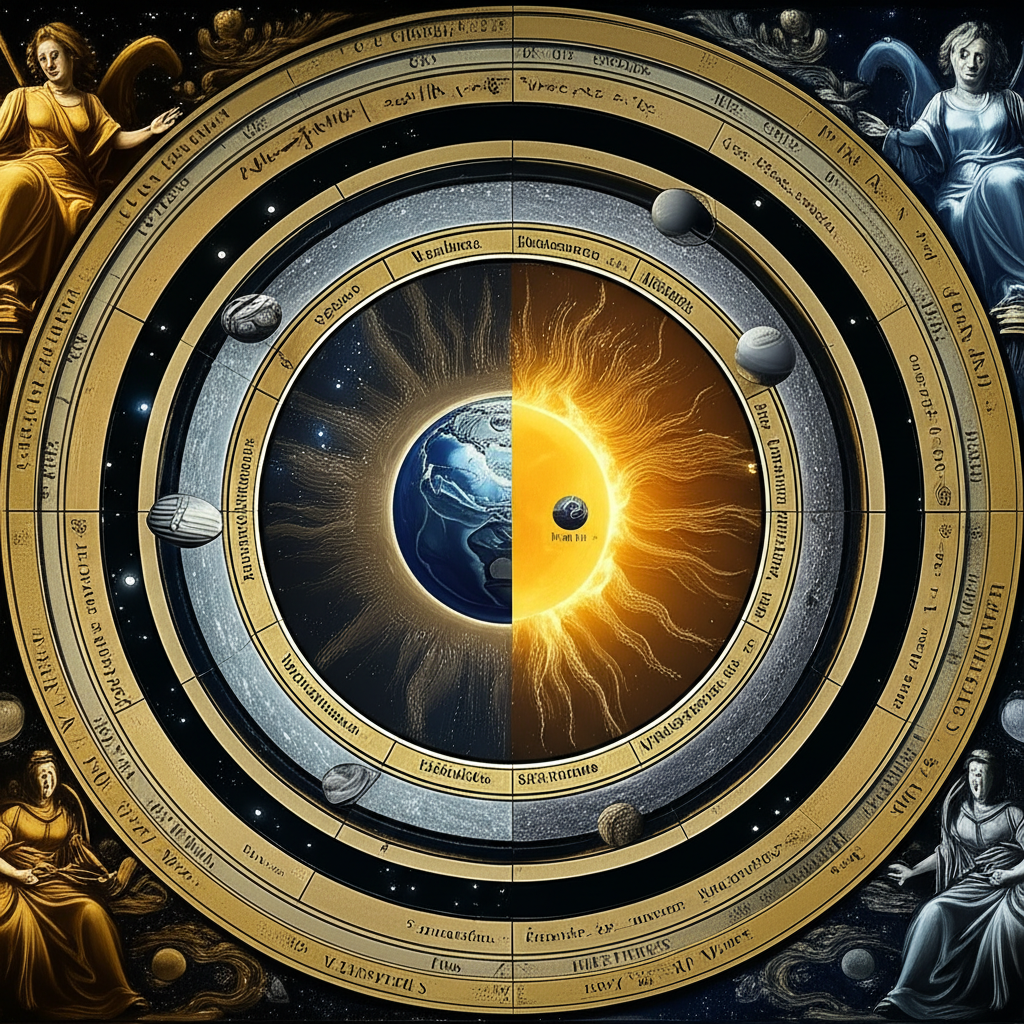
For millennia, the 'world' was understood as a singular, Earth-centered entity. Ancient astronomy, as codified by Ptolemy in his Almagest and deeply influenced by Aristotle's cosmology, presented a beautifully intricate, if ultimately incorrect, geocentric model. The Earth stood still at the center, enveloped by crystalline spheres carrying the moon, planets, and fixed stars. This model wasn't merely a scientific theory; it was a profound philosophical statement about human centrality and cosmic order.
- The World Defined: A finite, hierarchical system with humanity at its core.
- Space: A series of nested, perfect spheres, distinct from the terrestrial realm.
- Time: Primarily cyclical, driven by the predictable motions of celestial bodies.
This geocentric world provided a coherent framework for understanding existence, morality, and even divine purpose, as eloquently discussed in various texts within the Great Books of the Western World, from Plato's Timaeus to Dante's Paradiso. The heavens, while distant, were intimately connected to earthly life.
The Copernican Revolution: Shifting the Center, Expanding the World
The 16th and 17th centuries witnessed a seismic shift. Nicolaus Copernicus's heliocentric model, later championed by Galileo Galilei with his telescopic observations, irrevocably dislodged Earth from its privileged position. This was more than a mere scientific correction; it was a philosophical earthquake.
The implications were staggering:
- Redefinition of the World: The 'world' was no longer synonymous with Earth, but rather a planet orbiting a star, one among potentially many.
- Expansion of Space: The finite cosmic spheres gave way to an increasingly vast, seemingly boundless space. The very idea of an 'outside' to the universe began to form.
- Reconsideration of Time: While not immediately altering the perception of time itself, the concept of a moving Earth necessitated a different understanding of celestial mechanics and the long stretches of time required for such movements.
This revolution, a cornerstone of modern science, profoundly challenged religious dogma and philosophical certainty, forcing thinkers like Giordano Bruno to imagine infinite worlds, an idea that led to his tragic end but paved the way for future astronomical insights.
Newton's Universe: Infinite Space and Absolute Time
The work of Isaac Newton, particularly his Philosophiæ Naturalis Principia Mathematica, solidified the new cosmic order. Newton's universal law of gravitation explained the movements of celestial bodies with unprecedented precision, uniting earthly and heavenly mechanics under a single, elegant framework.
Newton posited:
- Space as Absolute: An infinite, empty stage upon which all cosmic events unfolded, independent of matter.
- Time as Absolute: Flowing uniformly and independently of any observer or event.
This Newtonian world was a grand, deterministic machine, vast beyond previous imaginings, yet governed by knowable laws. Astronomy became the ultimate expression of rational inquiry, pushing the boundaries of the 'world' to encompass an entire, potentially infinite, cosmos.
Beyond Our Galaxy: Modern Astronomy and the Expanding World
The 20th century, with Albert Einstein's theories of relativity and Edwin Hubble's discovery of an expanding universe, shattered even Newton's absolute space and time. Modern astronomy has revealed a universe far more complex, dynamic, and immense than ever conceived.
Consider these revelations:
- Galaxies: Our Milky Way is just one of billions of galaxies, each a 'world' of countless stars.
- Cosmic Time: The universe has a beginning (the Big Bang) and an incredibly long history, measured in billions of years, making human time scales infinitesimally small.
- Space-Time Continuum: Space and time are no longer separate absolutes but interwoven dimensions, curved and influenced by mass and energy.
The 'world' now encompasses a vast, evolving space-time fabric, where black holes warp reality, and quantum phenomena challenge our most fundamental assumptions about existence. The cosmic perspective offered by modern astronomy — that we are a tiny, fragile speck on a pale blue dot in an unimaginably vast cosmos — compels profound philosophical reflection on our significance, or lack thereof.
Philosophical Reverberations: Our Place in the Cosmos
The relentless march of astronomy has continuously forced philosophy to re-evaluate fundamental questions:
- What is the nature of reality when space and time are relative?
- Does human consciousness hold any special significance in an indifferent, expanding universe?
- How do we reconcile our immediate, lived experience of the 'world' with the vast, impersonal cosmic scale?
From Kant's sublime contemplation of the starry heavens above and the moral law within, to contemporary existentialism grappling with cosmic insignificance, astronomy remains a powerful catalyst for philosophical inquiry. It challenges our anthropocentrism, expands our imagination, and reminds us of the profound mystery that underlies our existence in the grand tapestry of space and time.
The 'world' is no longer a fixed concept but a continuously evolving understanding, shaped by every new observation and theoretical breakthrough in astronomy. It is a testament to the human spirit's insatiable quest to know, to measure, and to ultimately comprehend its own precarious, yet wondrous, position within the universe.
📹 Related Video: What is Philosophy?
Video by: The School of Life
💡 Want different videos? Search YouTube for: ""Philosophy of Astronomy: Cosmic Perspective" and "Great Books of the Western World: Ptolemy and Copernicus""