

The Idea of God as a First Principle: Unveiling the Metaphysical Ground
The concept of God, often relegated to the realm of theology, finds a profound and enduring residence within philosophy, particularly when viewed as a First Principle. This isn't merely about belief, but about the Idea of an ultimate, uncaused cause or an absolute ground for all existence. From the ancient Greeks to the Enlightenment thinkers, many of the greatest minds in Western thought have grappled with this notion, seeking a foundational Principle to make sense of the cosmos. This article delves into the Metaphysics of this Idea, exploring how the concept of God has served as a cornerstone for understanding reality, causality, and knowledge itself, drawing heavily from the rich tradition of the Great Books of the Western World.
Unpacking the First Principle: What Does It Mean?
Before we embark on this intellectual journey, it's crucial to define our terms. A First Principle (or arche in Greek) is that from which all else proceeds, without itself proceeding from anything else. It is the ultimate ground of being, the fundamental explanation, the starting point of all reasoning and existence. For many philosophers, the universe's apparent order, its existence rather than non-existence, and the very possibility of knowledge demand such a foundational Principle.
- The Uncaused Cause: A principle that does not require an external cause for its own existence.
- The Ultimate Explanation: A concept that provides the final answer to "why?"
- The Ground of Being: That which underpins all reality and makes it intelligible.
The Idea of God, in this philosophical context, often embodies these characteristics. It's less about a specific religious dogma and more about a conceptual necessity for a coherent Metaphysics.
Historical Echoes: God as First Principle in the Great Books
The notion of an ultimate, foundational Principle permeates the history of philosophy, often culminating in or converging with the Idea of God. Let us consider a few pivotal moments from the Great Books:
Plato's Forms and the Good
In Plato's Republic, the Form of the Good functions much like a First Principle. It is the ultimate source of all truth, beauty, and existence, illuminating all other Forms and making them knowable. While not explicitly "God" in a monotheistic sense, the Form of the Good possesses many divine attributes: eternal, unchanging, perfect, and the ultimate cause of all reality. It is the Idea from which all other Ideas derive their being and intelligibility.
Aristotle's Unmoved Mover
Aristotle, in his Metaphysics, posits the Unmoved Mover as the ultimate cause of motion and change in the universe. Everything that moves is moved by something else, leading to an infinite regress unless there is a first mover that is itself unmoved. This entity is pure actuality, eternal, perfect, and exists necessarily. It moves the world not by physical force, but as an object of desire or love – a final cause. This Unmoved Mover is a prime example of God conceived as a pure Principle of being and causality.
Medieval Syntheses: Aquinas and the Scholastics
Building upon Aristotle, Thomas Aquinas, in his Summa Theologica, famously offers Five Ways to demonstrate God's existence. These "ways" are not arguments from faith, but rather philosophical deductions from observable reality, seeking a First Principle:
| Way to God's Existence | First Principle Implied | Core Concept |
|---|---|---|
| From Motion | Unmoved Mover | God as the ultimate source of motion. |
| From Causation | Uncaused Cause | God as the first efficient cause. |
| From Contingency | Necessary Being | God as the being whose existence is not contingent on another. |
| From Degrees of Being | Perfect Being | God as the ultimate standard of perfection. |
| From Design/Teleology | Grand Designer | God as the intelligence ordering the universe. |
For Aquinas, the Idea of God is the necessary conclusion of a rational inquiry into the Principles governing the cosmos, firmly establishing God as the ultimate Metaphysical ground.
Descartes' Clear and Distinct Idea
René Descartes, in his Meditations on First Philosophy, starts from radical doubt and rebuilds knowledge from the ground up. He argues that the Idea of a perfect, infinite God is so clear and distinct within his mind that it must have originated from an actually existing perfect being. The Idea itself, with its inherent perfection, serves as a proof of God's existence, making God a Principle for the very possibility of certainty and true knowledge. Without a non-deceiving God, Descartes argues, even mathematical truths could be suspect.
Spinoza's God or Nature (Deus Sive Natura)
Baruch Spinoza, in his Ethics, presents perhaps the most radical philosophical conception of God as a First Principle. For Spinoza, God is the one, infinite, self-caused substance, identical with nature itself. Everything that exists is a mode or attribute of this single substance. This God or Nature is the ultimate Principle of all reality, existing necessarily and eternally. There is no external cause; God is existence, thought, and extension. This monistic Metaphysics posits God as the absolute, all-encompassing Idea and Principle.
The Metaphysical Imperative: Why a First Principle?
The enduring philosophical interest in God as a First Principle stems from a deep-seated Metaphysical imperative. Without such a Principle:
- Infinite Regress: We face an endless chain of causes, explanations, and dependencies, leaving nothing ultimately explained.
- Contingency without Necessity: If everything is contingent (could be otherwise), then there is no ultimate reason for anything to exist at all. A necessary Principle provides this anchor.
- Unintelligibility: A universe without a foundational Idea or Principle risks being ultimately chaotic and incomprehensible to human reason.
The Idea of God, therefore, often emerges as a rational response to these challenges, providing a coherent framework for understanding existence. It offers a Metaphysical bedrock upon which the edifice of reality and knowledge can be built.
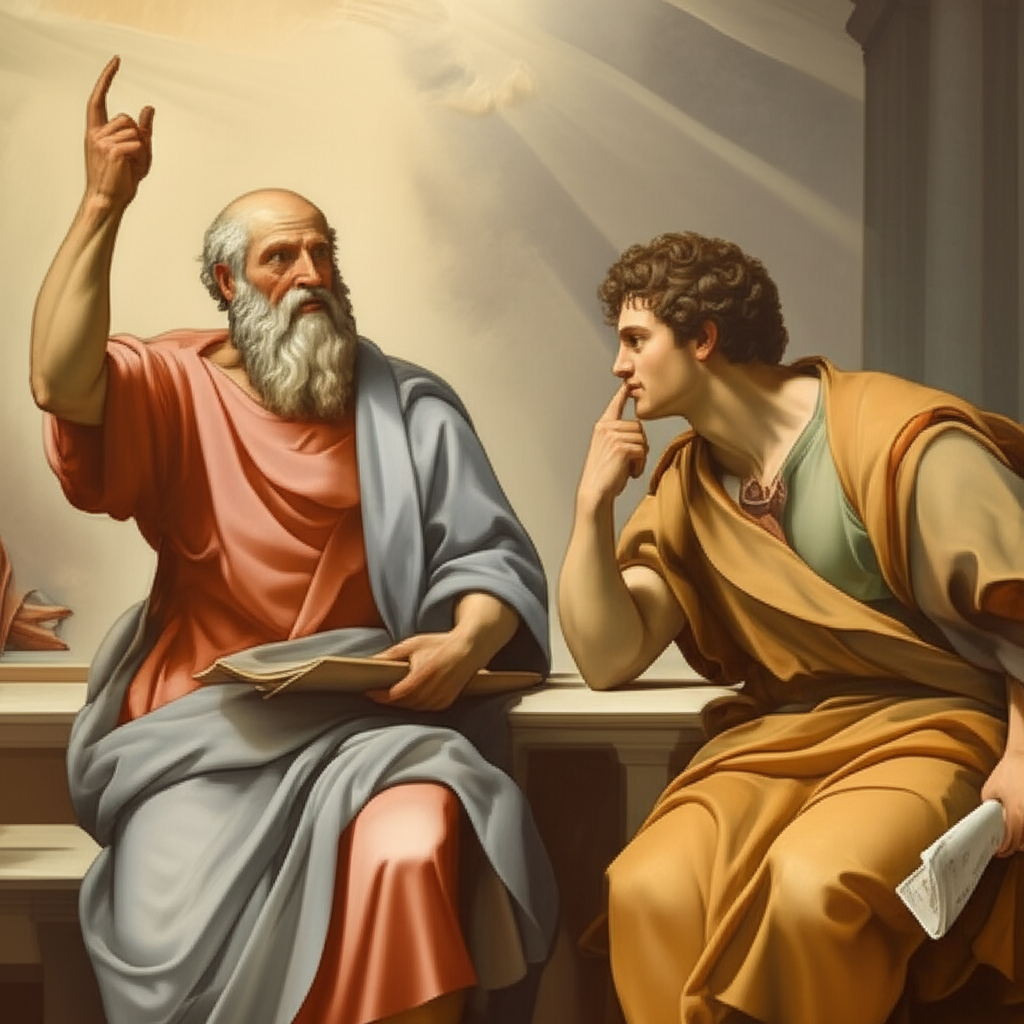 and Aristotle gesturing horizontally towards the earthly realm (empirical observation). The background shows a classical architectural setting, perhaps the Academy, with other philosophers or students in the periphery, symbolizing the intellectual lineage of the Great Books.)
Conclusion: The Enduring Idea
The journey through the Great Books of the Western World reveals that the Idea of God as a First Principle is not a static dogma, but a dynamic and evolving philosophical concept. From Plato's Good to Aristotle's Unmoved Mover, Aquinas's Necessary Being, Descartes' Perfect Being, and Spinoza's all-encompassing Substance, the drive to identify an ultimate Principle has profoundly shaped our understanding of Metaphysics.
This philosophical exploration of God is a testament to humanity's persistent quest for foundational truth. It highlights that even in a secular age, the Idea of an ultimate ground, a First Principle, continues to provoke thought and inspire inquiry into the deepest questions of existence. It compels us, as Daniel Fletcher, to continually re-examine the very Principles by which we make sense of our world.
Further Philosophical Exploration:
📹 Related Video: ARISTOTLE ON: The Nicomachean Ethics
Video by: The School of Life
💡 Want different videos? Search YouTube for: ""Aristotle Unmoved Mover Explained""
📹 Related Video: ARISTOTLE ON: The Nicomachean Ethics
Video by: The School of Life
💡 Want different videos? Search YouTube for: ""Descartes Ontological Argument for God's Existence""