

The Unseen Blueprint: Exploring the Idea of Form in Metaphysics
The concept of Form stands as a cornerstone in the edifice of Metaphysics, offering a profound lens through which we attempt to grasp the fundamental nature of Being. This article delves into the historical genesis and philosophical implications of the Idea of Form, primarily through the unparalleled insights of Plato, as illuminated in the Great Books of the Western World. We will explore how Forms are conceived as eternal, perfect, and unchanging archetypes that lend intelligibility and reality to the transient world of our senses, shaping our understanding of existence itself and fueling enduring philosophical inquiry.
Introduction: Unveiling the Enduring Question of Reality
From the earliest philosophical inquiries, humanity has grappled with a fundamental dichotomy: the fleeting, ever-changing world of our perceptions versus a presumed underlying, stable reality. How can we speak of "justice" or "beauty" as universal concepts when every instance we encounter is imperfect and temporary? This profound question led ancient thinkers, most notably Plato, to posit the Idea of Form – a concept that transcends the immediate sensory experience to reveal a deeper, more permanent layer of Being. This exploration into the Idea of Form is not merely an academic exercise; it is an investigation into the very fabric of existence, a journey into the heart of Metaphysics.
Plato's World of Forms: The Archetypes of Being
Plato, whose works like the Republic, Phaedo, and Parmenides are central to the Great Books of the Western World collection, is the most celebrated proponent of the theory of Forms. For Plato, the visible world, the one we apprehend through our senses, is merely a shadow or an imperfect copy of a higher, more real dimension: the World of Forms.
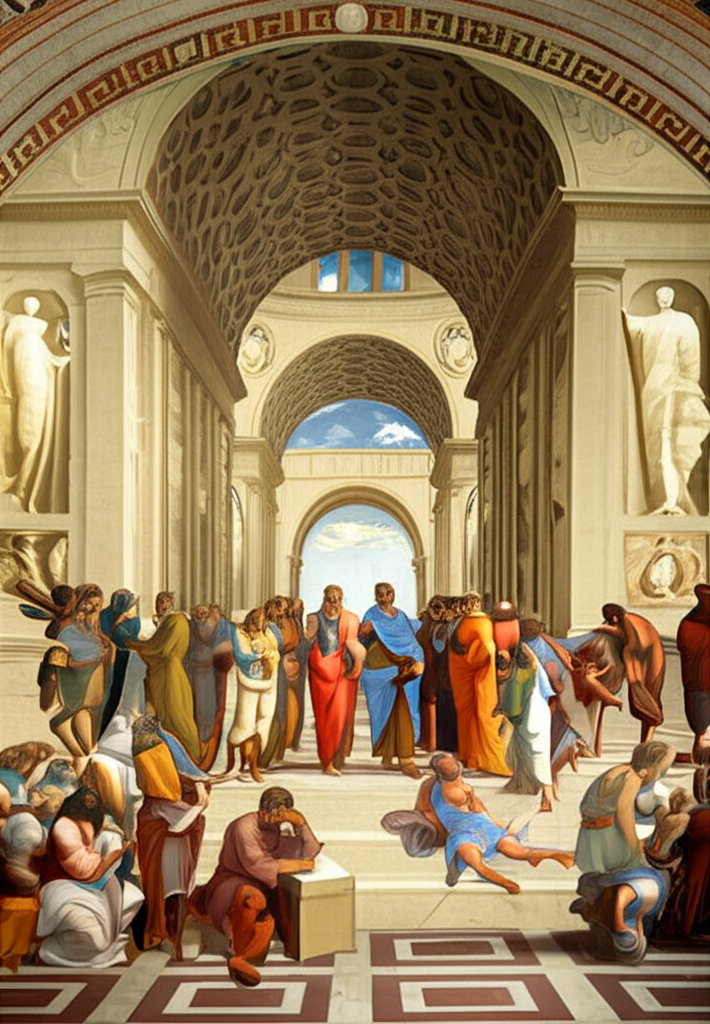
The Idea of a Form, for Plato, is not merely a mental construct or a human abstraction. Instead, it represents an objective, independent reality. Consider the concept of "Chair." We see many chairs – wooden, metal, comfortable, broken – but what makes them all "chairs"? Plato would argue that they all participate in the Form of the Chair, an ideal, perfect, and eternal archetype of chair-ness that exists independently of any particular chair.
- The Realm of Particulars: This is our everyday world, characterized by change, impermanence, and sensory experience. Everything here is an imperfect imitation.
- The Realm of Forms: This is a transcendent, non-physical realm, inhabited by eternal, perfect, and unchanging Forms. These are the true objects of knowledge.
This distinction is crucial to understanding Plato's Metaphysics, as it establishes a hierarchy of Being, where the Forms possess a higher degree of reality than their earthly counterparts.
Characteristics of the Platonic Forms
To fully grasp the revolutionary nature of Plato's Idea of Form, it's essential to delineate its key attributes:
- Unchanging and Eternal: Unlike physical objects that are born, decay, and die, Forms are timeless and immutable. The Form of Justice, for instance, does not change with societal whims or historical epochs.
- Perfect and Ideal: Forms represent the ultimate perfection of a concept. Any beautiful object we encounter is beautiful because it partakes in the Form of Beauty, which itself is perfectly beautiful.
- Intelligible, Not Sensible: Forms cannot be perceived through our senses. They are grasped only by the intellect, through reason and philosophical contemplation. This is why true knowledge, for Plato, is intellectual, not empirical.
- Transcendent: Forms exist independently of the physical world and human minds. They are not created or destroyed by us.
- Archetypal: Forms serve as the original models or blueprints for everything that exists in the sensible world. A particular tree is a tree because it participates in the Form of Tree.
- The Ultimate Reality: For Plato, the Forms constitute true Being. The physical world is merely phenomenal, a reflection of this deeper reality.
Forms and the Problem of Universals
One of the significant philosophical problems that the Idea of Form attempts to resolve is the "Problem of Universals." How do we account for the fact that many particular things can share a common property or characteristic? For example, what makes all red objects "red," or all virtuous actions "virtuous"?
Plato's solution is that these particulars share a common property because they all "participate" in a single, universal Form. The Form of Redness is the universal that gives all red objects their redness. This participation is what lends intelligibility to the world, allowing us to categorize, understand, and discuss things beyond their individual manifestations. Without these universal Forms, our language and concepts would crumble, leaving us with an incomprehensible array of isolated particulars.
Aristotle's Immanent Forms: A Different Perspective on Being
While Plato's theory of Forms profoundly shaped Western thought, it also drew critique, notably from his most famous student, Aristotle, whose Metaphysics is another monumental work in the Great Books of the Western World. Aristotle agreed that there are universal principles (Forms) that give structure and intelligibility to reality, but he disagreed with Plato's notion of their transcendent existence.
For Aristotle, the Form of a thing is not separate from the thing itself; it is immanent within it. The "chair-ness" of a chair is inherent in the chair, not in a separate realm. The form and matter are inseparable, like the shape of a statue and the bronze from which it is made. Aristotle's approach shifted the focus of Metaphysics from a separate, ideal realm to the careful observation and classification of the world around us, seeking to understand the Being of things through their internal principles.
The Enduring Relevance: The Idea of Form Beyond Antiquity
The debate between Plato's transcendent Forms and Aristotle's immanent Forms has echoed through centuries of philosophical discourse, profoundly influencing Neoplatonism, medieval scholasticism, and even modern scientific thought. The Idea of Form, in its various interpretations, continues to provoke questions about:
- The Nature of Reality: Is there an underlying structure to the universe that is independent of our perception?
- The Source of Knowledge: Do we discover truths about the world, or do we construct them?
- The Basis of Universals: How do we account for shared properties and concepts?
Even in contemporary fields like mathematics, where abstract concepts like numbers and geometric shapes are treated as having an objective existence, or in theoretical physics, which seeks fundamental laws governing the universe, we can discern the lingering influence of Plato's quest for ideal, unchanging Forms. The search for fundamental principles, for the "blueprint" of reality, remains a central endeavor in understanding Being itself.
YouTube Video Suggestions:
-
📹 Related Video: PLATO ON: The Allegory of the Cave
Video by: The School of Life
💡 Want different videos? Search YouTube for: "Plato's Theory of Forms Explained - Philosophy Basics"
2. ## 📹 Related Video: PLATO ON: The Allegory of the Cave
Video by: The School of Life
💡 Want different videos? Search YouTube for: "Aristotle vs Plato - Forms and Reality Debate"