

The Enduring Blueprint: Plato's Idea of Form (Eidos) in Metaphysics
In the grand tapestry of Western philosophy, few concepts have cast as long and profound a shadow as Plato's Theory of Forms. At its core, this metaphysical doctrine posits that beyond the fleeting, imperfect world we perceive with our senses lies a realm of perfect, eternal, and unchanging Forms or Ideas (Greek: Eidos). These Forms are the true reality, serving as the archetypal blueprints for everything that exists in our physical world. For Plato, understanding these transcendent Universals was the key to unlocking genuine knowledge and grasping the essence of reality, rather than merely observing its ever-changing Particulars.
Unveiling Reality: Beyond the Shadows
Plato, deeply influenced by his teacher Socrates and the intellectual ferment of ancient Greece, grappled with a fundamental problem: how can we have stable, certain knowledge if the world around us is in constant flux? Heraclitus famously declared that "you cannot step into the same river twice," highlighting the ephemeral nature of sensory experience. Yet, we speak of "justice," "beauty," or "equality" as if they possess an unchanging meaning, regardless of individual instances. This discrepancy led Plato to a revolutionary conclusion: true knowledge must pertain to something beyond the physical.
- The Ephemeral vs. The Eternal: Our world of particulars (a beautiful flower, a just act, an equal pair of stones) is impermanent and imperfect. These things come into being and pass away, and they are always flawed approximations.
- The Quest for True Knowledge: If knowledge is to be genuine and universal, it cannot be based on these shifting shadows. It must be grounded in something stable, perfect, and accessible through reason, not just the senses.
This pursuit of ultimate reality, the very essence of Metaphysics, led Plato to his theory of Forms.
What are Plato's Forms (Eidos)?
The Form (or Idea, Eidos) is the perfect, non-physical essence of every object and concept. Imagine the perfect circle – not any circle you've ever drawn, which will always be slightly imperfect, but the ideal circle, existing independently of any physical manifestation. That's a Form.
Here’s a breakdown of their key characteristics:
| Characteristic | Description | Example |
|---|---|---|
| Transcendent | They exist independently of space and time, in a separate realm, not within the physical world. | The Form of Beauty exists whether or not any beautiful objects exist. |
| Eternal | They have no beginning or end; they are everlasting. | The Form of Justice has always existed and always will. |
| Unchanging | They are immutable; they never alter or decay. | The Form of a Tree is always the perfect tree, never growing or dying. |
| Perfect | They embody absolute perfection; they are the ideal standard. | A physical chair is merely an imperfect copy of the perfect Form of Chair. |
| Intelligible | They are grasped by the intellect (reason), not by the senses. | We "see" the Form of Equality with our minds, not our eyes. |
| Archetypal | They are the original patterns or blueprints for everything that exists in the physical world. | All individual horses in the world are modeled after the Form of Horse. |
The physical objects we encounter are merely imitations or participations in these perfect Forms. A beautiful painting is beautiful because it participates in the Form of Beauty. A just action is just because it partakes in the Form of Justice.
The Problem of Universal and Particular
One of the most profound contributions of Plato's Forms is how they address the philosophical problem of Universals and Particulars. How can many individual, particular things (e.g., individual red apples, red cars, red shirts) all share the same quality of "redness"? What is "redness" itself, apart from these individual instances?
Plato's answer: "redness" is a Universal – the Form of Redness – existing independently. Each particular red object merely reflects or participates in this universal Form.
- Particulars: The individual, sensory objects we perceive (e.g., this specific cat, that specific act of courage). They are multiple, imperfect, and perishable.
- Universals: The common essence or quality shared by many particulars (e.g., "cat-ness," "courage"). For Plato, these Universals are the Forms themselves.
Without the Forms, Plato argued, there would be no stable ground for predication, no way to say that multiple things are beautiful, or are just, in a meaningful, shared sense. The Forms provide the objective standard, the unchanging Idea that underpins all shared qualities.
The Journey to the Forms: Recollection and Reason
Plato believed that our souls, before inhabiting our bodies, resided in the realm of the Forms and apprehended them directly. Learning, therefore, is not the acquisition of new information, but rather a process of recollection (anamnesis) – remembering the Forms our souls once knew. This is why reason and philosophical inquiry are paramount; they are the tools that help us transcend sensory data and reconnect with these eternal truths.
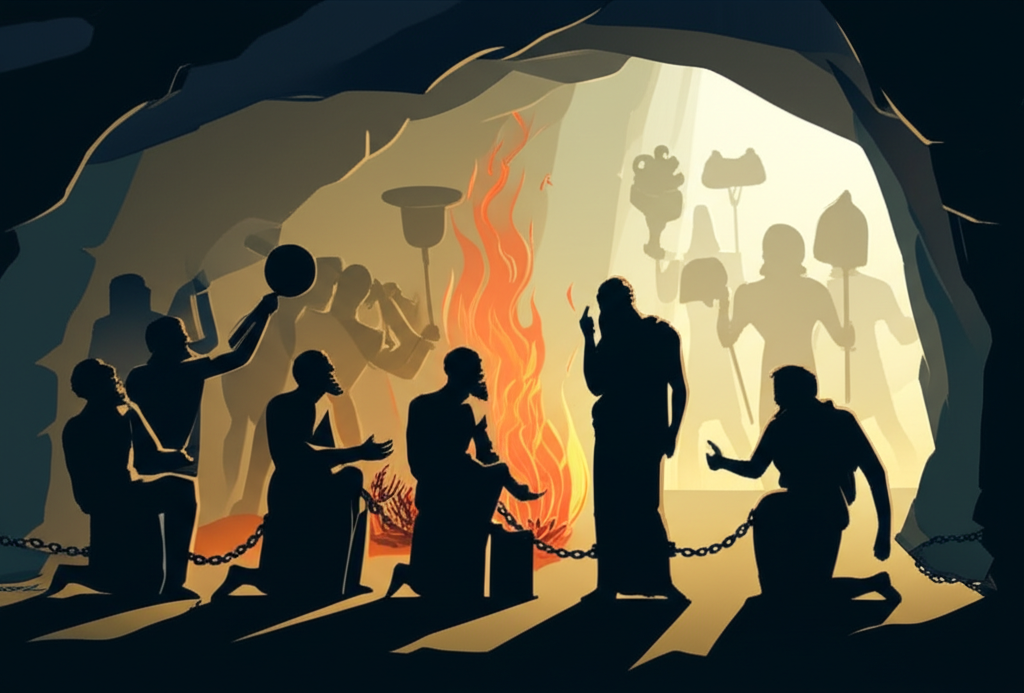
This journey from the shadows of sensory experience to the illuminating truth of the Forms is famously illustrated in Plato's Allegory of the Cave, a powerful metaphor for the philosopher's ascent from ignorance to enlightenment. The prisoners, chained and seeing only shadows, represent humanity engrossed in the world of particulars. The objects casting the shadows are like the physical world, and the sun outside the cave is the ultimate Form – the Form of the Good, which illuminates all other Forms and makes them intelligible.
Enduring Legacy and Critical Dialogue
Plato's Theory of Forms, explored extensively in works like Phaedo, Republic, and Parmenides (all found in the Great Books of the Western World collection), laid the groundwork for much of Western metaphysics and epistemology. It profoundly influenced Neoplatonism, early Christian theology, and various strands of rationalism.
However, it also faced significant criticism, most notably from Plato's own student, Aristotle. Aristotle argued that Forms could not exist in a separate, transcendent realm; rather, the form of an object was inherent within the object itself, inseparable from its matter. This debate between transcendent Forms and immanent forms continues to resonate in philosophical discussions about universals, essences, and the nature of reality.
Despite the critiques, the Idea of Form (Eidos) remains a cornerstone of philosophical inquiry, challenging us to look beyond the superficial and question the very nature of what is real, what is knowable, and what constitutes the ultimate Metaphysics of existence.
YouTube Suggestions:
-
📹 Related Video: PLATO ON: The Allegory of the Cave
Video by: The School of Life
💡 Want different videos? Search YouTube for: "Plato's Theory of Forms Explained"
2. ## 📹 Related Video: PLATO ON: The Allegory of the Cave
Video by: The School of Life
💡 Want different videos? Search YouTube for: "Universal and Particular Plato Aristotle"