

Unveiling the Blueprint: Plato's Enduring Idea of Form in Metaphysics
The philosophical concept of Form, or Eidos, is one of the most profound and influential ideas in Western thought, serving as a cornerstone of metaphysics. At its heart, it posits that beyond the fleeting, imperfect world of our senses lies a realm of perfect, eternal, and unchanging archetypes – the Forms – that give meaning and reality to everything we perceive. This article delves into the origins and implications of this powerful Idea, exploring how it grapples with the relationship between the universal and particular and shapes our understanding of existence itself.
The Immutable Blueprint: What is a Philosophical Form?
When we speak of "Form" in philosophy, especially within the context of Plato, we're not talking about shape or structure in the everyday sense. Instead, we're referring to an ultimate reality, an Idea that exists independently of the physical world. Imagine the perfect circle – not any circle you can draw, which will always be slightly imperfect, but the abstract, ideal essence of circularity. This ideal essence is a Form.
These Forms are:
- Perfect and Pure: They embody the ultimate realization of a concept (e.g., the Form of Beauty is perfect beauty).
- Eternal and Unchanging: Unlike physical objects, they are not subject to decay or alteration.
- Non-Physical: They reside in an intelligible realm, accessible only through intellect, not the senses.
- Archetypal: They are the blueprints or models for all particular instances in the physical world.
The study of these fundamental realities – what exists and the nature of existence itself – is the domain of metaphysics. Plato's theory of Forms stands as one of the most significant contributions to this field, attempting to provide a coherent explanation for knowledge, reality, and morality.
Plato's Realm of Forms: The Intelligible vs. The Sensible
Plato, as illuminated in his dialogues found within the Great Books of the Western World, famously articulated his theory of Forms to resolve a fundamental philosophical dilemma: how can we have certain knowledge in a world that is constantly changing? His solution posited two distinct realms of existence:
- The Sensible World: This is the world we experience through our senses – the world of physical objects, sights, sounds, and tastes. It is a world of change, imperfection, and opinion. A beautiful flower, a just act, a round table – these are all particular instances that are beautiful, just, or round, but they are not beauty itself, justice itself, or roundness itself. They are transient and can be perceived differently by different individuals.
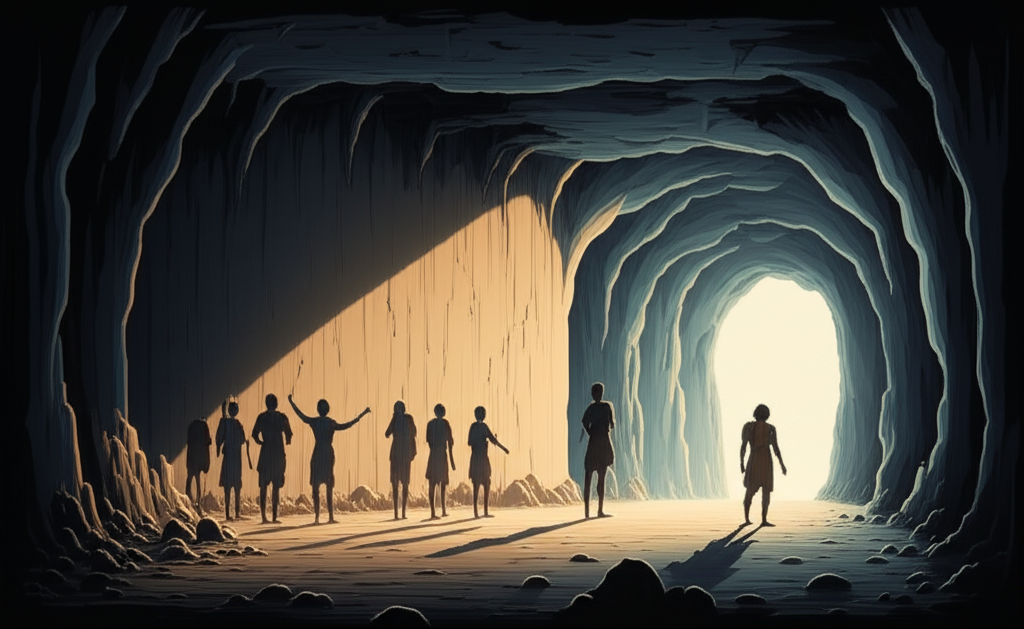
- The Intelligible World (The World of Forms): This is a non-physical, eternal realm accessible only through reason and intellect. It is the home of the Forms, where perfect Beauty, absolute Justice, and the ideal Circle reside. These Forms are the universals that provide the true nature and definition for all the particulars we encounter in the sensible world.
Table: Contrasting Plato's Two Worlds
| Feature | Sensible World (World of Particulars) | Intelligible World (World of Forms) |
|---|---|---|
| Nature | Physical, temporal, changing, imperfect | Non-physical, eternal, unchanging, perfect |
| Access | Through senses (sight, touch, etc.) | Through intellect, reason, contemplation |
| Knowledge | Opinion, belief, uncertain | True knowledge, understanding, certainty |
| Reality Level | Appears real, but is a copy or imitation | Ultimate reality, true being |
| Examples | A beautiful painting, a specific cat, a just law | The Form of Beauty, The Form of Catness, The Form of Justice |
The connection between these two worlds is "participation." Particular objects in the sensible world participate in the universal Forms. For instance, a specific act is just because it participates in the Form of Justice. A person is beautiful because they participate in the Form of Beauty. The Forms are thus the causes of the being and characteristics of everything in the physical world.
The Universal and Particular: Bridging the Divide
The Idea of Form directly addresses one of philosophy's most enduring problems: the relationship between the universal and particular. How can a single concept (like "humanity" or "redness") apply to many individual things (Socrates, Grace, planksip.org's readers; a rose, a stop sign, a fire truck)?
Plato's Forms provide a solution: the Form (e.g., the Form of Humanity) is the universal essence, existing independently. Individual humans are particulars that embody or partake in that universal Form. Without the universal Form, the particular instances would lack their essential nature and definition. This allows for coherent thought and communication; when we say "that is a chair," we are implicitly referencing the universal Idea of a chair, even if the particular chair before us is unique.
Aristotle's Immanent Forms: A Different Perspective
While Plato placed Forms in a separate, transcendent realm, his student Aristotle, also a giant of the Great Books, offered a significant critique and refinement. Aristotle agreed that Forms (or essences) were crucial for understanding reality, but he argued that they were immanent within the particular objects themselves, not separate from them. For Aristotle, the Form of a chair is found in the chair, inseparable from its matter. The Form is the "whatness" of a thing, its structure and function, which organizes its matter into a coherent entity.
This distinction highlights the ongoing debate in metaphysics: are the fundamental realities transcendent and separate, or are they inherent in the world around us?
The Enduring Legacy of the Idea of Form
The Idea of Form, whether in Plato's transcendent sense or Aristotle's immanent one, has had an immeasurable impact on philosophy, theology, and even science. It compels us to look beyond superficial appearances and seek deeper, underlying truths. It challenges us to consider:
- What is truly real?
- How do we gain genuine knowledge?
- What is the source of order and meaning in the universe?
From the perfect geometric shapes that underpin physics to the moral ideals that guide ethical conduct, the echoes of Plato's Forms resonate. They provide a framework for understanding not just the physical world, but also abstract concepts like justice, truth, and beauty, suggesting that these are not mere human constructs but reflections of deeper, universal realities. The metaphysical quest for the ultimate nature of reality often begins with this profound Idea of Form.
📹 Related Video: PLATO ON: The Allegory of the Cave
Video by: The School of Life
💡 Want different videos? Search YouTube for: "Plato's Theory of Forms explained"
📹 Related Video: PLATO ON: The Allegory of the Cave
Video by: The School of Life
💡 Want different videos? Search YouTube for: "Aristotle vs Plato Forms"