

The Enduring Idea of Form (Eidos) in Metaphysics
The concept of Form, or Eidos, stands as a cornerstone of Western Metaphysics, particularly through the lens of Plato's philosophy. At its heart, the Idea of Form posits an independent, non-physical realm of perfect and unchanging archetypes that serve as the true reality behind the fleeting, imperfect world we perceive through our senses. These Forms are the ultimate referents for all that exists, providing meaning, structure, and intelligibility to our experience. Understanding Eidos is crucial for grasping how classical philosophy grappled with the nature of reality, knowledge, and the profound distinction between the Universal and Particular.
Defining the Eidos: What is Form?
In philosophical terms, the Eidos (Greek for "Form" or "Idea") refers to the perfect, eternal, and unchanging essence of a thing. It is not a physical shape or contour, but rather the intrinsic nature or blueprint that makes something what it is. For Plato, these Forms exist independently of human minds and the physical world. They are not concepts in our minds, but objective realities that our minds can apprehend.
Consider a beautiful flower. Its beauty is fleeting, subjective, and imperfect. But for Plato, there exists a Form of Beauty itself – an absolute, unchanging, and perfect beauty that all beautiful things in our world merely participate in or imitate. This distinction is fundamental to Metaphysics, as it suggests a reality beyond mere sensory perception.
Plato's Theory of Forms: Origins and Core Tenets
The Theory of Forms is arguably Plato's most famous and influential contribution to philosophy, extensively explored in dialogues like The Republic, Phaedo, and Parmenides. Drawing on the insights of his predecessors, particularly Parmenides' concept of an unchanging Being and Socrates' quest for universal definitions, Plato posited a dualistic understanding of existence.
Key Tenets of Plato's Theory of Forms:
- Objectivity and Independence: Forms exist independently of human thought or the physical world. They are not mental constructs.
- Perfection and Immutability: Forms are perfect, eternal, and unchanging. They are not subject to decay, alteration, or the imperfections of the sensible world.
- Transcendence: Forms reside in a separate, non-physical realm, accessible only through intellect and reason, not the senses.
- Archetypal Nature: Forms serve as the perfect models or blueprints for all things in the physical world.
- Causality and Explanation: Forms are the causes of the properties of things in the sensible world. A chair is a chair because it participates in the Form of Chair.
- Epistemological Significance: True knowledge (episteme) can only be attained by grasping the Forms, as sensory experience provides only opinion (doxa).
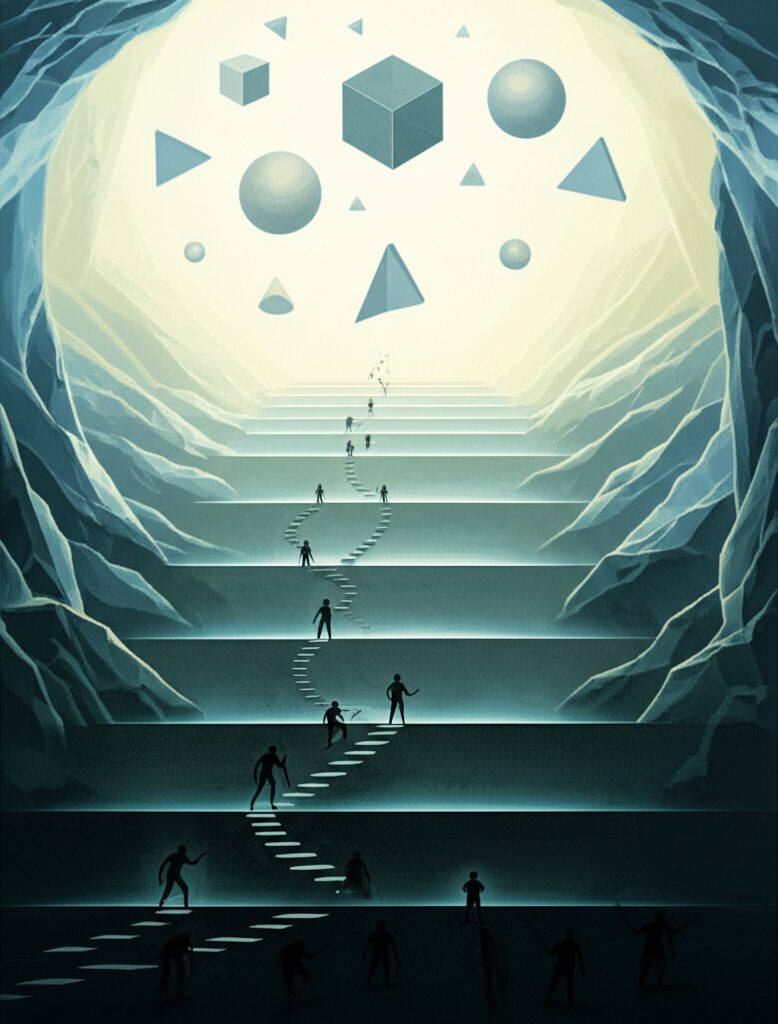
The Realm of Forms vs. The Sensible World
Plato sharply distinguished between two realms of existence, each with its own characteristics and mode of apprehension:
| Feature | The Realm of Forms (Intelligible World) | The Sensible World (Physical World) |
|---|---|---|
| Nature | Perfect, eternal, unchanging, non-physical, ultimate reality | Imperfect, temporal, changing, physical, derivative reality |
| Access | Intellect, Reason, Philosophical Contemplation | Senses (sight, touch, hearing, etc.) |
| Knowledge | Episteme (True Knowledge, Certainty) | Doxa (Opinion, Belief, Conjecture) |
| Examples | The Form of Justice, the Form of Beauty, the Form of the Good | A just act, a beautiful painting, a good person |
| Relationship | Physical objects participate in or imitate the Forms | Physical objects are copies or reflections of the Forms |
This metaphysical dualism is central to understanding Plato's entire philosophical system, from his ethics to his political theory.
The Relationship Between the Universal and Particular
One of the most profound implications of the Theory of Forms is its attempt to solve the problem of the Universal and Particular.
- Particulars: These are the individual, concrete objects we encounter in the sensible world – this specific red apple, that particular cat, this unique act of bravery. Particulars are numerous, distinct, and subject to change.
- Universals: These are the shared qualities, properties, or types that many particulars can exemplify – redness, cat-ness, bravery. Universals are singular concepts that apply across multiple instances.
Plato's Forms are essentially his answer to the problem of universals. He argued that universals are not merely concepts in our minds or linguistic conveniences. Instead, they exist independently as objective Forms. For instance, the Form of Cat is the universal essence that all particular cats participate in, making them cats. This provides a stable ground for knowledge and meaning, suggesting that there is a shared reality underlying our diverse experiences. Without the Idea of a universal "cat," how could we recognize countless individual animals as belonging to the same species?
Impact and Evolution in Metaphysics
Plato's Theory of Forms has profoundly shaped Western thought, offering a powerful framework for understanding reality, knowledge, and morality. It influenced Neoplatonism, early Christian theology (e.g., the concept of God's perfect ideas), and medieval scholasticism.
However, the Forms also faced significant criticism, even from Plato's own student, Aristotle. Aristotle argued that universals do not exist in a separate realm but are immanent in particulars themselves. The "cat-ness" of a cat, for Aristotle, is inherent in the individual cat, not in a transcendent Form of Cat. This debate between transcendent universals (Plato) and immanent universals (Aristotle) remains a central tension in Metaphysics to this day.
Criticisms and Enduring Questions
Despite its enduring influence, the Theory of Forms has been subject to various critiques:
- The "Third Man" Argument: Raised by Plato himself in Parmenides, this argument suggests an infinite regress. If a particular man resembles the Form of Man, then there must be a third Form (a "Third Man") that explains the resemblance between the particular man and the original Form of Man, and so on.
- Problem of Participation: How exactly do physical objects "participate" in or "imitate" the Forms? The relationship remains somewhat vague.
- Explanatory Redundancy: Do Forms truly explain anything, or do they simply double the number of entities in the universe without adding clarity?
- Accessibility: If Forms are in a separate, non-physical realm, how can humans access and know them?
These criticisms highlight the challenges inherent in positing a realm beyond sensory experience. Yet, the questions Plato raised about the nature of reality, the source of universals, and the distinction between appearance and reality remain central to contemporary Metaphysics.
Conclusion: The Lasting Idea of Form
The Idea of Form (Eidos) in Metaphysics, as articulated by Plato, represents a monumental attempt to establish an objective, stable, and knowable reality beyond the flux of sensory experience. By positing a realm of perfect, eternal archetypes, Plato sought to ground knowledge, ethics, and the very structure of the cosmos. While the specific details of his theory have been debated and refined over millennia, the fundamental questions it addresses—concerning the nature of reality, the relationship between the Universal and Particular, and the possibility of true knowledge—continue to inspire and challenge philosophers. The Forms, whether accepted literally or reinterpreted, remain a powerful testament to the human intellect's enduring quest for ultimate understanding.
YouTube Video Suggestions:
-
📹 Related Video: PLATO ON: The Allegory of the Cave
Video by: The School of Life
💡 Want different videos? Search YouTube for: "Plato Theory of Forms Explained"
2. ## 📹 Related Video: What is Philosophy?
Video by: The School of Life
💡 Want different videos? Search YouTube for: "Universal and Particular Philosophy Explained"