

The Enduring Blueprint: Unpacking the Idea of Form (Eidos) in Metaphysics
The concept of Form, or Eidos, stands as a cornerstone of Western Metaphysics, particularly through the monumental work of Plato. At its heart, the Idea of Form posits that beyond the fleeting, imperfect world of our senses lies a transcendent realm of perfect, unchanging archetypes. These Forms are not mere mental constructs but objective realities, serving as the true essence of everything we perceive. They provide the ultimate explanation for how we can have genuine knowledge, understand Universal concepts, and make sense of the Particular objects that populate our ever-changing world. This article delves into Plato's revolutionary insight, exploring its characteristics, implications, and enduring legacy in philosophical thought.
Plato's Radical Vision: A World Beyond Appearances
Before Plato, philosophers grappled with the apparent contradiction between the constant flux of the sensible world (Heraclitus) and the unchanging nature of being (Parmenides). Plato's theory of Forms emerged as a brilliant synthesis, offering a solution to how knowledge could be stable and certain in a world of perpetual change. He proposed that true knowledge, episteme, cannot be derived from the unreliable data of our senses but must come from an understanding of these eternal, non-physical Forms.
The Two Realms:
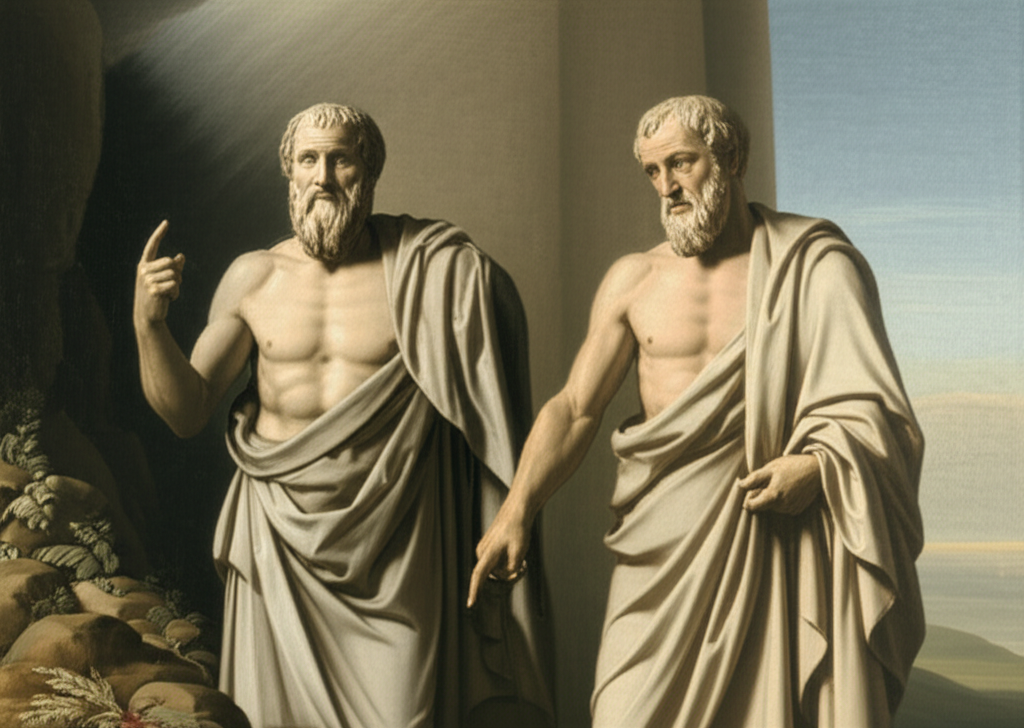
Plato famously divided reality into two distinct realms:
- The Sensible World (World of Becoming): The world we perceive through our senses. It is characterized by change, imperfection, multiplicity, and temporality. Objects here are Particulars – individual horses, beautiful paintings, just acts.
- The Intelligible World (World of Being): The realm of the Forms, accessible only through intellect and reason. It is characterized by permanence, perfection, unity, and eternity. Here reside the Universals – the Form of Horse, the Form of Beauty, the Form of Justice.
Defining the Forms: Characteristics of Eidos
What exactly are these Forms, and what are their defining features? Plato meticulously outlined several key characteristics:
- Objective Reality: Forms are not subjective ideas in our minds but exist independently of human thought. They are real, more real, in fact, than the physical objects that imitate them.
- Transcendent: They exist outside of space and time, in a separate, non-physical realm. They are not located anywhere in the sensible world.
- Eternal and Unchanging: Forms are immutable; they do not come into being or pass away, nor do they undergo any alteration. The Form of Beauty is eternally beautiful, never becoming less so.
- Perfect and Pure: Each Form is the ideal, perfect exemplar of its kind. A particular circle drawn in sand is imperfect, but the Form of Circularity is perfectly circular.
- Archetypal: They serve as the blueprints or models for all the particular things we encounter in the sensible world. A specific horse is a horse because it "participates" in or "imitates" the Form of Horse.
- Intelligible: Forms cannot be grasped by the senses but only by the intellect, through reason and philosophical inquiry.
The Universal and the Particular: Bridging the Divide
One of the most profound contributions of Plato's theory of Forms is its explanation of the relationship between Universals and Particulars.
Understanding the Distinction:
| Feature | Universal (Form) | Particular (Sensible Object) |
|---|---|---|
| Nature | One, perfect, unchanging essence | Many, imperfect, changing instances |
| Existence | Transcendent, non-physical, eternal | Immanent, physical, temporal |
| Access | Reason, intellect | Senses, experience |
| Example | The Form of "Redness," "Humanity," "Justice" | A specific red apple, individual person, a just action |
| Role | Provides meaning, definition, and intelligibility | Manifests, participates in, or imitates the Universal |
How do we recognize countless different chairs as "chairs"? Plato argues that it's because each individual chair, despite its variations, participates in the single, unified Form of Chair. This Form of Chair is the Universal essence that all Particular chairs share, allowing us to categorize and understand them. Without the Form, each chair would be an utterly unique and incomparable object, making knowledge and communication impossible. The Form provides the commonality.
The Enduring Impact on Metaphysics
The Idea of Form profoundly influenced subsequent philosophical discourse, shaping debates in epistemology, ethics, and aesthetics. While Aristotle, Plato's most famous student, critiqued the notion of separate, transcendent Forms, proposing instead that Forms are immanent within the particulars themselves, he nonetheless retained the fundamental concept of an enduring essence. The debate over the nature of universals – whether they exist independently (Platonic realism), only in particulars (Aristotelian realism), or merely as concepts in the mind (nominalism) – continues to this day, all stemming from Plato's initial formulation.
The Form of the Good, for Plato, was the highest Form, illuminating all other Forms and providing the ultimate goal for human striving. This ethical dimension demonstrates that the theory of Forms was not merely an abstract metaphysical speculation but had profound implications for how one ought to live.
Conclusion: A Legacy of Idealism
The Idea of Form, or Eidos, represents one of the most ambitious and influential theories in the history of Metaphysics. By positing a realm of perfect, unchanging Universals that serve as the true reality behind the fleeting Particulars of our sensory experience, Plato provided a coherent framework for understanding knowledge, ethics, and the very structure of existence. While challenged and reinterpreted over millennia, the profound questions it raised about appearance versus reality, the nature of truth, and the source of meaning continue to resonate, inviting each generation to grapple with the enduring blueprint of the Forms.
YouTube Video Suggestions:
-
📹 Related Video: PLATO ON: The Allegory of the Cave
Video by: The School of Life
💡 Want different videos? Search YouTube for: "Plato Theory of Forms Explained"
-
📹 Related Video: What is Philosophy?
Video by: The School of Life
💡 Want different videos? Search YouTube for: "Universal and Particular Philosophy Explained"