

The Enduring Idea of Form (Eidos) in Metaphysics
The concept of Form, or Eidos as the ancient Greeks knew it, stands as a cornerstone in the grand edifice of Western Metaphysics. It’s a profound notion, primarily articulated by Plato, that seeks to explain the very nature of reality, bridging the gap between the fleeting world of our senses and a more permanent, intelligible order. At its heart, the Idea of Form posits that beyond the myriad particular objects we encounter daily, there exist perfect, unchanging, non-physical blueprints—the Universals—that give these particulars their identity and meaning. This article delves into this fundamental concept, exploring its origins, implications, and lasting influence on philosophical thought, drawing from the foundational texts often found in the Great Books of the Western World.
What is the Idea of Form (Eidos)? A Metaphysical Blueprint
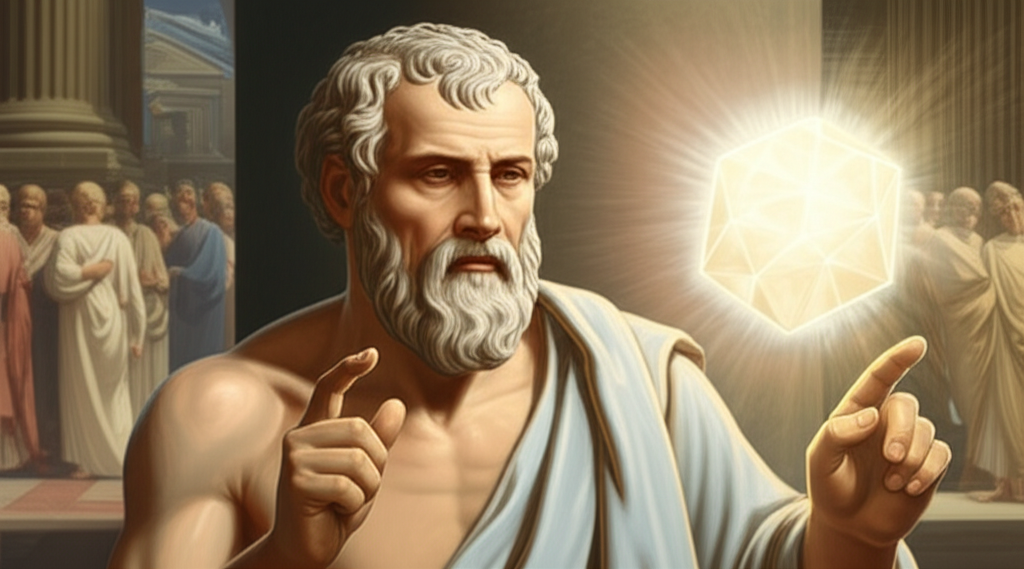
In the realm of Metaphysics—the branch of philosophy concerned with the fundamental nature of reality—Plato introduced the revolutionary Idea of Forms. For Plato, the world we perceive through our senses is merely a shadow, an imperfect reflection of a higher, more real plane of existence. This higher plane is populated by the Forms (Eidos), which are perfect, eternal, and unchanging archetypes.
Consider a beautiful sunset, a just act, or a perfectly round circle drawn on a blackboard. While each specific instance might be beautiful, just, or round, none are perfectly so. The sunset fades, the act might be contested, and the circle is never truly perfect. Plato argued that for us to even recognize these qualities, there must be an ideal, perfect standard against which we measure them. These standards are the Forms.
Key Characteristics of Platonic Forms:
- Transcendent: They exist independently of the physical world and human minds.
- Pure and Perfect: They embody the essence of a quality or object without any imperfections.
- Eternal and Unchanging: Unlike physical objects, Forms do not come into being or pass away.
- Intelligible: They can only be grasped by the intellect, not by the senses.
- Archetypes/Blueprints: Physical objects are imperfect copies or participants in these perfect Forms.
Universal and Particular: Bridging the Divide
One of the central problems the Idea of Form addresses is the relationship between Universals and Particulars.
- Particulars: These are the individual objects and instances we experience in the sensory world—this specific chair, that beautiful flower, a particular act of courage. They are unique, temporal, and subject to change.
- Universals: These are the general qualities, properties, or types that many particulars can share. For instance, "chairness," "beauty," or "courage" are Universals.
Plato's theory posits that the Forms are these Universals. The Form of "Chair" is the perfect, abstract essence of what it means to be a chair, of which all physical chairs are imperfect particular manifestations. When we say "that is a chair," we are recognizing its participation in, or resemblance to, the Form of Chair.
Examples of Forms in Metaphysics:
| Type of Form | Description | Corresponding Particulars |
|---|---|---|
| Moral/Ethical | The perfect essence of virtues. | Individual acts of justice, courage, kindness. |
| Aesthetic | The ideal standard of beauty. | A beautiful painting, a stunning landscape, a harmonious melody. |
| Mathematical | Perfect geometric shapes and numerical concepts. | A drawn circle, a calculated equation, a group of three objects. |
| Physical Objects | The ideal essence of a category of objects. | A specific table, a particular tree, an individual human being. |
The World of Ideas: More Than Just Concepts
It's crucial to understand that Plato's Forms are not merely concepts or thoughts existing in our minds. They are objective realities. The Form of Beauty exists whether any human mind contemplates it or not. It is a fundamental constituent of the universe, prior to and independent of our perception or understanding. This makes the Idea of Form a genuinely metaphysical claim about the independent structure of reality.
Aristotle's Re-evaluation: Immanence and Essence
While Plato's student, Aristotle, acknowledged the importance of Forms, he disagreed with their transcendent nature. Aristotle, whose works also feature prominently in the Great Books of the Western World, argued that the Form (which he often referred to as "essence" or "whatness") is not separate from the particular object, but rather immanent within it. For Aristotle, the Form of a chair is inherent in every actual chair, making it what it is, rather than existing in a separate, ideal realm.
Aristotle's Metaphysics shifted the focus from a "world beyond" to the reality embedded within the physical world itself. He saw Form as one of his four causes (the formal cause), defining the structure and essence of a thing, inseparable from its matter. This debate between Plato's transcendent Forms and Aristotle's immanent essences profoundly shaped subsequent philosophical inquiry.
The Enduring Legacy: Why Forms Still Matter
The Idea of Form remains a potent force in philosophy and beyond. It forces us to confront fundamental questions about reality:
- What is truly real? Is it the changing world of our senses, or an underlying, unchanging structure?
- How do we know anything? If sensory experience is deceptive, how do we access truth and knowledge?
- What gives meaning to our concepts? How can we speak of justice or beauty if there isn't some shared, ideal understanding?
The exploration of Form and Idea in Metaphysics continues to influence discussions in epistemology, ethics, aesthetics, and even modern science, where the search for underlying patterns, laws, and Universals is a constant pursuit. Understanding Plato's Forms is not merely an academic exercise; it's an entry point into a profound way of thinking about the cosmos and our place within it, a journey into the very structure of existence that has captivated thinkers for millennia.
📹 Related Video: PLATO ON: The Allegory of the Cave
Video by: The School of Life
💡 Want different videos? Search YouTube for: "Plato Theory of Forms Explained"
📹 Related Video: KANT ON: What is Enlightenment?
Video by: The School of Life
💡 Want different videos? Search YouTube for: "Metaphysics Universal and Particular"