

Beyond the Horizon: Exploring the Hypothesis of Multiple Worlds
Summary: The Hypothesis of Multiple Worlds posits that our universe may not be the sole existing reality, but rather one among many. This profound idea, spanning millennia from ancient atomism to modern cosmology, challenges our fundamental understanding of existence, space, and time. It pushes the boundaries of both Astronomy and Metaphysics, inviting us to consider what it truly means for a World to be.
The Infinite Tapestry of Reality: A Philosophical Journey
For centuries, humanity has gazed at the night sky, pondering the vastness beyond our immediate grasp. Is our World unique, or are there countless others, perhaps mirroring our own, or wildly different? The Hypothesis of Multiple Worlds, or the multiverse theory as it is often termed today, is not merely a modern scientific speculation; it is a concept deeply rooted in philosophical inquiry, stretching back to the very dawn of Western thought. It demands that we grapple with profound questions about reality, chance, and the very nature of existence itself.
Ancient Seeds: Atomists and Infinite Worlds
The earliest explicit articulation of a Hypothesis akin to multiple worlds can be found in the pre-Socratic philosophers, particularly the atomists like Democritus and Epicurus. As explored in the Great Books of the Western World, their radical proposition was that the cosmos consists of an infinite number of indivisible particles (atoms) moving in an infinite void. From this simple premise, they deduced that if there are infinite atoms and infinite space, then it is inevitable that an infinite number of worlds would form, separate from our own.
- Democritus' Vision: “There are infinite worlds both like and unlike this world.”
- Epicurus' Cosmology: Believed in an infinite number of worlds, some coming into being, others perishing, all arising from the chance collisions of atoms.
This stood in stark contrast to the more ordered, singular cosmos envisioned by philosophers like Plato and Aristotle, who favored a single, perfect, and finite universe. The debate over a singular versus a pluralistic World thus became a foundational point of contention in ancient Metaphysics.
The Astronomical Shift: From Geocentric to Myriad Worlds
The scientific revolution, particularly the work of Copernicus, Galileo, and Kepler, fundamentally altered our perception of our place in the cosmos. Earth was demoted from the center of creation to merely one planet orbiting the Sun. This shift opened the door to a more radical Hypothesis: if Earth is just one planet, why couldn't there be other planets, other suns, and indeed, other worlds?
One of the most vocal proponents of this idea was Giordano Bruno, a 16th-century philosopher and astronomer. Drawing inspiration from ancient atomists, Bruno passionately argued for an infinite universe containing an infinite number of stars, each potentially surrounded by its own planets, or "worlds," some perhaps inhabited. His revolutionary ideas, which challenged the prevailing religious and scientific doctrines of his time, ultimately led to his execution. Yet, his vision foreshadowed modern Astronomy and its search for exoplanets, which has now confirmed that planets around other stars are not an exception, but the norm.
Modern Metaphysics and the Multiverse Hypothesis
Today, the Hypothesis of Multiple Worlds has found new life within theoretical physics and cosmology, often under the banner of the "multiverse." These modern interpretations, while distinct from ancient philosophical musings, share the same fundamental impulse: to explore the possibility of realities beyond our observable universe. They delve deep into Metaphysics, questioning the very fabric of existence and the nature of physical laws.
The modern multiverse Hypothesis arises from various scientific theories:
- Inflationary Cosmology: Suggests that our universe is just one "bubble" or "pocket" universe within a much larger, eternally inflating super-region.
- Quantum Mechanics (Many-Worlds Interpretation): Proposes that every quantum measurement causes the universe to "split" into multiple parallel worlds, each representing a different outcome of the measurement.
- String Theory/M-Theory: Some versions suggest the existence of extra dimensions and "brane worlds," where our universe is merely one brane floating in a higher-dimensional space, potentially alongside other branes.
These scientific hypotheses are inherently metaphysical in their implications, as they often posit realities that are currently beyond direct empirical observation. They force us to confront questions of probability, necessity, and the fine-tuning of our own World for life.
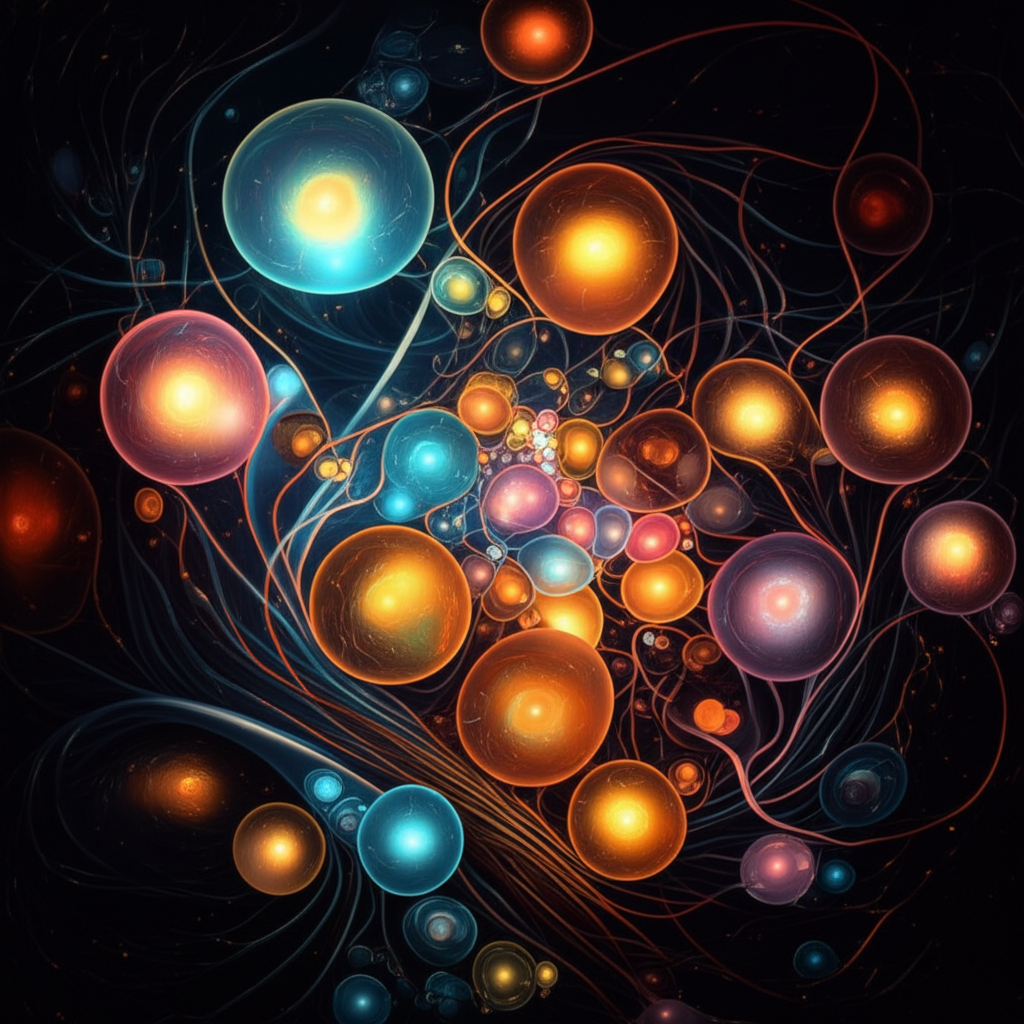
A Spectrum of Worlds: Categorizing the Multiverse
The modern Hypothesis of multiple worlds can be broadly categorized into several types, each with unique implications for our understanding of reality.
| Multiverse Type | Description | Philosophical Implications |
|---|---|---|
| Level I: Infinite Parallel Worlds | Our universe is infinite, meaning all possible arrangements of matter will eventually occur, leading to exact replicas or variations of our World infinitely far away. | Challenges uniqueness, raises questions of identity and free will if exact duplicates exist. |
| Level II: Bubble Universes | Different universes arise from cosmic inflation, potentially having different physical constants and laws. Our World is just one such bubble. | Explains the "fine-tuning" problem; if enough universes exist, some are bound to support life. Highlights the arbitrary nature of our laws. |
| Level III: Many-Worlds (Quantum) | Every quantum event causes the universe to split into parallel realities, each representing a different outcome. All possibilities are realized in some World. | Profound implications for causality, determinism, and the nature of consciousness. Our choices create branching realities. |
| Level IV: Mathematical Universes | The ultimate form of the multiverse, where all mathematically consistent structures exist as actual universes. Our World is merely one such structure. | Radical Metaphysics; suggests reality is fundamentally mathematical. Raises questions about the source of mathematical laws. |
| Philosophical: Possible Worlds | A concept in modal logic and Metaphysics where "possible worlds" represent ways the world could have been. Not necessarily physically existing, but logically coherent. | Helps analyze necessity, possibility, and counterfactuals. Provides a framework for understanding logical space, distinct from physical realities. |
The Enduring Quest: Truth and the Nature of Reality
Whether viewed through the lens of ancient philosophy, historical Astronomy, or contemporary theoretical physics, the Hypothesis of Multiple Worlds remains one of the most compelling and challenging ideas in human thought. It forces us to confront the limits of our perception and the boundaries of empirical knowledge. While direct proof of other worlds or universes remains elusive, the very act of contemplating such possibilities enriches our understanding of our own World and expands the scope of our Metaphysical inquiry. It reminds us that the quest for truth is an ongoing journey, ever pushing the horizon of what we believe to be real.
YouTube Video Suggestions:
-
📹 Related Video: KANT ON: What is Enlightenment?
Video by: The School of Life
💡 Want different videos? Search YouTube for: "Sean Carroll Many-Worlds Interpretation"
-
📹 Related Video: ARISTOTLE ON: The Nicomachean Ethics
Video by: The School of Life
💡 Want different videos? Search YouTube for: "Brian Greene The Multiverse Explained"